Critical Remote Code Execution Vulnerability in GitLab Exposes Self-Managed Servers to Severe Risk Following Delayed Security Classification.

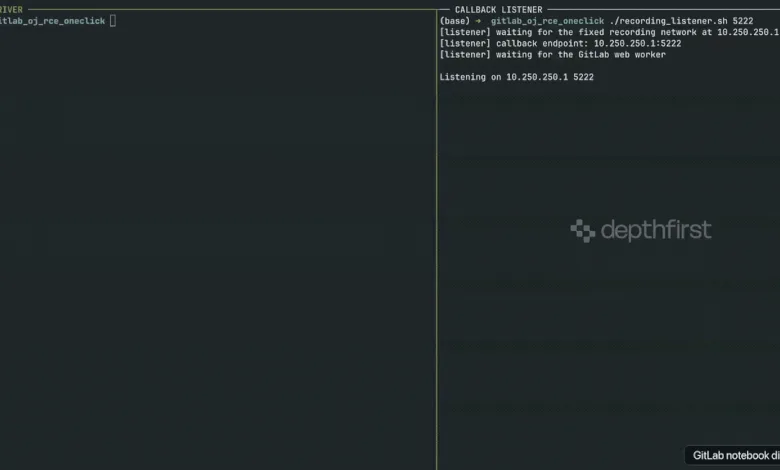
A critical remote code execution (RCE) vulnerability in self-managed GitLab instances, stemming from two memory corruption bugs within the widely used Oj Ruby JSON parser, has been brought to public attention with the release of working exploit code by security researchers ‘depthfirst’. This revelation, published on July 24, 2026, highlights a significant security oversight, as GitLab had patched the underlying issue six weeks earlier, on June 10, but controversially classified it as a mere bug fix rather than a critical security vulnerability, leaving countless system administrators unaware of the urgent need to update their systems. The exploit allows any authenticated user with push access to a project to execute arbitrary commands as the git user on unpatched GitLab 18.11.3 servers, posing a severe threat to the integrity and confidentiality of sensitive development data and infrastructure.
Understanding the Remote Code Execution Vulnerability
The RCE vulnerability, designated by depthfirst as a critical chain, leverages two distinct memory corruption bugs in the Oj Ruby JSON parser. Oj, a performant Ruby gem implemented largely in native C, is responsible for parsing JSON data within Ruby applications. In the context of GitLab, the vulnerability is exploited through the platform’s Jupyter notebook renderer, an in-tree gem named ipynbdiff. This renderer processes repository-controlled .ipynb (Jupyter notebook) JSON files, passing them directly to Oj::Parser.usual.parse within a long-lived Puma worker process. This critical interaction allows attacker-controlled bytes to reach Oj’s manually managed C memory, executing within the application’s process space.
The attack chain is ingenious and requires no administrator rights, no continuous integration (CI) or runner access, and crucially, no victim interaction. An attacker simply needs authenticated access to push to any project. The process unfolds in several stages: first, a crafted Jupyter notebook is committed to a project. When its commit diff is subsequently opened, a heap pointer leak is triggered. By repeating this process with enough crafted notebooks, an automated probe can precisely map the memory layout of the affected GitLab instance, locating critical libraries in memory. Once the memory layout is understood, two additional specially crafted notebooks are used to deliver the final payload, pointing the start callback of the parser to the system() function, thereby achieving arbitrary command execution. Commands are executed as the git user, the account under which the Puma web server process runs. The implications of this level of access are profound, potentially exposing source code repositories, Rails secrets, internal service credentials, sensitive CI/CD data, and providing a foothold into other internal services accessible by the GitLab application.
The Technical Intricacies of the Oj Bugs
The two memory corruption bugs at the heart of this exploit demonstrate the subtle yet catastrophic impact that seemingly minor flaws in low-level parsing libraries can have on high-level applications.
The first bug involves an out-of-bounds write past a fixed 1,024-byte nesting stack. When triggered, this allows an attacker to control the parser’s start callback. This callback is a critical control point, as it determines which function is executed when the parser encounters specific structures in the JSON input.
The second bug is a heap pointer leak. It occurs when a large object key, exceeding 65,565 bytes, is truncated to a mere 29 bytes due to a signed 16-bit field overflow. Critically, this truncation returns a live heap pointer, which GitLab’s diff renderer then inadvertently exposes to the attacker. This leaked heap pointer is instrumental in bypassing Address Space Layout Randomization (ASLR), a security technique designed to prevent such memory-based attacks. With the leaked pointer, attackers can accurately determine the memory addresses of libc (the standard C library) and other vital components, effectively mapping the application’s memory landscape. Once libc is located, the controlled start callback can be redirected to system(), a function within libc capable of executing arbitrary shell commands, thus achieving the coveted RCE.

Depthfirst stated that their system, an AI-powered vulnerability discovery platform, autonomously flagged these memory corruption bugs in Oj, demonstrating the evolving landscape of security research where advanced tools can identify complex flaws that might otherwise go unnoticed. Researchers then manually chained these vulnerabilities to demonstrate the full RCE potential within GitLab.
A Troubling Timeline and Misclassification
The chronology of this vulnerability’s disclosure and patching reveals a concerning gap in security communication.
- May 21, 2026: Depthfirst reports the initial Oj bugs to the maintainer.
- May 27, 2026: Fixes for the Oj bugs are merged into the Oj gem’s codebase.
- June 4, 2026: Oj gem version
3.17.3is officially shipped, incorporating the critical fixes. This version also carried other fixes from the same review, but specifically addressed the two memory corruption bugs exploited in the GitLab chain. - June 5, 2026: The full GitLab RCE chain, demonstrating how the Oj bugs could be exploited within the GitLab platform, is reported to GitLab by depthfirst.
- June 8, 2026: GitLab independently reproduces and confirms the RCE vulnerability.
- June 10, 2026: GitLab releases patch versions
18.10.8,18.11.5, and19.0.2. However, the criticalOj 3.17.3bump, which directly remediated the RCE, was listed under "bug fixes" in the release notes, not in the dedicated security-fix table. - July 24, 2026: Depthfirst publishes working exploit code and a detailed technical write-up, making the vulnerability publicly known and demonstrating its practical exploitability. This occurred six weeks after GitLab’s patch, creating a significant window where administrators might have overlooked the crucial update.
The decision by GitLab not to file the fix as a security patch is a central point of concern. Standard industry practice for critical vulnerabilities, especially RCE, involves assigning a Common Vulnerabilities and Exposures (CVE) identifier and a Common Vulnerability Scoring System (CVSS) score. These metrics are vital for security teams to triage and prioritize patches. The absence of a CVE, a CVSS score, and any explicit mention of the notebook-diff chain meant that system operators who reviewed the June 10 release notes had no compelling reason to treat the update as urgent. This misclassification inadvertently delayed patching for many self-managed instances, extending their exposure to this severe threat.
The Hacker News has reached out to GitLab for clarification on why the fix was not classified as a security issue and whether a CVE will be assigned. Responses are currently pending. Depthfirst has also been contacted regarding the portability of the exploit, given its current build for a specific GitLab version.
Affected Systems and Remediation
The vulnerability affects a broad spectrum of GitLab CE/EE (Community Edition/Enterprise Edition) versions across all tiers, from Free through Ultimate. Specifically, affected GitLab CE/EE versions include:

- 15.2.0 to 18.10.7 (fixed in 18.10.8)
- 18.11.0 to 18.11.4 (fixed in 18.11.5)
- 19.0.0 to 19.0.1 (fixed in 19.0.2)
The underlying Oj gem versions affected range from 3.13.0 to 3.17.1, with the fix introduced in 3.17.3. It is important to note that Oj 3.17.2 carried other fixes but did not include the specific memory corruption patches relevant to this RCE.
Immediate action is required for all affected self-managed GitLab administrators. The recommended remediation is to upgrade to one of the following patched versions: 18.10.8, 18.11.5, or 19.0.2.
For organizations utilizing Helm charts or Kubernetes Operators for GitLab deployments, a critical detail often overlooked is to verify the GitLab version inside the Webservice image running Puma, not just the chart or Operator version. There have been instances where chart versions lag behind the underlying application updates, leading to a false sense of security.
A significant challenge arises for installations on older GitLab lines, specifically versions 15.2 through 18.9. These versions fall outside GitLab’s security-maintained patch trains and will not receive backports for this vulnerability. Consequently, administrators of these legacy systems face a more complex task: they must migrate their installations to a currently supported release line to mitigate the risk. Neither GitLab nor depthfirst has offered any viable workarounds for those unable to immediately upgrade, underscoring the urgency of applying the official patches or migrating to a supported version.
Exploit Availability and Portability Challenges
The publicly released exploit code is currently tailored for GitLab 18.11.3 running on an x86-64 architecture. Developing such an exploit is a complex undertaking, requiring precise knowledge of gadget offsets, register states, and the behavior of memory allocators like jemalloc, which can vary across different versions and environments. The exploit also relies on a recovered library base address that remains valid only until the Puma master process restarts, implying that sustained exploitation or re-exploitation might require re-profiling the target.
While the current exploit is not "drop-in" against an arbitrary target, depthfirst has indicated that the underlying Oj bugs are general. Porting the exploit to other GitLab versions or different architectures would require "real work," but is certainly feasible for determined attackers. Depthfirst measured the memory search phase of the exploit to take five to ten minutes on a fresh two-worker GitLab install, projecting up to one to two hours on longer-running instances with more complex memory layouts. This indicates that while not instantaneous, the process is well within the typical timeframe for targeted attacks.

Crucially, depthfirst stated that they are not aware of any in-the-wild exploitation of this vulnerability as of their publication. This provides a narrow window for administrators to apply patches before attackers potentially weaponize the public exploit for broader campaigns. The independent reproduction of the RCE by GitLab also validates the severity and exploitability of the reported chain.
Broader Implications and Industry Call to Action
The incident surrounding this GitLab RCE vulnerability carries significant implications for the broader cybersecurity landscape and serves as a stark reminder of several critical security principles.
Firstly, the misclassification of a severe RCE as a routine bug fix highlights a systemic risk in vulnerability management and communication. When vendors fail to adequately flag critical security updates, it directly undermines the efforts of security teams and administrators to protect their systems. The lack of standard identifiers like CVEs and CVSS scores deprives organizations of the essential tools needed for effective risk assessment and patch prioritization. This incident may prompt a re-evaluation of disclosure policies and the need for greater transparency from software vendors regarding the security impact of their fixes, even if they originate from third-party components.
Secondly, the vulnerability underscores the persistent danger of memory corruption bugs in foundational libraries. Despite advancements in memory-safe languages and secure coding practices, applications often rely on components written in languages like C, where manual memory management can introduce subtle yet devastating flaws. The "supply chain" aspect, where vulnerabilities in a third-party gem like Oj directly translate into critical risks for a major platform like GitLab, reinforces the need for comprehensive security audits of all dependencies. The fact that depthfirst’s AI agent autonomously discovered these bugs also points to the increasing role of advanced automated tools in identifying complex, deep-seated vulnerabilities that human analysis might miss.
Finally, this situation serves as an urgent call to action for all organizations leveraging self-managed GitLab instances. The public availability of exploit code significantly lowers the bar for potential attackers, transforming a theoretical risk into an immediate and tangible threat. Organizations must prioritize applying the recommended patches (18.10.8, 18.11.5, or 19.0.2) without delay. For those on unsupported versions, a strategic plan for migration to a secure, maintained release must be expedited. Beyond immediate patching, this event should prompt a review of internal patch management policies, emphasizing vigilance for all updates, even those not explicitly labeled as "security fixes," and a deeper understanding of the components running within critical infrastructure. The potential compromise of source code, credentials, and CI/CD pipelines represents an existential threat to development operations and overall enterprise security, necessitating an immediate and decisive response.