Critical Memory-Corruption Vulnerability in Google’s Brotli Decoder Threatens Runtimes and Proxies Worldwide

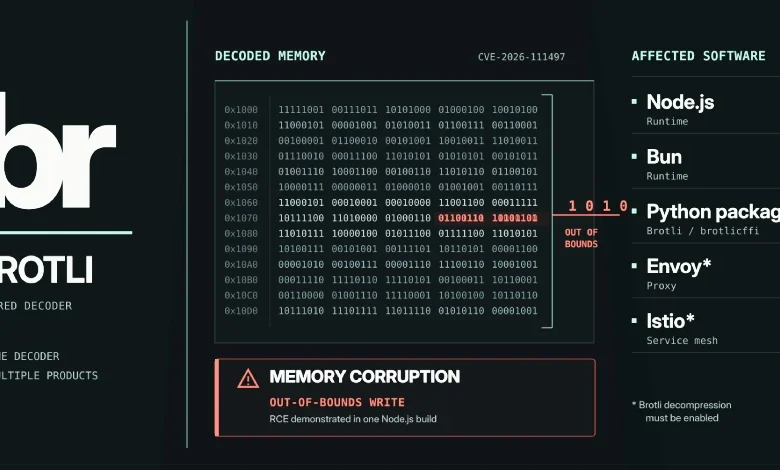
A severe memory-corruption vulnerability residing within Google’s widely adopted Brotli compression and decompression library has left a broad array of software packages, language runtimes, and high-performance network proxies vulnerable to potential remote code execution. Tracked formally under the identifier CVE-2026-111497, the security flaw targets the low-level C codebase responsible for unpacking compressed data streams. Because numerous development ecosystems and enterprise tools embed their own static or dynamically linked copies of the Brotli decoder, the discovery has triggered an urgent, widespread coordinated patching effort across the global technology sector.
The vulnerability stems from improper bounds checking within the Brotli decompression engine. When processing a maliciously crafted, highly compressed data stream, the decoder can be manipulated into writing data past the allocated boundaries of a memory buffer. This out-of-bounds write corrupts adjacent memory regions within the host program. Depending on the targeted architecture and the specific memory layout of the host application, exploitation can yield severe consequences, including application crashes, denial-of-service conditions, memory leakage, or the execution of arbitrary, attacker-controlled machine code.
Scope of Impact and Vulnerable Ecosystems
The sheer ubiquity of the Brotli compression format—which was originally developed by Google to optimize web traffic, minimize payload sizes, and accelerate page load times across the modern internet—magnifies the reach of CVE-2026-111497. The flaw is not constrained to a single application layer; rather, it permeates any software ecosystem that relies on the native C implementation of the Brotli decompression library.
Prominent software environments affected by the vulnerability include mainstream JavaScript and TypeScript runtimes such as Node.js and Bun, high-performance service meshes and proxies like Envoy and Istio, and widely used Python wrapper libraries including the native brotli and brotlicffi packages. Specialized developer tooling, such as the software bill of materials (SBOM) generation tool cdxgen, has also required emergency updates.
The vector of exposure varies significantly depending on how a given application interacts with external data feeds. For instance, in modern JavaScript runtimes like Node.js and Bun, applications typically become vulnerable when utilizing built-in HTTP client utilities—such as the standard fetch() API—to process incoming responses containing the Content-Encoding: br header. Similarly, server-side frameworks or middleware components (such as Express and body-parser) that automatically parse incoming HTTP request bodies encoded with Brotli introduce an attack vector. In these scenarios, a malicious client can compromise an unpatched server, while a malicious server can equally target an unpatched client utilizing tools like cURL with compression enabled.

In the Python ecosystem, the risk profile is dictated by package installation rather than explicit code imports. Once the vulnerable brotli or brotlicffi packages are present in a Python environment, popular HTTP client libraries—including requests, urllib3, httpx, and aiohttp—automatically unpack Brotli-compressed HTTP responses by default. Consequently, a Python application can be rendered vulnerable simply by having the package installed in its dependency tree, even if the application’s core logic never explicitly invokes Brotli decompression routines.
Chronology and Discovery
The journey from the inception of the vulnerability to its public disclosure reveals an unusual timeline that highlights the complexities of open-source supply chain security. According to technical disclosures from artificial intelligence research organizations and core maintainers, the fundamental root-cause defect in the Brotli source code was actually resolved quietly months prior to public awareness.
On February 27, code modifications addressing memory handling were inadvertently merged into the upstream Google Brotli source repository. At the time of the commit, however, neither the committers nor the broader open-source community recognized that the underlying defect constituted a severe security vulnerability. Because no official, stable release of the Brotli C library was pushed to production repositories immediately following the February commit, downstream consumers of the code—including major language runtimes and proxy maintainers—continued to build upon vulnerable snapshots of the library.
The security implications of the flaw came to light months later when researchers from OpenAI’s Codex Security team—specifically identified as Khai Tran and Sylvie Mayer—discovered the exploit chain and reported it to maintainers. Google subsequently assigned the tracking identifier CVE-2026-111497 and rated the vulnerability as critical, assigning it a base score of 9.2 on the CVSS 4.0 scale. Other organizations, such as Red Hat, evaluated the risk profile as important with a score of 8.1, while Node.js maintainers categorized the issue with high severity.
On October 21, a coordinated public disclosure occurred. Google, Node.js, and several other major software vendors simultaneously published emergency security advisories and pushed patched releases across their respective ecosystems. Matteo Collina and Antoine du Hamel were credited by Node.js maintainers for formulating the necessary patches for the runtime environment. In the days following the initial disclosure, maintainers of Bun, Envoy, Istio, and various Python packaging repositories released sequential updates to supplant vulnerable decoder instances.
Technical Demonstrations and Proof-of-Concept Status
Shortly following the public advisory, security researchers from Imperva’s Red Team demonstrated a functional exploitation methodology dubbed "Node2Shell." Working with an unpatched build of Node.js 24.22.0 running on a Linux ARM64 architecture, the Red Team successfully executed arbitrary, attacker-supplied code through both an incoming HTTP response fetched by the runtime and an HTTP request body processed by an Express-based server.

Despite the success of the Imperva demonstration, security analysts emphasize that the exploit required multiple attempts, and a reliable, universally weaponized public proof-of-concept had not been released to the wild at the time of reporting. Cybersecurity and Infrastructure Security Agency (CISA) assessments conducted in late October recorded active exploitation in the wild as "none," noting a complete absence of automated scanning or widespread exploitation frameworks targeting the vulnerability.
Security analysts have noted that traditional perimeter defenses, such as Web Application Filters (WAFs), offer only partial mitigation against CVE-2026-111497. For example, cloud platform provider Vercel implemented emergency firewall rules upon initial disclosure but explicitly cautioned customers that WAF rules cannot inspect or sanitize responses fetched by serverless functions from third-party servers. Complete mitigation requires direct updates to the underlying software runtimes and libraries.
Comprehensive Vulnerability Matrix and Remediation Status
To secure infrastructure against CVE-2026-111497, system administrators and developers must systematically audit their software dependencies, apply authorized patches, and ensure that all running processes are fully restarted to flush vulnerable codebases from active memory.
| Product / Ecosystem | Vulnerable Versions | Fixed Versions | Primary Exposure Vector |
|---|---|---|---|
| Google Brotli (C Library) | 1.0.3 through 1.2.0 | 1.0.10, 1.1.1, 1.2.1 | Processing untrusted Brotli data streams |
| Node.js | 22.x, 24.x, 26.x (prior to patch); 20.x and older (EOL) | 22.23.4, 24.22.1, 26.12.1 | fetch() parsing br responses, Express or body-parser payload ingestion |
| Bun | 1.4.3 and earlier | 1.4.4 | fetch() parsing br responses or node:zlib module usage |
| Envoy Proxy | 1.39.2, 1.38.5, 1.37.7, 1.36.11 | 1.40.0, 1.39.3, 1.38.6, 1.37.8, 1.36.12 | Active configuration utilizing the Brotli decompressor filter |
| Istio Service Mesh | 1.31.0–1.31.1, 1.30.0–1.30.5, 1.29.0–1.29.8 | 1.31.2, 1.30.6, 1.29.9 | Active configuration with Brotli decompression enabled |
Python brotli package |
1.2.0 and earlier | 1.2.1 | Package presence combined with HTTP client automatic decoding |
Python brotlicffi package |
1.2.0.x and earlier | 1.2.1.0 | Package presence combined with HTTP client automatic decoding |
| cdxgen | Standalone binaries/images, 13.4.0 and 12.8.8 and earlier | 13.5.0, 12.8.9 | Scanning untrusted input via standalone binary or container image |
Strategic Recommendations and Mitigation Steps
Mitigating CVE-2026-111497 requires a multi-layered approach across software development life cycles and infrastructure management. Simply stripping the br token from client Accept-Encoding request headers is insufficient, as malicious or compromised servers may independently return Brotli-compressed payloads regardless of client requests.
- Immediate Package Upgrades: Organizations must update all affected runtimes, proxies, and language packages to their respective patched versions as outlined in the vulnerability matrix.
- Process Restarts and Container Rebuilds: Because running daemons and containerized processes retain loaded dynamic libraries in memory, system administrators must restart services and rebuild container images to ensure vulnerable decoders are purged from active execution states.
- Manual Dependency Auditing: Automated dependency scanners and software composition analysis (SCA) tools may experience delays in indexing newly issued advisories—particularly concerning Python ecosystem packages where CVE records historically mapped primarily to Google’s core repository. Security teams should manually verify installed versions of Python
brotliandbrotlicffilibraries. - Temporary Decompression Restrictions: In environments where immediate patching is operationally unfeasible, engineering teams should disable Brotli decompression configurations within proxies, API gateways, and application middleware to eliminate the attack surface entirely.