Creative Throws a Stone at iPod A Metaphor Explored
Creative throws a stone at iPod. This phrase sparks a fascinating exploration of the relationship between creativity and technology. Imagine a rebellious artist rejecting the sleek simplicity of a ubiquitous music player, a defiant act that symbolizes a broader struggle between tradition and innovation. What does it mean, and how does it connect to our evolving understanding of creativity and the ever-changing landscape of technology?
We’ll delve into the symbolic meaning of this metaphor, considering alternative interpretations and potential emotional states. We’ll also examine the historical significance of the iPod, exploring its role as a cultural icon and how it shapes our relationship with music and technology. This journey will uncover potential conflicts between tradition and innovation, and ultimately, consider the future implications of this creative resistance.
Understanding the Metaphor
The phrase “creative throws a stone at iPod” evokes a potent image, hinting at a complex interplay between creativity, technology, and perhaps, rejection or defiance. It suggests a deliberate act, implying a certain emotional weight and a potential conflict between the impulse to create and the constraints or perceived limitations of technology. This exploration delves into the symbolic meaning, alternative interpretations, and emotional undertones associated with this intriguing metaphor.The act of “throwing a stone” implies a deliberate, forceful, and potentially destructive action.
Pairing this with the “iPod” – a symbol of modern, easily accessible digital music and technology – creates a powerful contrast. The stone represents a raw, untamed creative force, while the iPod represents a polished, streamlined, and perhaps even restrictive aspect of modern life. This metaphor suggests a conflict between the intuitive, spontaneous nature of creativity and the structured, regulated nature of technology.
Symbolic Meaning of the Phrase
The “stone” in this metaphor represents the raw, unfiltered expression of creativity. It’s a forceful act of creation, potentially fueled by passion and emotion. The “iPod,” conversely, embodies the structured, controlled nature of technology. The act of throwing a stone at it could symbolize a rejection of technology’s perceived limitations on creativity, or perhaps a yearning for a more organic, less controlled creative process.
Alternative Interpretations
The meaning of the phrase can shift depending on the context. For example, in a context of artistic rebellion, the phrase might represent a rejection of formulaic approaches to music or other forms of art. Alternatively, it could signify a frustration with technology’s perceived limitations on artistic expression, a struggle against the perceived standardization of creative output, or a desire for originality.
It could also suggest a yearning for a more visceral and emotive form of artistic creation.
Emotional States Implied
The action implies a range of possible emotional states. Frustration, anger, or even a sense of liberation might be associated with this action. A creative individual feeling stifled by the limitations of technology might find a cathartic release in this metaphorical act. Alternatively, it might suggest a longing for a simpler, less technologically-mediated creative process.
Comparison to Other Metaphors
The metaphor “creative throws a stone at iPod” shares similarities with other expressions that contrast the human creative impulse with technology. Consider the expression “smashing a keyboard” in the context of frustration with a computer program or digital creation tool. These metaphors highlight the tension between human creativity and the tools we use to express it. Both suggest a need for a balance between the two.
Cultural and Historical Influences
The metaphor may draw upon cultural anxieties surrounding technological advancement and its potential to stifle human expression. Throughout history, various artistic movements have challenged societal norms and conventions, potentially finding resonance with the image of throwing a stone at technology. This metaphor speaks to a persistent human desire for authenticity and the fear of being homogenized by mass culture.
Role of Technology in the Metaphor
Technology, in this case represented by the iPod, is presented as a potential obstacle or limitation to creative expression. This suggests a belief that technology can sometimes feel overly structured or restrictive in its ability to support and allow the free-flowing, spontaneous nature of creative processes.
Contrast Between Creativity and Technology
The metaphor highlights the inherent contrast between the spontaneous, unpredictable nature of creativity and the structured, often formulaic nature of technology. The act of throwing a stone symbolizes a deliberate choice to reject the constraints of technology in favor of a more intuitive and emotionally charged creative process.
The Nature of Creativity
Throwing a stone at an iPod, a seemingly simple act, embodies a profound reflection on creativity. It speaks to the human impulse to challenge, to resist, and to find new ways of engaging with the world around us, even when those ways seem counterintuitive or disruptive. This act can be seen as a metaphor for the creative process itself, and it prompts us to consider the relationship between human ingenuity and technological advancement.The act of throwing a stone, though seemingly mundane, inherently requires creativity.
It necessitates the consideration of factors like trajectory, force, and potential impact. The same applies to the creative process in all fields. It’s about understanding the problem, considering alternative solutions, and envisioning unexpected outcomes. Just as a thrower must anticipate the stone’s flight path, a creative individual must anticipate the impact of their work.
Characteristics of Creativity in Relation to Throwing
Creativity, in the context of throwing a stone at an iPod, involves several key characteristics. It demonstrates a willingness to defy convention, to question the established order, and to seek novel solutions. This resistance to the status quo is a fundamental aspect of creativity. It also implies a deep understanding of the object and the environment, enabling the individual to strategize and execute a calculated disruption.
Different Approaches to Creative Problem-Solving
The creative process often involves a combination of divergent and convergent thinking. Divergent thinking encourages exploring multiple possibilities, while convergent thinking focuses on refining those possibilities to arrive at the most effective solution. Problem-solving in the creative sphere often involves a non-linear approach, bouncing between these two modes of thought. For instance, the thrower might visualize various angles and speeds before selecting the most effective one.
Remember that bizarre ad campaign where someone creatively threw a stone at an iPod? It was a pretty memorable way to grab attention, but it also foreshadowed a trend. Advertisers are increasingly getting into the game literally, using unexpected and sometimes even disruptive tactics to stand out. This trend of advertisers getting into the game literally is reflected in this approach, and ultimately, campaigns like this one are all about finding ways to connect with consumers on a different level.
It’s all part of the evolving landscape of creative ad campaigns.
Impact of Technology on the Creative Process
Technology has profoundly impacted the creative process across numerous fields. Digital tools have expanded the palette of creative expression, offering new avenues for artists and designers. However, technology can also present constraints. Sometimes, reliance on technology can diminish the need for deeper understanding of fundamental principles. It’s crucial to strike a balance, harnessing technology’s potential while preserving the essence of human ingenuity.
Relationship Between Creativity and Technology in Various Fields
The relationship between creativity and technology varies significantly across different fields. In music, technology enables composers to experiment with sounds and rhythms, creating entirely new genres. In architecture, advanced design software allows architects to explore complex structures and aesthetic possibilities. In contrast, in fields like filmmaking, technology has both enhanced and sometimes limited the creative process.
Creative Resistance to Technology
The act of throwing a stone at an iPod embodies a form of creative resistance to technology. It’s a rejection of passive consumption and a call for engagement with the physical world. It emphasizes the importance of human interaction and the tangible over the digital. This resistance isn’t necessarily about rejecting technology, but about finding a balance between its benefits and its potential drawbacks.
Potential Conflicts Between Tradition and Innovation
The metaphor of throwing a stone at an iPod highlights the potential conflicts between tradition and innovation. The iPod represents a technological advancement, while the stone represents a more traditional form of engagement with the environment. This conflict can be seen as a constant tension in creative fields, where established practices are challenged by emerging technologies. For instance, the introduction of digital photography fundamentally altered traditional photographic practices.
Facets of Creativity and Technology
| Creative Approach | Technological Tool | Impact on the Creative Process | Example |
|---|---|---|---|
| Divergent thinking | Digital audio workstation | Expands sonic possibilities | Creating a unique musical composition |
| Convergent thinking | 3D modeling software | Refines design solutions | Designing an innovative architectural structure |
| Resistance to technology | Physical materials | Emphasizes human interaction | Creating a sculpture |
| Balance between tradition and innovation | Mixed media art | Combines old and new techniques | Combining digital elements with traditional painting |
The Role of the iPod: Creative Throws A Stone At Ipod
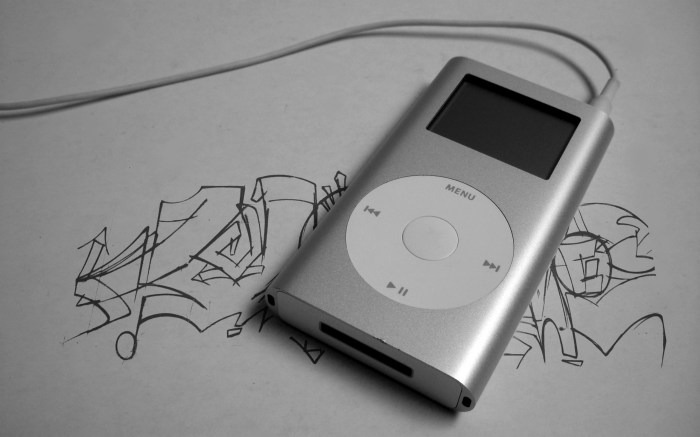
The iPod, a seemingly simple digital music player, profoundly impacted popular culture and the way we interact with technology. Its sleek design and innovative features captivated consumers, sparking a revolution in music consumption. More than just a device, the iPod became a symbol of a new era in personal technology and entertainment.The iPod wasn’t just another MP3 player; it was a game-changer.
Its compact size, combined with its impressive storage capacity and intuitive interface, made it a desirable and accessible product for a broad range of users. This accessibility, combined with the strong marketing campaign that positioned it as a stylish and trendy accessory, transformed the device into a cultural phenomenon.
Historical Significance in Popular Culture
The iPod’s impact extended far beyond its technological capabilities. It became a symbol of a particular era and a status symbol, signifying access to modern technology and a desire to be part of a new wave of music lovers. This association with youth culture and a particular aesthetic solidified its position as a cultural icon. The iPod’s sleek design and user-friendly interface also made it an attractive device for those outside of the hardcore music enthusiast community, widening its appeal.
The iPod as a Symbol of Technology
The iPod represented a significant advancement in portable digital technology. Its ability to store vast quantities of music on a device small enough to fit in a pocket highlighted the potential of digital storage and its implications for personal entertainment. The ease of use and the seamless integration of music into daily life further underscored the iPod’s role as a symbol of technological progress and convenience.
It also signaled a shift from physical media to digital, marking a turning point in how people consumed and experienced music.
Impact on Music Consumption and Listening Habits
The iPod fundamentally altered music consumption. No longer were people reliant on physical albums or cumbersome cassette tapes. The iPod’s ability to hold thousands of songs in a single device fostered a shift towards on-demand listening and curated playlists. This shift affected the way music was discovered, shared, and experienced. The convenience of having your entire music library at your fingertips led to a change in how people listened to music, moving away from traditional listening habits and embracing a more personalized and dynamic approach.
Comparison to Other Music-Playing Devices
Compared to earlier portable music players, the iPod offered significantly improved storage capacity, better sound quality, and a more intuitive user interface. The iPod’s superior features made it stand out from predecessors like Walkmans, which were often bulky and had limited storage. The iPod’s seamless integration with personal computers also contributed to its widespread adoption, setting a new standard for portable music players.
Historical Overview of Portable Music Players, Creative throws a stone at ipod
The evolution of portable music players showcases a progression from bulky cassette players to the sleek, high-capacity iPod. The development of smaller, more powerful storage devices, coupled with advancements in digital audio technology, paved the way for the iPod’s success. The transition from physical media to digital music was a significant factor in this evolution.
Remember that time Creative threw a stone at an iPod? It was a symbolic act, highlighting the frustration with technology sometimes feeling like a frustrating, expensive necessity. Similarly, socialized broadband, while seemingly a good idea, faces hurdles that make it a tough sell. For instance, why socialized broadband wont work often comes down to practical issues like funding and managing a network at scale.
It’s a complex problem, and throwing stones at the problem is just a metaphor for the need for a better, more sustainable technological solution. Even Creative, in their own way, was just trying to make a point about the cost of innovation.
Symbolic Representation in Contemporary Society
The iPod, while no longer the dominant portable music player, continues to hold a symbolic place in contemporary society. Its influence on design, user experience, and the very concept of personal music libraries is undeniable. Its legacy lives on in later generations of portable music devices and its imprint on popular culture is evident in the way people interact with technology and music.
It represents a pivotal moment in the digital age, reminding us of the technological and cultural changes that shaped our present.
Evolution of Music Technology and Listening Habits
| Era | Technology | Listening Habits | Impact on Culture |
|---|---|---|---|
| Pre-1980s | Vinyl records, cassette tapes | Limited portability, curated albums, physical collections | Music as a shared experience, physical presence of music |
| 1980s-1990s | Portable cassette players, early MP3 players | Increasing portability, limited storage, some digital options | Growing interest in portable music, early digitalization |
| 2000s | iPod, portable hard drive music players | High portability, extensive storage, on-demand listening | Shift to digital music, curated playlists, personal music libraries |
| 2010s-Present | Smartphones, streaming services | Seamless integration with daily life, access to vast libraries | Music consumption is highly personalized, social media integration, streaming services dominate |
Potential Scenarios and Interpretations
The phrase “throwing a stone at an iPod” evokes a potent blend of frustration, nostalgia, and reflection on the relationship between technology and human expression. It hints at a disconnect, a yearning for something beyond the readily available, and a desire to re-evaluate the very nature of creativity in a digital age. This metaphor invites exploration into the diverse ways in which people interact with technology and express themselves through actions both tangible and intangible.This exploration will analyze potential scenarios surrounding the act, examining the motivations behind it, and highlighting the underlying themes and anxieties it potentially represents.
The aim is to decipher the nuances of this seemingly simple act, revealing its capacity to encapsulate complex emotions and societal shifts.
Creative’s latest throw at the iPod, a seemingly simple act, feels a bit more significant now that the Great Plains 8.0 has hit the street. This new tech, great plains 8 0 hits the street , might just change the game. Ultimately, though, Creative’s throw still feels like a bold statement about the future of portable audio.
Potential Scenarios
The act of “throwing a stone at an iPod” can be interpreted in a multitude of ways, depending on the context. The following scenarios demonstrate the various motivations and emotional states that might underpin such an action.
| Character | Setting | Motivation | Interpretation |
|---|---|---|---|
| A frustrated artist | A cluttered studio, surrounded by half-finished projects | Feeling overwhelmed by the perceived limitations of digital tools, yearning for a return to analog methods, or simply wanting to break the monotony of digital creation. | This action represents a rejection of the immediate gratification of digital tools and a longing for the process of physical creation. |
| A nostalgic teenager | An antique store, surrounded by vintage electronics | Seeking a connection with the past, recognizing the perceived simplicity of older technologies, and lamenting the loss of a certain era. | This scenario speaks to the generational shift in technology, highlighting the value of historical context and the potential for longing for bygone eras. |
| A disillusioned student | A crowded library, surrounded by academic papers | Feeling overwhelmed by the pressure of academic expectations, and a sense of disconnect between digital research and the real-world. | This act portrays a sense of frustration with digital tools in a research context, implying a longing for a more tangible connection with the subject matter. |
| A rebellious activist | A protest rally, amidst a sea of digital devices | Rejecting the dominance of digital technology in society, and advocating for a return to a more hands-on, tangible approach to social change. | This demonstrates a critique of society’s over-reliance on technology and a call for a return to more fundamental, tactile means of expression and engagement. |
Possible Dialogues
The act of “throwing a stone at an iPod” can also be explored through imagined dialogues. These dialogues help to illuminate the underlying emotions and motivations behind the action.
- “I feel like all my creativity is being sucked into this little box. I need to disconnect from this digital world to reconnect with the real world.”
- “This technology has made everything so easy, so instant. I miss the struggle, the process of creating something tangible. It’s a reminder of what I’ve lost.”
- “This device is just a distraction. It’s taking away from my ability to think critically. I need to break away from it.”
Themes and Messages
The act of “throwing a stone at an iPod” conveys several potent themes. It suggests a potential disconnect between technology and human experience, a longing for a return to simpler, more tactile methods, and a critique of society’s increasing reliance on digital tools.
- The metaphor highlights the ongoing debate about the balance between technology and human creativity. It emphasizes the importance of maintaining a connection with the physical world while embracing the potential of technology.
- The action also reflects anxieties about the impact of technology on society. It suggests a potential loss of connection, a sense of alienation, and a longing for something more meaningful and tangible.
- Furthermore, the act raises questions about the future of technology and its role in shaping human expression. It implies a need for a critical assessment of our dependence on technology and a recognition of the value of non-digital forms of creation.
Implications for the Future
This metaphor implies a potential shift towards a more balanced relationship between humans and technology. It suggests a need for a critical examination of the role of technology in shaping our creativity and expression, and the importance of maintaining a connection with the physical world.
- It signals a possible shift in artistic expression, encouraging a more conscious approach to the integration of technology into creative processes.
- This metaphor suggests that the future of creativity will involve a more nuanced understanding of technology’s influence on human expression, and a recognition of the importance of maintaining a connection with the physical world.
Creative Expression and Technology
The interplay between human creativity and technological advancement has been a constant source of innovation and evolution throughout history. From the earliest cave paintings to the most sophisticated digital art installations, technology has consistently shaped and been shaped by human expression. This relationship is not merely one of tool use; technology can also act as a catalyst for new forms of creative expression, challenging established norms and pushing the boundaries of what is possible.Technology acts as a powerful amplifier of human creativity, enabling artists and creators to explore previously unimaginable ideas and techniques.
The digital age has ushered in an era of unprecedented creative freedom, allowing individuals to share their work globally and connect with a wider audience than ever before. However, this relationship is not without its complexities, and finding the right balance between technological innovation and artistic vision remains a key challenge.
Examples of Technology in Creative Expression
Technology has profoundly impacted various creative disciplines. Digital painting software allows artists to create intricate and nuanced pieces with ease, while music production software provides musicians with unprecedented control over their sound. 3D modeling and animation software enables the creation of elaborate visual worlds, opening up possibilities for storytelling and artistic expression in film and gaming.
Methods of Creative Expression
Creative expression takes numerous forms. From visual arts, like painting and sculpture, to performing arts, such as dance and music, and literary arts, such as poetry and novels, the methods of expression are diverse. The digital age has expanded these options, introducing new forms of interactive art, digital storytelling, and virtual reality experiences.
Challenging Established Norms with Technology
Artists have historically used technology to challenge established norms and provoke societal discourse. For instance, early film-makers used the medium to explore social issues and critiques of societal structures, and the advent of digital media has empowered artists to express dissenting opinions and subvert conventional artistic styles. This challenging of the status quo can manifest in various ways, from using technology to create art that challenges traditional aesthetics to using digital platforms to build alternative communities and disseminate ideas.
Balance Between Creativity and Technology
Striking a balance between human creativity and technological advancement is essential for fostering meaningful artistic expression. While technology can amplify creativity, it shouldn’t overshadow the human element of imagination, emotional depth, and unique perspective. The key lies in using technology as a tool to enhance and augment human creativity, rather than relying on it to replace it entirely.
Relationship Between Human Creativity and Technological Advancement
The relationship between human creativity and technological advancement is a symbiotic one. Technological advancements often spark new forms of creative expression, while human creativity drives innovation and shapes the direction of technological development. This dynamic interplay has resulted in numerous breakthroughs in art, design, and other creative fields. Consider how the printing press revolutionized literature, or how the internet fostered new forms of digital storytelling.
Impact of Technological Advancements on Creative Industries
Technological advancements have had a profound impact on the creative industries, altering production processes, distribution methods, and consumption patterns. Digital tools have lowered barriers to entry for many creative fields, enabling independent artists and creators to reach global audiences directly. At the same time, the shift to digital platforms has presented new challenges for established artists and institutions, requiring adaptation and innovation to remain relevant in the evolving landscape.
Relationship Between Creative Expression and Technology Across Disciplines
| Discipline | Creative Expression | Technology | Examples of Interaction |
|---|---|---|---|
| Visual Arts | Painting, Sculpture, Photography | Digital Painting Software, 3D Modeling, VR/AR | Creating digital portraits, generating 3D sculptures, immersive virtual art exhibitions |
| Music | Composition, Performance | Digital Audio Workstations (DAWs), MIDI, Sound Design Software | Creating complex compositions, manipulating soundscapes, virtual instrument performance |
| Film/Animation | Storytelling, Cinematography | Digital Filmmaking Tools, CGI, Animation Software | Creating visual effects, producing complex narratives, interactive animation |
| Literature | Writing, Storytelling | E-books, Digital Publishing Platforms, Interactive Narratives | Self-publishing, creating interactive novels, online storytelling communities |
Last Word
In conclusion, “Creative throws a stone at iPod” is more than just a catchy phrase; it’s a potent metaphor that reflects the complex interplay between human creativity and technological advancement. Through exploring the various facets of this metaphor, we’ve seen how it represents a broader cultural conversation about our relationship with technology and the ever-evolving nature of creative expression.
The metaphor suggests that sometimes, resistance to the status quo, symbolized by the act of throwing a stone, is a necessary part of innovation and progress. Ultimately, the future of creativity and technology seems intertwined, with the constant need to find balance.