Fiber Optics Let There Be Light
Fiber optics let there be light, illuminating the world with its revolutionary communication technology. This fascinating journey explores the history, principles, and applications of fiber optics, from its humble beginnings to its current role in modern infrastructure and beyond. We’ll delve into the science behind light transmission, the advantages over traditional methods, and the exciting possibilities shaping the future of this technology.
The intricate structure of fiber optic cables, the principles of total internal reflection, and the different types of fiber (single-mode and multi-mode) will be examined. We’ll explore its vital role in telecommunications, internet infrastructure, and its growing importance in diverse fields like medicine and industrial automation. The technology’s impact on communication, data transfer, and overall connectivity will be highlighted.
Historical Context of Fiber Optics: Fiber Optics Let There Be Light
The journey of fiber optics is a fascinating tale of scientific innovation and relentless pursuit of better communication. From its humble beginnings in the realm of theoretical physics, the technology has evolved into an indispensable component of our modern interconnected world. This evolution has been driven by a combination of fundamental breakthroughs in materials science and ingenious engineering solutions.
This exploration delves into the key milestones, highlighting the challenges overcome and the advancements that have shaped the fiber optic landscape we know today.The development of fiber optics is a story of gradual improvement, each advancement building upon the previous. Early concepts were often theoretical, but the persistent efforts of researchers and engineers steadily led to practical applications.
This progression is evident in the changing characteristics of fiber optic technology, from its initial limitations to its current widespread use.
Early Concepts and Experiments
The concept of using light for communication dates back to the 1840s. Early experiments involved using light to transmit signals over short distances, but the limitations of available materials and technologies hindered widespread adoption. Significant advancements in glass manufacturing and understanding of light propagation were crucial in the later development of fiber optic technology.
Key Milestones in Fiber Optic Development
- The 1960s saw significant theoretical and experimental work in the field. Researchers began exploring the potential of using optical fibers for communication, driven by the limitations of existing copper wire technologies. Key experiments demonstrated the possibility of transmitting light through glass fibers, but the quality and efficiency were far from ideal. Early experiments laid the foundation for future progress.
- The 1970s marked a turning point. Scientists developed techniques for creating high-quality, low-loss optical fibers. The invention of the first low-loss silica-based fiber by Corning Glass Works in 1970 was a pivotal moment. This breakthrough made optical fiber a viable alternative to traditional copper cables.
- The 1980s saw the rapid expansion of fiber optic networks. Improvements in fiber manufacturing and signal transmission technologies made fiber optic communication systems more efficient and reliable. This period saw the rise of fiber optic communication networks, which quickly began to replace copper wire in long-haul applications.
- The 1990s and 2000s saw further refinement and optimization. Developments in lasers and signal processing techniques led to significantly increased bandwidth and data transmission rates. This led to the widespread use of fiber optics in telecommunications, data centers, and other high-bandwidth applications.
Materials Science and Engineering Advancements
The development of fiber optics is deeply intertwined with advancements in materials science and engineering. The quest for low-loss fibers necessitated improvements in glass composition and manufacturing processes. Researchers focused on minimizing impurities and imperfections within the fiber material to reduce signal loss. This pursuit of better materials drove innovation in glass synthesis and processing.
Comparison of Early and Modern Fiber Optics
Early fiber optic technologies often suffered from high signal loss and limited bandwidth. The fibers were less precise in their construction, leading to a substantial amount of signal degradation over distance. Modern fibers, on the other hand, exhibit significantly lower loss and higher bandwidth capabilities. This improvement is due to advancements in manufacturing processes and the development of advanced materials.
Key Dates, Inventors, and Advancements
| Date | Inventor/s | Advancement |
|---|---|---|
| 1966 | Charles Kao and George Hockham | Proposed the concept of low-loss optical fiber communication. |
| 1970 | Corning Glass Works | Developed the first low-loss silica-based fiber. |
| 1980 | Various researchers | Significant improvements in fiber manufacturing and signal transmission technologies. |
| 1990-2000 | Various researchers and companies | Further refinement and optimization of fiber optic technology, leading to increased bandwidth and data transmission rates. |
Fundamental Principles of Fiber Optics
Fiber optics, a revolutionary technology, has transformed communication and countless other industries. This technology relies on the intricate interplay of light and incredibly thin strands of glass or plastic to transmit information at phenomenal speeds. Understanding the fundamental principles behind this remarkable feat is key to appreciating its widespread application.The core principles of fiber optics revolve around guiding light through these strands, enabling data transmission across vast distances with minimal signal loss.
Fiber optics, truly amazing technology, allows for light to travel incredibly long distances, a feat that’s fundamental to modern communication. This incredible speed and efficiency in data transmission is crucial, especially in the digital age. Recently, hotmail and gmail are working to make the online experience even safer by introducing new domains to fight fraud. hotmail fights fraud and gmail with new domains is a smart move that should improve the security and integrity of these widely used email services.
Ultimately, fiber optics are still the backbone of this digital world, letting there be light and connecting us all.
This intricate process leverages the unique properties of light interacting with the fiber’s structure, creating a sophisticated method of carrying information. Delving into the structure and working principles of fiber optic cables will unveil the marvels of this technological advancement.
Fiber optics, those amazing strands of glass that carry light, are revolutionizing communication. But the advancements don’t stop there. Samsung’s upcoming mass production of high-density NAND flash memory devices ( samsung to mass produce high density nand flash memory devices ) will be crucial in storing all the data that these light-speed networks transmit. Ultimately, fiber optics let there be light, information, and future possibilities.
Light Transmission through Fiber Optic Cables
Light propagation within a fiber optic cable relies on a phenomenon known as total internal reflection. Light rays are repeatedly reflected off the inner walls of the fiber, maintaining a guided path. This controlled reflection allows light to travel considerable distances with minimal signal degradation. The precise angle of incidence and the refractive index difference between the fiber core and cladding are critical to achieving total internal reflection.
Fiber Optic Cable Structure and Composition
A typical fiber optic cable consists of three primary components: the core, cladding, and buffer coating. The core, the central part of the cable, is composed of a high-refractive-index material, usually glass or plastic. The cladding, surrounding the core, has a slightly lower refractive index. This difference in refractive indices is crucial for total internal reflection. The buffer coating, the outermost layer, protects the cable from physical damage and environmental factors.
Total Internal Reflection in Light Propagation
Total internal reflection is the fundamental principle behind light transmission in fiber optics. When light traveling through a denser medium (the core) encounters a boundary with a less dense medium (the cladding), it can be reflected back into the core if the angle of incidence is greater than the critical angle. This critical angle is determined by the refractive indices of the core and cladding materials.
The repeated reflections of light along the fiber’s path enable long-distance transmission with minimal signal loss.
Total internal reflection occurs when the angle of incidence is greater than the critical angle, causing the light to reflect back into the core.
Single-Mode vs. Multi-Mode Fiber Optics
Fiber optic cables are categorized into single-mode and multi-mode types, based on the size of the core and the nature of light propagation. Single-mode fibers have a very small core diameter, typically around 9 µm, which allows only one mode of light propagation. This characteristic enables higher data transmission rates over longer distances with minimal signal distortion. Multi-mode fibers, on the other hand, have a larger core diameter (typically 50 µm or 62.5 µm), allowing multiple light paths (modes) to propagate.
This design facilitates faster data transmission over shorter distances, but is susceptible to signal degradation over longer distances due to modal dispersion.
Internal Structure of a Fiber Optic Cable
| Component | Description |
|---|---|
| Core | The central part of the fiber, made of high refractive index material. Light travels through this part. |
| Cladding | The layer surrounding the core, with a slightly lower refractive index. It guides light through total internal reflection. |
| Buffer Coating | The outermost layer, protecting the fiber from damage and environmental factors. |
Applications of Fiber Optics in Communication
Fiber optics has revolutionized communication, ushering in an era of faster, more reliable, and more efficient data transmission. Its unique properties make it a superior alternative to traditional copper cables, opening up a wide range of applications in various sectors. This section will explore the diverse uses of fiber optics in telecommunications, highlighting its advantages, bandwidth capacity, and crucial role in modern internet infrastructure.
Telecommunications Applications
Fiber optics has become the backbone of modern telecommunications networks. Its ability to carry vast amounts of data over long distances makes it ideal for long-haul transmission of voice, video, and data. This capability is particularly crucial for global communication networks and undersea cables, enabling seamless connections across continents.
Advantages over Copper Cables
Fiber optic cables offer significant advantages over traditional copper cables. Their superior bandwidth capacity allows for transmission of significantly more data, supporting high-definition video streaming, high-speed internet access, and numerous other demanding applications. Furthermore, fiber optic cables are immune to electromagnetic interference, ensuring reliable and consistent signal transmission. Their lightweight and compact nature also simplifies installation and maintenance compared to copper cables.
Bandwidth Capacity Comparison
Fiber optic cables possess significantly higher bandwidth capacity than copper cables. This allows for significantly faster data transmission rates. For instance, a single fiber optic cable can support hundreds of thousands of simultaneous voice calls, video conferences, and data streams. This capability greatly surpasses the limitations of copper cables, which struggle to maintain such high bandwidth over long distances.
Other transmission mediums, like microwave links or satellite communications, often have limitations in terms of range or bandwidth, making fiber optics a more versatile and powerful solution for high-capacity networks.
Fiber Optics in Internet Infrastructure
Fiber optic cables are the essential component of modern internet infrastructure. They form the backbone of the internet, connecting data centers, internet service providers (ISPs), and end-users. The high bandwidth capacity of fiber optic cables is crucial for handling the increasing demands of internet traffic, supporting applications like online gaming, video conferencing, and cloud computing. As internet usage continues to grow exponentially, fiber optic infrastructure plays a vital role in ensuring smooth and reliable connectivity.
Applications Table
| Application | Description | Advantages |
|---|---|---|
| Long-haul Telecommunication | Connecting cities, countries, and continents | High bandwidth, low signal loss, immune to electromagnetic interference |
| Cable Television | Delivering high-definition video signals | High bandwidth, supports multiple channels, long-distance transmission |
| Internet Access | Providing high-speed internet to homes and businesses | High bandwidth, reliable connection, cost-effective over long distances |
| Data Centers | Connecting servers and networking equipment | High bandwidth, low latency, efficient data transfer |
| Undersea Cables | Connecting continents via underwater cables | High bandwidth, long-distance transmission, reliable communication |
Applications of Fiber Optics in Other Fields
Fiber optics, beyond its crucial role in telecommunications, finds diverse applications across various sectors, revolutionizing how we approach medicine, industrial processes, and scientific research. The unique properties of fiber optic cables, such as their immunity to electromagnetic interference and high bandwidth capacity, make them ideal tools for a wide range of specialized tasks. These capabilities enable precise measurements, remote control, and enhanced data transmission in demanding environments.
Fiber Optics in Medical Technology
Fiber optics have significantly impacted medical technology, enabling minimally invasive procedures and advanced diagnostic tools. Endoscopes, a crucial instrument in various medical specialties, utilize fiber optics to transmit images from the inside of the body to a viewing screen. This allows doctors to visualize internal organs and tissues, facilitating precise diagnoses and surgical interventions. Fiber optic illumination systems provide bright, focused light, crucial for high-quality visualization during procedures.
Moreover, fiber optic sensors are being developed for continuous monitoring of physiological parameters, like blood pressure and heart rate, offering real-time insights into patient conditions.
Fiber Optics in Sensing and Measuring Technologies
Fiber optic sensors are invaluable in diverse sensing and measuring applications due to their unique characteristics. They offer high sensitivity, allowing for precise measurements in various environments. Fiber optic sensors are used to detect strain, temperature, and pressure. For instance, strain sensors based on fiber optics can be used in structural health monitoring, detecting subtle changes in materials and structures.
These sensors offer high accuracy and long-term stability, enabling continuous monitoring of critical parameters. Furthermore, fiber optic sensors are employed in chemical sensing, allowing for the detection of specific chemicals in liquids or gases.
Fiber Optics in Industrial Automation
Fiber optics are revolutionizing industrial automation, offering superior data transmission capabilities and enabling real-time monitoring and control of complex processes. In automated manufacturing environments, fiber optics transmit data between sensors and control systems with minimal signal loss and high reliability. They are used in industrial automation to transmit signals for monitoring and controlling machinery, reducing downtime and increasing productivity.
Fiber optic cables can withstand harsh industrial environments, making them well-suited for applications in manufacturing and other industries.
Other Specialized Applications of Fiber Optics
Beyond medical and industrial applications, fiber optics play a vital role in various other specialized fields. In the aerospace industry, fiber optic sensors are used to monitor aircraft structures and detect potential issues during flight. They provide a highly reliable means of transmitting data over long distances, which is crucial for space exploration and deep-sea research. Fiber optics also find application in environmental monitoring, allowing for remote sensing and data collection in challenging environments.
Additionally, the technology is employed in scientific research, enabling high-resolution imaging and data acquisition in various scientific disciplines.
Table of Industrial and Medical Applications of Fiber Optics
| Application Area | Specific Application | Key Benefit |
|---|---|---|
| Medical | Endoscopes, Laparoscopic Surgery, Optical Coherence Tomography (OCT) | Minimally invasive procedures, high-resolution imaging, real-time visualization |
| Industrial | Automated Manufacturing, Industrial Automation, Process Monitoring | High-speed data transmission, reliable signal transmission in harsh environments, reduced downtime |
| Sensing & Measuring | Strain Sensors, Temperature Sensors, Pressure Sensors, Chemical Sensors | High sensitivity, accuracy, long-term stability, remote sensing capabilities |
| Aerospace | Aircraft Structural Monitoring, Space Exploration, Deep-Sea Research | Long-distance data transmission, high reliability, high accuracy |
Fiber Optics and the Future
Fiber optics technology is rapidly evolving, pushing the boundaries of what’s possible in communication and beyond. Ongoing research and development are constantly refining existing systems and exploring entirely new applications. This exploration into the future of fiber optics promises exciting advancements that will shape industries and daily life in profound ways.
Ongoing Advancements in Fiber Optic Technology, Fiber optics let there be light
Significant strides are being made in fiber optic materials and manufacturing techniques. New materials with enhanced performance characteristics, such as lower attenuation and higher bandwidth capacity, are under development. Improved manufacturing processes are leading to more efficient and cost-effective production of fiber optic cables. These advancements contribute to the growing deployment of high-capacity fiber optic networks.
Future Trends and Challenges in Fiber Optics
The future of fiber optics hinges on several key trends. Increased demand for higher bandwidth and faster data transmission rates is driving the need for even more advanced fiber optic systems. The integration of fiber optics with other technologies, such as artificial intelligence and machine learning, promises to unlock new possibilities in data analysis and processing. However, challenges such as the efficient deployment of fiber optic infrastructure in diverse environments and the continued reduction of manufacturing costs remain crucial considerations.
Potential New Applications and Innovations
Fiber optics are poised to play a vital role in emerging technologies. Potential applications include enhanced medical imaging techniques, high-resolution sensors for environmental monitoring, and ultra-fast data transfer for cloud computing and big data analysis. The use of fiber optics in quantum computing is also being explored, which holds the potential to revolutionize information processing.
Fiber Optics in Sustainable Technologies
Fiber optics play a role in sustainable technologies. The development of fiber optic sensors for monitoring energy consumption and environmental parameters contributes to optimizing energy use and minimizing environmental impact. High-efficiency data transmission systems based on fiber optics reduce the energy consumption of data centers and cloud computing, supporting sustainable infrastructure. Moreover, the use of recycled materials in fiber optic manufacturing processes is an important step toward a circular economy.
Recent Developments in Fiber Optic Technology
“Researchers at [University Name] have recently developed a new type of fiber optic cable with significantly reduced attenuation at wavelengths crucial for high-capacity optical communication systems.”
- Development of novel fiber designs with improved performance characteristics is ongoing. This includes the exploration of photonic crystal fibers, which offer enhanced light confinement and potentially higher bandwidth capacities.
- The integration of fiber optics with other technologies, such as wireless communications, is leading to hybrid systems that combine the strengths of both technologies. For instance, fiber optic cables can be used to connect and expand the reach of wireless networks.
- Fiber optics are being used to create high-speed sensors for monitoring various environmental parameters, such as temperature, pressure, and chemical composition. This has applications in environmental monitoring and control, contributing to sustainability efforts.
- Advanced manufacturing techniques are constantly improving, leading to the production of cost-effective and high-performance fiber optic cables. These developments contribute to broader accessibility and adoption of fiber optic technology.
Challenges and Limitations of Fiber Optics
Fiber optic technology, while revolutionizing communication and various other fields, faces inherent limitations and challenges. These hurdles, though often manageable, significantly impact the deployment, maintenance, and overall performance of fiber optic networks. Understanding these limitations is crucial for optimizing the technology and ensuring its continued effectiveness.
Manufacturing and Installation Challenges
Fiber optic cable production, while highly automated, still presents complexities. Maintaining consistent quality across long production runs is crucial for reliability. Variances in fiber diameter, refractive index profile, and material composition can lead to signal loss and performance degradation. Furthermore, installing fiber optic cables, especially in complex environments like underground or densely populated areas, presents significant logistical and labor-intensive challenges.
Precise trenching, cable routing, and splicing are critical for minimizing signal loss and ensuring network integrity. The high initial cost of equipment and skilled labor also contribute to the overall cost of deployment.
Signal Degradation and Attenuation
Signal degradation, a common issue in fiber optic communication, occurs due to attenuation. Attenuation refers to the reduction in signal strength as it travels along the fiber. Factors like material impurities, imperfections in the fiber structure, and environmental conditions such as temperature fluctuations can contribute to signal loss. Different types of fiber exhibit varying levels of attenuation, with single-mode fiber generally showing lower attenuation than multi-mode fiber over longer distances.
This limitation necessitates the use of repeaters or amplifiers at specific intervals to boost the signal strength and maintain acceptable quality.
Maintenance and Repair Difficulties
Maintaining and repairing fiber optic infrastructure is a significant undertaking. The intricate nature of fiber optic networks, coupled with their often remote locations, makes access and repair challenging. Specialized tools and highly skilled technicians are required for accurate splicing, testing, and troubleshooting. Damage to the fiber, whether accidental or due to environmental factors, can lead to service disruptions and costly repairs.
Implementing robust monitoring systems and preventative maintenance strategies is crucial for minimizing downtime and ensuring network reliability.
Summary of Limitations and Challenges
| Category | Limitations/Challenges |
|---|---|
| Manufacturing | Maintaining consistent fiber quality, variations in fiber parameters, high initial equipment costs |
| Installation | Complex installations in challenging environments, precise routing and splicing, skilled labor requirements |
| Signal Transmission | Attenuation due to material impurities, structural imperfections, environmental conditions, need for repeaters/amplifiers |
| Maintenance | Specialized tools and skilled technicians required, remote locations and access challenges, potential for damage and costly repairs |
Fiber Optic Components and Systems
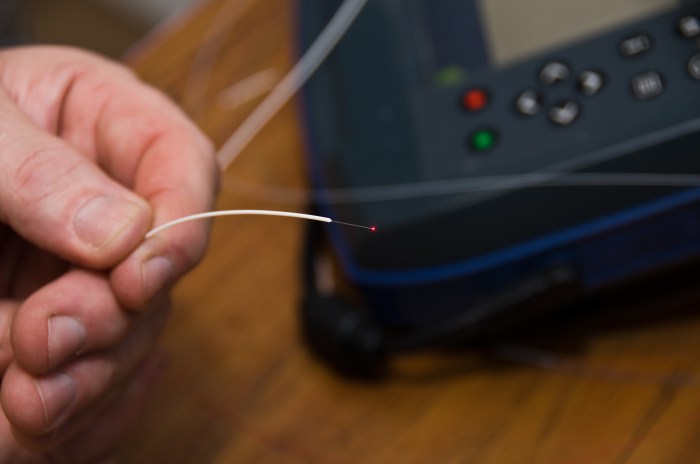
Fiber optic communication relies heavily on a sophisticated network of components working in harmony. These components, from connectors to amplifiers, determine the efficiency, reliability, and overall performance of the system. Understanding their roles and characteristics is crucial for designing and maintaining robust fiber optic networks.Fiber optic components are carefully engineered to transmit light signals over long distances with minimal loss.
Different types of components cater to specific functions, enabling signal transmission, amplification, and routing. This intricate system ensures the seamless flow of information in modern communication networks.
Fiber Optic Connectors
Fiber optic connectors are crucial for connecting fiber optic cables. Their design ensures reliable and low-loss connections. Different types of connectors are employed, each with specific advantages and disadvantages.
- SC (Subscriber Connector): A popular choice due to its compact size and ease of use. It’s commonly used in data centers and local area networks (LANs).
- FC (Ferrule Connector): Known for its robust design and high-performance capabilities, often found in high-bandwidth applications.
- ST (Straight Tip): A simple and cost-effective connector, widely used in older systems.
- LC (Lucent Connector): A smaller connector than SC, increasing the density of connections in fiber optic panels.
- MPO/MTP (Multi-fiber Push-on/Multi-fiber Termination): Used for high-density applications where multiple fibers are bundled together.
Fiber Optic Splices
Splices are permanent connections between fiber optic cables, often required for cable repairs or extending networks. The quality of a splice significantly impacts signal transmission.
- Fusion Splices: Create a permanent bond by fusing the ends of two fibers together. Fusion splicing results in extremely low-loss connections and is considered the industry standard for high-quality connections.
- Mechanical Splices: Use specialized tools to align and hold the fibers together. Mechanical splices are often less expensive than fusion splices but might have higher loss rates.
Optical Amplifiers and Repeaters
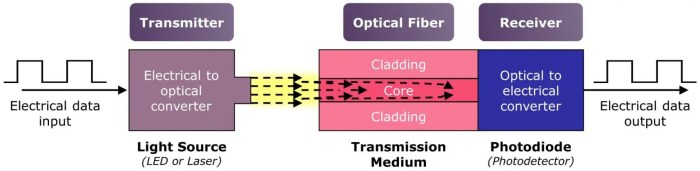
Optical amplifiers and repeaters are critical for boosting signal strength over long distances. Optical amplifiers work at the optical level, while repeaters convert the optical signal to electrical, amplify it, and then convert it back to optical.
Fiber optics, the technology that lets there be light in our communications, is truly amazing. It’s a fundamental part of our digital world, and the recent news of Verizon acquiring NextWave spectrum licenses for a hefty 3 billion dollars verizon to get nextwaves spectrum licenses for 3 billion highlights the ongoing investment in improving connectivity. Ultimately, fiber optics will continue to be crucial for future innovation and advancements in how we interact with the world digitally.
- Optical Amplifiers: Employ various technologies to amplify the optical signal without converting it to electrical form. This minimizes signal degradation and allows for longer transmission distances. Erbium-doped fiber amplifiers (EDFAs) are a common type.
- Optical Repeaters: Convert the optical signal to electrical, amplify the electrical signal, and then convert it back to optical. This is a more traditional approach compared to optical amplifiers, though optical amplifiers are becoming more prevalent.
Optical Transceivers
Optical transceivers are responsible for converting electrical signals into optical signals and vice versa. They are essential for the end-to-end communication process.
- Design and Operation: Optical transceivers are sophisticated devices that incorporate lasers, photodetectors, and electronic circuitry. They precisely convert the digital data into optical signals, transmit them through the fiber, and then convert the received optical signals back into electrical signals. Different transceivers are designed for various data rates and distances.
Optical Filters and Couplers
Optical filters and couplers are vital components in fiber optic systems, enabling selective signal transmission and combining or splitting signals.
- Optical Filters: Selectively transmit light signals of specific wavelengths. This is crucial for applications like wavelength division multiplexing (WDM) where multiple signals can travel over a single fiber simultaneously.
- Optical Couplers: Combine or split optical signals. These are essential in WDM systems, allowing for the routing of signals and the distribution of information across various channels.
Fiber Optic Components Characteristics
| Component | Function | Characteristics |
|---|---|---|
| Fiber Optic Connectors | Connect fiber optic cables | Various types (SC, FC, ST, LC, MPO/MTP), specific advantages and disadvantages. |
| Fiber Optic Splices | Permanent connections between fibers | Fusion splices (low loss) and mechanical splices (often less expensive). |
| Optical Amplifiers | Boost signal strength | Work at the optical level, e.g., EDFA. |
| Optical Repeaters | Boost signal strength | Convert optical to electrical, amplify, then convert back. |
| Optical Transceivers | Convert between electrical and optical signals | Essential for end-to-end communication, varying data rates. |
| Optical Filters | Select specific wavelengths | Enable wavelength division multiplexing (WDM). |
| Optical Couplers | Combine or split signals | Essential for routing and distributing information in WDM systems. |
Fiber Optics and Light
Fiber optics wouldn’t exist without light. The technology hinges on the precise manipulation and transmission of light signals through incredibly thin strands of glass or plastic. This intricate interplay between light and these materials forms the bedrock of modern communication networks and countless other applications. Understanding the specifics of this relationship is crucial to grasping the power and potential of fiber optics.
Light as the Carrier
Light, in its various forms, serves as the primary carrier of data in fiber optic systems. The transmission of information relies on modulating light waves to encode digital data. Different light wavelengths are used for various purposes, each optimized for specific applications and distances. The efficient transmission of information hinges on the ability to manipulate and control light precisely.
Light Sources in Fiber Optics
The choice of light source significantly impacts the performance and cost-effectiveness of a fiber optic system. Various types of light sources are employed, each with its own advantages and disadvantages.
- Light Emitting Diodes (LEDs): LEDs are a common and cost-effective light source, particularly suitable for shorter distances and lower-bandwidth applications. Their relatively low cost and ease of implementation make them ideal for applications like local area networks (LANs).
- Laser Diodes: Laser diodes offer significantly higher bandwidth and power than LEDs, enabling them to transmit data over longer distances. Their coherent light output results in lower signal attenuation and better signal quality, making them essential for long-haul communication systems.
Light Transmission Over Long Distances
The transmission of light signals over significant distances is a complex process, influenced by various factors, including the material properties of the fiber and external environmental conditions. Light signals, representing the digital data, are susceptible to attenuation, or loss of intensity, as they travel along the fiber. Techniques like signal regeneration are implemented to maintain data integrity across extended distances.
Light-Fiber Interactions
The interaction between light and fiber optic materials is governed by fundamental principles of physics, primarily reflection and refraction. Understanding these interactions is crucial for optimizing fiber design and performance.
The interaction of light with the fiber’s core and cladding is based on the phenomenon of total internal reflection. Light entering the core is reflected repeatedly off the boundary between the core and the cladding, guiding it along the length of the fiber. The difference in refractive indices between the core and cladding is crucial for maintaining this guided light path.
Examples of Light Interactions
Consider a light beam entering a fiber optic cable. The refractive index difference between the core and cladding causes the light to be repeatedly reflected off the boundary, traveling along the fiber’s length. This controlled reflection is the key to efficient light transmission over long distances. The efficiency of this transmission depends on the purity and homogeneity of the fiber material, as imperfections can lead to scattering and signal loss.
Final Summary
From its historical roots to its future potential, fiber optics has revolutionized communication and continues to shape the world around us. The intricate interplay of light, materials, and engineering has led to incredible advancements. The future promises even more innovative applications and challenges, continuing to drive progress in numerous sectors. This exploration has highlighted the power and potential of fiber optics to connect us, inform us, and advance our understanding of the world.