
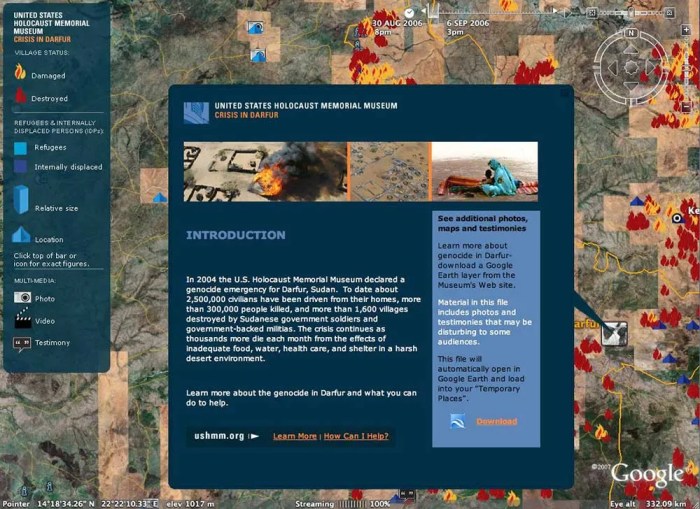
Google Earth Zooms into Darfurs Darkness
Google earth zooms into heart of darfurs darkness – Google Earth zooms into heart of Darfur’s darkness, revealing the harrowing realities of conflict and displacement. This exploration delves into the historical, geographical, and socio-political context of Darfur, examining how satellite imagery from Google Earth provides unique insights into the ongoing humanitarian crisis. The detailed visualizations, coupled with contextual information, paint a powerful picture of the human cost of conflict, and the urgent need for international intervention.
The project meticulously analyzes satellite imagery spanning various periods of conflict in Darfur, offering a visual timeline of the devastation. Comparing images from different years allows for a striking illustration of the impact of violence on the landscape and the displacement of populations. This analysis further explores the accessibility and limitations of Google Earth as a tool for understanding and addressing conflicts in remote regions like Darfur, considering the varying levels of technological access and the challenges of data collection in conflict zones.
Introduction to Darfur
Darfur, a region in western Sudan, has a complex history marked by deep-seated ethnic tensions and protracted conflicts. Its geographical isolation and diverse population have contributed to a unique and often volatile socio-political landscape. Understanding these interwoven factors is crucial to comprehending the ongoing challenges and the need for sustainable solutions.The region’s history is characterized by periods of both relative peace and intense conflict, often exacerbated by competition for resources and power.
These conflicts have had devastating consequences, impacting the lives of millions and creating a humanitarian crisis that continues to this day.
Geographical Context of Darfur
Darfur’s geography plays a significant role in shaping its history and conflicts. Located in the western part of Sudan, it’s a vast region encompassing diverse terrains. From the arid plains and savannahs to the mountains and valleys, the geographical variations contribute to the region’s unique character. The arid and semi-arid nature of the region has created challenges in terms of water availability and resource management, which have often fueled conflicts between different groups.
Google Earth’s latest imagery of Darfur reveals a stark reality, highlighting the ongoing humanitarian crisis. Meanwhile, it’s fascinating to consider how this kind of imagery might be used in conjunction with advancements in communication technologies, like those being developed by industry players poised for a VoIP battle. industry players poised for voip battle This could potentially revolutionize aid distribution and disaster response in such remote and conflict-ridden areas, offering a new perspective on the challenges faced in Darfur.
Historical Overview of Darfur
The historical record of Darfur reveals a complex interplay of events, leading to the conflicts we see today. The region has seen various kingdoms and rulers throughout history. The emergence of the modern conflicts, however, are closely tied to the rise of the Sudanese government in the 20th century. Increased competition for resources and land, coupled with political marginalization of certain groups, contributed to the outbreak of the First Darfur Conflict in 2003.
Socio-Political Landscape of Darfur
Darfur is home to a multitude of ethnic groups, each with its own cultural traditions and historical presence. The primary ethnic groups include the Fur, Zaghawa, and Arab groups, each with distinct social structures and power dynamics. Historical power imbalances and differing access to resources have frequently fueled conflicts between these groups. These power imbalances have been exacerbated by political and economic policies that have historically favored certain groups over others.
Ethnic Groups in Darfur
Darfur’s diverse ethnic makeup has been a significant factor in shaping the region’s history. The Fur, historically dominant, have faced challenges from other groups like the Zaghawa and Arab groups. These ethnic groups often hold distinct views on governance and resource management, leading to tensions and conflicts. The complexity of these groups and their interactions within the region has contributed to the region’s instability.
Imagery and Visualization
Google Earth’s powerful imagery capabilities offer a unique perspective on the Darfur conflict, allowing us to visualize the human cost and geographic context of the crisis. Through satellite imagery, aerial photography, and 3D models, Google Earth provides a window into the region, showing the impact of conflict and displacement on the landscape. This visual record can help in understanding the complex situation and informing humanitarian efforts.The ability to zoom into remote areas and analyze the changes in the terrain over time allows us to gain insights into the impact of the conflict on the environment and the lives of the people affected.
This visualization can contribute significantly to a better understanding of the situation and can be a crucial tool in advocating for peace and supporting the victims.
Comparison of Satellite Imagery Across Conflict Periods
Satellite imagery from Google Earth can provide a powerful visual record of the Darfur conflict. Analyzing images from different periods reveals the changing landscape and the impact of the conflict. A table comparing satellite imagery showing different periods of conflict provides insight into these transformations.
| Date | Location | Visual Impact |
|---|---|---|
| 2003 | West Darfur, particularly areas around the town of El-Geneina | Sparsely populated areas, predominantly agricultural land with limited infrastructure. |
| 2007 | North and South Darfur | Increased presence of displacement camps, evident by concentrations of temporary shelters, with signs of ongoing displacement and destruction of infrastructure. |
| 2010 | All regions of Darfur | Some areas show signs of rebuilding, but widespread damage and displacement are still visible. There are also signs of the presence of armed groups in certain locations. |
| 2016 | Areas around major towns and cities | Signs of further recovery in some areas. The displacement camps are still present but show signs of more permanent structures, with more infrastructure. The presence of armed groups may be less visible, though there are reports of renewed violence in some areas. |
Types of Imagery Available on Google Earth
Google Earth provides a variety of imagery types, each with its own characteristics and uses. Understanding the different types of imagery is crucial to evaluating the data.
| Type of Imagery | Resolution | Date | Source |
|---|---|---|---|
| Satellite Imagery | Variable, ranging from low resolution to high resolution | Dates vary depending on the image; some date back to the early 2000s, while more recent imagery is available | Various satellite providers, such as Landsat, MODIS, and others |
| Aerial Photography | High resolution | Dates vary depending on the source and mission | Various aerial photography sources; often from humanitarian organizations or government agencies. |
| 3D Models | High resolution | Dates vary depending on the source and acquisition method | Created from a combination of imagery and other data sources |
Impact of Google Earth Imagery on the Humanitarian Crisis
Google Earth imagery plays a critical role in showcasing the humanitarian crisis in Darfur. The ability to visualize the impact of the conflict on the landscape, including displacement camps, damaged infrastructure, and changes in population density, can raise awareness and mobilize support for aid efforts. Images of the damage and displacement can be used in advocacy efforts to highlight the urgent need for humanitarian assistance.
Unique Insights from Zooming into Remote Areas
Google Earth’s ability to zoom into remote areas in Darfur provides unique insights into the situation. This capability allows the visualization of the conflict’s impact on areas that might otherwise be inaccessible or unseen. The detail of satellite imagery, aerial photographs, and 3D models allows for a detailed assessment of the situation on the ground, including the location of displacement camps, the extent of damage, and the presence of armed groups.
This can be invaluable in guiding humanitarian aid and in understanding the complexity of the conflict.
Access and Availability
Google Earth, a powerful tool for visualizing geographical data, presents unique opportunities for understanding complex situations, including the ongoing challenges in Darfur. However, its accessibility isn’t uniform across populations, and limitations exist in its effectiveness for conflict zone analysis. This section delves into the factors influencing Google Earth’s availability and usability, especially in the context of Darfur and similar conflict zones.The digital divide significantly impacts the utilization of Google Earth.
Access to computers, internet connectivity, and even basic digital literacy is unevenly distributed globally. This disparity in technological infrastructure presents a barrier to leveraging Google Earth’s potential, particularly in regions like Darfur, where infrastructure development is often lagging. Furthermore, cultural factors can also hinder access, with a lack of familiarity with digital tools affecting the ability to utilize this resource effectively.
Technological Limitations
The availability of high-resolution imagery, crucial for detailed analysis, is not consistent. Imagery resolution can vary significantly, impacting the ability to identify specific features or assess the scale of damage. Furthermore, the frequency of image updates plays a critical role. In dynamic conflict zones like Darfur, timely imagery is essential for monitoring changes in the situation, but data availability may be intermittent or delayed.
Outdated imagery can lead to inaccurate assessments and hinder a comprehensive understanding of the current situation. These factors are often interconnected, creating challenges in leveraging the potential of Google Earth.
Google Earth’s deep dive into the heart of Darfur’s darkness highlights the incredible power of satellite imagery for humanitarian aid. This kind of detailed visual data is revolutionizing how we understand and respond to crises. Think about the possibilities, and how this same technology could reshape entire industries. Perhaps it’s a sign of things to come, a signal that maybe even Microsoft Office needs to take a good hard look at itself, and watch out – here comes Google with its innovative tools and new approaches to data visualization.
watch out ms office here comes google. Ultimately, Google Earth’s work in Darfur serves as a powerful reminder of the crucial role technology plays in exposing and addressing global issues.
Geographical Limitations, Google earth zooms into heart of darfurs darkness
The terrain and weather conditions in Darfur, like many conflict zones, can affect the quality and availability of imagery. Cloud cover and dense vegetation can obscure areas, hindering detailed analysis. Furthermore, access to specific locations within conflict zones might be restricted due to security concerns or ongoing hostilities. These limitations can restrict the comprehensive coverage provided by Google Earth, requiring careful interpretation and consideration of potential biases.
Factors Influencing Information Availability
The availability of information and imagery in conflict zones is profoundly affected by the political and security context. Restrictions on access imposed by warring parties or governing authorities can limit the acquisition and dissemination of crucial data. Furthermore, the presence of armed groups or active conflict can severely impede access to sensitive locations, making accurate and up-to-date information scarce.
Comparative Analysis of Google Earth Usage
While Google Earth offers a valuable resource for analyzing conflict zones, its effectiveness can vary significantly based on specific regional circumstances. For example, in regions with robust infrastructure and less active conflict, Google Earth imagery might be more readily available and detailed. In contrast, conflict zones like Darfur, characterized by ongoing political instability and limited access, might face greater limitations in utilizing Google Earth effectively.
Google Earth’s recent zoom into the heart of Darfur’s darkness highlights the crucial need for humanitarian aid in the region. Meanwhile, Microsoft’s foray into the crowded VoIP market, as seen in microsoft ventures into crowded voip market , suggests a broader tech industry response to global issues. Ultimately, tools like Google Earth can be vital in visualizing these problems and directing aid, especially in remote and conflict-affected areas like Darfur.
Furthermore, the accessibility and usage patterns will differ depending on the type of conflict, the involvement of international actors, and the degree of public access to the data. A comprehensive understanding requires considering these nuanced differences.
Influence of Conflict Dynamics
The ongoing conflict in Darfur significantly impacts the availability of imagery and information. Active hostilities, restricted access, and the presence of armed groups limit the potential for collecting and disseminating accurate information. This, in turn, hinders the ability of humanitarian organizations and researchers to monitor the situation and respond effectively. The comparison with other conflict zones reveals that similar limitations and challenges exist, highlighting the critical need for alternative information sources and data collection methods in conflict-affected areas.
Impact and Consequences
The visualization of the Darfur conflict through Google Earth imagery presents a powerful tool with the potential to significantly impact international awareness and response. This powerful technology, however, also carries potential risks that must be carefully considered. The ability to observe the devastation and suffering in such vivid detail can be both a catalyst for change and a source of emotional distress.
Understanding the potential positive and negative consequences is crucial for responsible use.
Potential Effects on Awareness and Public Opinion
The detailed imagery of the conflict zones in Darfur, made accessible through Google Earth, can dramatically raise global awareness of the humanitarian crisis. This heightened awareness can galvanize public opinion, potentially putting pressure on governments and international organizations to take action. Examples of similar situations show how visual representations of conflict, such as aerial photographs of war-torn cities, have influenced public sentiment and led to increased support for humanitarian aid and diplomatic interventions.
However, prolonged exposure to such images can also lead to desensitization, where the impact of the suffering is diminished over time.
Impact on International Response and Humanitarian Aid
The ability to observe conflict zones from a distance through Google Earth can significantly impact international response. Detailed imagery can help identify critical needs, assess the extent of damage, and pinpoint areas requiring immediate humanitarian aid. This allows for more targeted and effective allocation of resources. For instance, satellite imagery has been instrumental in identifying refugee camps and assessing the distribution of resources in other conflicts, enabling aid organizations to more accurately prioritize their efforts.
Potential Impacts on Local Communities
Exposure of conflict zones to the global public through Google Earth can have complex and potentially diverse effects on local communities. While increased awareness can bring much-needed international attention and support, it can also raise concerns about the privacy and security of local residents. The constant observation of their homes and communities might cause stress and anxiety, or conversely, the community might embrace the opportunity for external aid.
Furthermore, there is a risk that the portrayal of the conflict might reinforce negative stereotypes or fuel further conflict.
Table: Potential Consequences of Using Google Earth Imagery in Darfur
| Impact Type | Description | Potential Mitigation Strategies |
|---|---|---|
| Increased Awareness | Detailed imagery can raise global awareness of the conflict and suffering in Darfur, potentially leading to increased pressure on governments and international organizations to act. | Promote balanced and nuanced portrayals of the conflict, avoiding sensationalism. Emphasize the human stories behind the images. |
| Improved Humanitarian Response | Satellite imagery can assist in identifying critical needs, assessing damage, and pinpointing areas requiring immediate humanitarian aid, leading to a more effective allocation of resources. | Establish clear communication channels with local communities to ensure aid is delivered effectively and respectfully. Engage local experts in the assessment and planning processes. |
| Potential for Desensitization | Prolonged exposure to the images of conflict can potentially lead to a diminished emotional response, reducing the urgency for action. | Limit the duration and frequency of exposure to the images, while maintaining a consistent message about the ongoing suffering. Pair the imagery with personal stories and accounts of the crisis. |
| Impact on Local Communities | Exposure of conflict zones to the global public may affect the privacy and security of local residents. Images may reinforce negative stereotypes or fuel further conflict. | Ensure transparency and respect for local communities in the use and sharing of the imagery. Partner with local organizations to ensure that the imagery is used responsibly and ethically. |
| Potential for Misinterpretation | The imagery might be misinterpreted or used out of context, leading to misinformed judgments or policies. | Provide clear context and background information about the conflict. Develop educational materials to accompany the imagery, explaining the historical and political factors contributing to the crisis. |
Contextual Information
Understanding the Darfur conflict requires more than just looking at satellite imagery. Visual representations, like those from Google Earth, are powerful tools, but their interpretation is deeply intertwined with the historical, cultural, and political context of the region. Without this contextual understanding, images can be easily misinterpreted, potentially leading to a skewed perspective on the conflict’s complexities. The crucial element is to provide sufficient supplementary information alongside the visual data.The visual record, while offering a stark and often heartbreaking portrayal of the conflict, needs to be understood in the context of the social, political, and economic forces that shaped the events.
These factors deeply influence how people perceive and respond to the imagery. Providing context is essential to avoid misinterpretations and promote a nuanced understanding of the Darfur crisis.
Cultural Factors
Darfur’s diverse ethnic and cultural landscape is a key element of its history and conflict. Understanding the complex relationships between different groups, their traditions, and their historical grievances is crucial for interpreting the imagery. The images might reveal displacement patterns that reflect these cultural and historical tensions, but without knowledge of these underlying dynamics, the viewer might not grasp the depth of the conflict.
For instance, a particular settlement’s destruction could appear random, but understanding its cultural significance to a specific ethnic group would alter the viewer’s perception.
Historical Factors
The historical context of land disputes, resource scarcity, and power struggles in Darfur is essential for interpreting the visual record. Past grievances and historical patterns of exploitation often shape the present conflict. For example, imagery showing the gradual displacement of villages might be seen as a result of conflict, but the historical context of land grabs and resource control could provide a more complete picture.
Political Factors
The political dynamics, including the role of government policies, armed groups, and international involvement, significantly influence the conflict and its visual representation. Images showing the deployment of military forces, the construction of checkpoints, or the presence of specific groups can be better understood within the political context. For example, the presence of a specific armed group in a certain area can be viewed differently if understood in the context of the group’s political agenda or their relationship with the government.
Supplementary Information for Interpretation
To prevent misinterpretations and enhance the understanding of the Darfur conflict, additional information is essential. Supplementary data provides context that visual representations alone cannot convey.
| Source Type | Description | Relevance to the Darfur Conflict |
|---|---|---|
| Historical Records | Documentation of past events, land ownership disputes, and cultural practices. | Provides context for current conflicts, understanding underlying tensions, and past grievances. |
| Political Reports | Official and independent reports on government policies, armed groups, and international interventions. | Provides insights into the political actors, their actions, and the influence of political decisions on the conflict. |
| Socioeconomic Data | Data on population demographics, resource distribution, and economic conditions. | Helps understand the factors contributing to the conflict, such as resource scarcity or economic disparities. |
| Academic Studies | Research papers, articles, and books on Darfur. | Provides deeper insights into the historical, cultural, and political factors driving the conflict. |
| Oral Histories | Personal accounts from people affected by the conflict. | Offers unique perspectives on the lived experiences, emotional impacts, and the human cost of the conflict. |
| Satellite Imagery Metadata | Details about the imagery acquisition, resolution, and any known limitations. | Crucial for evaluating the accuracy and reliability of the visual data. |
Visual Storytelling: Google Earth Zooms Into Heart Of Darfurs Darkness
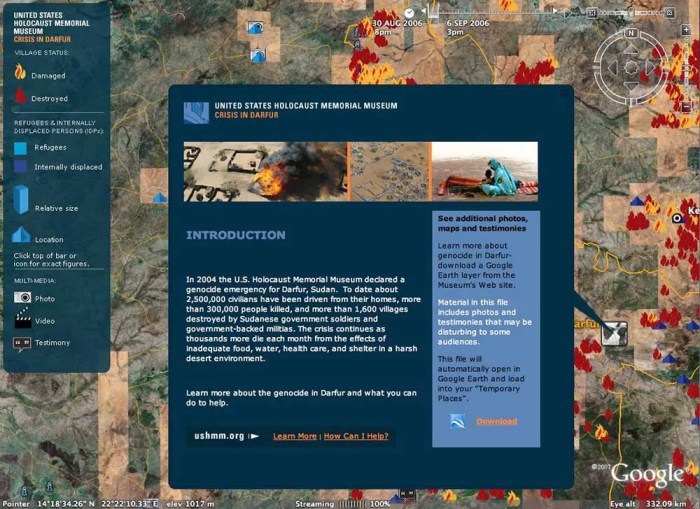
Darfur’s enduring conflict demands a powerful narrative, one that transcends mere statistics and reports. Visual storytelling, utilizing Google Earth’s capabilities, can bring the human cost and environmental impact into sharp focus, creating a visceral understanding for audiences worldwide. This approach goes beyond simply displaying maps; it aims to evoke emotion, inspire empathy, and ultimately, drive action.Effectively conveying the complex narratives surrounding the conflict requires a nuanced understanding of the crisis’s multifaceted dimensions.
This includes not only the direct effects of violence but also the insidious impact on the environment, the displacement of populations, and the breakdown of societal structures. Google Earth’s high-resolution imagery, coupled with carefully crafted narratives, provides a powerful medium to illustrate these complex realities.
Narrative Structure for a Visual Story
The structure of a visual narrative about the Darfur conflict should follow a clear arc. Begin with establishing the context, showcasing the pre-conflict landscape and highlighting the social and economic fabric of the region. This initial visualization will lay the foundation for understanding the subsequent disruption. The narrative should then chronologically trace the conflict, using Google Earth’s time-lapse capabilities to depict the gradual destruction of communities and the transformation of the environment.
Visual markers like overlayed data on population displacement and environmental damage can further amplify the story. Finally, the narrative should explore the consequences of the conflict and present potential pathways towards peace and reconciliation, ideally offering hope and resilience.
Visual Techniques for Impactful Storytelling
Visual techniques play a crucial role in crafting a compelling narrative. Employing a range of visual elements, such as interactive timelines, overlaid data layers, and dynamic animations, can transform static imagery into a dynamic story. Interactive maps, for instance, allow users to explore specific locations, triggering associated narratives and historical information. Furthermore, overlaying demographic data, conflict zones, and environmental changes onto Google Earth’s base imagery provides a comprehensive visual representation of the crisis’s impact.
A well-designed legend with clear explanations will assist viewers in interpreting the overlays. Using consistent color schemes and symbolic representations throughout the narrative aids comprehension and keeps the viewer engaged.
Impact of Conflict on Environment and Displacement
Google Earth’s capabilities can vividly illustrate the environmental impact of the conflict. The imagery can show the deforestation and land degradation in affected areas, juxtaposing pre-conflict and post-conflict images. By layering population density maps onto the satellite imagery, one can visualize the impact of displacement on settlements and the resulting urbanization patterns. Furthermore, the movement of refugees can be tracked over time, highlighting the sheer scale of human displacement and the arduous journeys undertaken.
Storytelling Techniques for Effective Visualization
Effective visual storytelling strategies include:
- Employing a clear narrative arc: This involves a beginning, middle, and end that traces the conflict’s progression, culminating in a clear message about the consequences and potential solutions.
- Utilizing interactive elements: Interactive maps and timelines offer a dynamic way for viewers to engage with the narrative, encouraging exploration and deeper understanding.
- Integrating diverse data sources: Layering data from various sources, such as demographic information, environmental indicators, and conflict reports, onto the Google Earth imagery provides a richer understanding of the conflict’s impact.
- Employing thematic maps: Thematic maps can highlight specific aspects of the conflict, such as the spread of diseases, the destruction of infrastructure, or the displacement of populations. This method allows viewers to understand the broader implications.
- Using compelling imagery: High-resolution satellite imagery, combined with carefully chosen annotations and overlays, can create a powerful and impactful visual narrative.
Final Summary
Ultimately, this investigation into Google Earth’s portrayal of the Darfur crisis highlights the powerful potential of visual storytelling in raising awareness and fostering international response. The project emphasizes the importance of context in interpreting imagery and the necessity of providing supplementary information to avoid misinterpretations. By showcasing the human cost of conflict, this project aims to inspire a deeper understanding of the Darfur crisis and encourage meaningful engagement with humanitarian efforts.