New Network Standard Fiber Ethernet Convergence
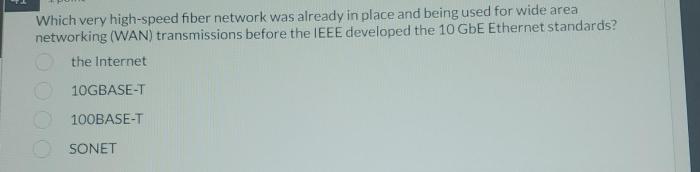
New network standard could converge fiber ethernet promises a revolution in data transmission, potentially merging the speed and capacity of fiber optic technology with the existing Ethernet framework. This convergence could dramatically reshape how we manage and transmit data, offering significant improvements in speed, cost-effectiveness, and scalability. Existing standards, like 10 Gigabit Ethernet, 40 Gigabit Ethernet, and 100 Gigabit Ethernet, are facing limitations, driving the need for a new, more robust standard.
The proposed standard could enhance network performance across various applications, from high-speed video streaming to cloud computing and data centers. It will likely involve significant architectural changes, potentially including advancements in modulation techniques and optical components. This new standard will also have a substantial impact on existing network infrastructure, necessitating upgrades and potentially the adoption of new hardware and software.
Overview of Fiber Ethernet
Fiber optic Ethernet has revolutionized network communication, offering unparalleled speed and capacity. From connecting data centers to powering global networks, fiber’s ability to transmit vast amounts of data over long distances has become indispensable. However, even with the current standards, limitations in speed, cost, and scalability persist, driving the need for new advancements.
Current Fiber Ethernet Standards
Fiber optic Ethernet standards have evolved significantly over the years, each iteration pushing the boundaries of speed and bandwidth. Early standards like 10 Gigabit Ethernet paved the way for faster data transfer rates, followed by 40 Gigabit Ethernet and 100 Gigabit Ethernet, each representing substantial improvements in throughput. These advancements have dramatically improved the efficiency of network operations.
Limitations of Existing Standards
Despite their impressive performance, current fiber optic Ethernet standards face limitations. Speed, while significantly improved, may not keep pace with the ever-increasing demands of data-intensive applications. The cost of implementing these higher-speed solutions can be prohibitive for smaller organizations or those with limited budgets. Moreover, scalability remains a challenge, as expanding existing infrastructure to accommodate future growth can be complex and expensive.
These factors highlight the necessity of a new network standard.
Comparison of Fiber Ethernet Standards
| Standard | Speed | Cost | Scalability |
|---|---|---|---|
| 10 Gigabit Ethernet | 10 Gigabit per second | Relatively low compared to higher speeds | Good scalability for smaller networks, but limitations for larger ones |
| 40 Gigabit Ethernet | 40 Gigabit per second | Higher than 10 Gigabit, but lower than 100 Gigabit | Improved scalability over 10 Gigabit, but still has limitations |
| 100 Gigabit Ethernet | 100 Gigabit per second | Significantly higher than previous standards | Good scalability, but high cost of implementation can limit its widespread adoption |
The table above provides a concise comparison of key features, illustrating the increasing speed and cost associated with each standard. Scalability improvements are also evident, although significant challenges persist. The evolution reflects the ongoing quest for faster, more affordable, and easily scalable network solutions.
A new network standard potentially converging fiber ethernet could revolutionize data transfer, but the increasing use of mobile devices by employees presents a significant security challenge for companies. Mobile devices create security challenge for companies are a double-edged sword, offering flexibility but also introducing vulnerabilities. Despite these challenges, this new standard could ultimately offer a more secure and efficient network infrastructure.
Potential Benefits of Convergence
Fiber optic technology, coupled with evolving network standards, presents a compelling opportunity for enhanced network performance and efficiency. The convergence of these technologies promises a significant leap forward, offering substantial advantages across various applications, from streaming video to data center operations. This convergence is poised to redefine the digital landscape, offering not only improved speeds but also substantial cost savings.
Enhanced Network Performance and Efficiency
The integration of fiber optic technology with advanced network protocols leads to optimized data transmission and reduced latency. This translates to improved network responsiveness and reduced delays in applications requiring real-time data exchange. The inherent speed and capacity of fiber optics allow for significantly higher data transfer rates, minimizing bottlenecks and ensuring seamless operations.
Cost Savings
Convergence can lead to substantial cost savings in the long run. The reduced need for extensive copper cabling infrastructure translates to lower installation and maintenance costs. Fiber optic cables, while initially more expensive, often prove to be more cost-effective over time due to their higher capacity and longer lifespan. Furthermore, the increased efficiency of converged networks minimizes the need for expensive upgrades and expansions in the future.
Increased Bandwidth and Data Transfer Rates
The adoption of fiber optic technology in network infrastructure enables significantly higher bandwidth and data transfer rates compared to traditional copper-based networks. This increased capacity is crucial for handling the growing demands of modern applications. For instance, video streaming services benefit from reduced buffering and improved quality, while cloud computing platforms experience faster data access and processing.
Impact on Network Applications
The potential impact of convergence on various network applications is substantial. The table below illustrates the expected improvement in performance.
| Application | Current Performance | Convergence Performance | Improvement |
|---|---|---|---|
| Video Streaming | Potentially choppy video with buffering delays | High-quality, low-latency video streaming | Significant improvement in quality and viewing experience |
| Cloud Computing | Slow data access and processing, potentially impacting application responsiveness | Faster data access and processing, improving application responsiveness | Faster application execution and user experience |
| Data Centers | Limited scalability and potential bottlenecks in handling large data volumes | Enhanced scalability and high-capacity data handling | Increased efficiency and ability to manage large-scale data processing |
| Gaming | Lag and delays in online gaming | Low latency, high-speed connection, ensuring smooth gameplay | Improved gameplay experience |
Technical Aspects of the New Standard
The convergence of fiber and Ethernet promises a significant leap forward in network performance. This necessitates a re-evaluation of existing architectures, modulation techniques, and optical components to unlock the full potential of this integration. The challenge lies in designing a standard that is both backward compatible with current systems and future-proof for the rapidly evolving needs of data transmission.
Potential Architectural Changes
The architecture of future networks will likely involve a more distributed and dynamic approach compared to today’s centralized hubs. This will allow for greater scalability and adaptability to changing traffic patterns. Increased use of software-defined networking (SDN) principles is expected to allow for more agile and efficient network management. This will involve changes in the routing protocols and switching mechanisms to optimize data flow in a distributed environment.
Furthermore, the introduction of network function virtualization (NFV) could allow for the dynamic allocation of network resources, potentially leading to significant improvements in resource utilization.
Advancements in Modulation Techniques and Signal Processing
New modulation schemes are crucial for maximizing bandwidth utilization. Techniques like coherent optical modulation, capable of higher-order modulation formats, are likely to be incorporated. Advanced signal processing algorithms will be essential for mitigating impairments like chromatic dispersion and polarization mode dispersion, enabling longer transmission distances and higher data rates. For example, the adoption of advanced equalization techniques could significantly reduce signal distortion and improve overall system performance.
Improvements in Optical Components and Fiber Cable Design
Significant advancements in optical components, such as erbium-doped fiber amplifiers (EDFAs) and optical switches, will be needed to support the increased data rates. Improved fiber cable designs, with enhanced characteristics like lower loss and increased bandwidth, are also essential for extending the transmission distance and capacity. For instance, the development of new fiber materials with lower attenuation and reduced dispersion will enable longer-reach transmission, reducing the need for repeaters.
Potential Modulation Schemes
| Modulation Scheme | Bandwidth (Gbps) | Error Rate | Complexity |
|---|---|---|---|
| Dual Polarization Quadrature Amplitude Modulation (DP-QAM) | 100-400+ | Low (e.g., 10-12) | Medium |
| Pulse Amplitude Modulation (PAM) | 500+ | Low (e.g., 10-9) | High |
| Coherent Optical OFDM | 1000+ | Low (e.g., 10-15) | High |
| Hybrid Modulation | Variable | Low | Medium-High |
The table above presents potential modulation schemes, showcasing a spectrum of bandwidths, error rates, and complexity levels. These are not exhaustive, but rather representative examples of the advancements that could be realized in the future. Each scheme has its tradeoffs, with higher bandwidth and lower error rates often correlating with increased complexity.
Impact on Network Infrastructure: New Network Standard Could Converge Fiber Ethernet
The convergence of fiber and Ethernet promises a significant overhaul of existing network infrastructure. This new standard, with its enhanced speed and capabilities, necessitates a careful consideration of how existing systems will adapt. This section delves into the implications for upgrades, replacements, and the potential for innovative hardware and software development.
Impact on Existing Equipment
Existing network infrastructure, primarily reliant on copper cabling and older Ethernet standards, will face a transition period. The high bandwidth and low latency offered by fiber optics will necessitate upgrades to network switches, routers, and other critical components. Direct replacement of legacy equipment may not always be economically viable for smaller organizations, leading to a hybrid approach involving the integration of new fiber components with existing copper infrastructure.
This approach will often involve careful planning to ensure compatibility and seamless data transfer.
Potential for Upgrades and Replacements
The shift to fiber-based Ethernet offers opportunities for both upgrades and replacements of existing equipment. Upgrades can involve replacing network interface cards (NICs) and upgrading switches to support the new standard. Replacements may be required for legacy routers or core network devices that are unable to support the high-bandwidth demands of fiber-based Ethernet. Organizations with extensive copper-based infrastructure may find that complete replacement is the most efficient approach in the long term.
This will be driven by factors such as the age of the existing equipment, its capabilities, and the organization’s financial resources.
Potential for New Hardware and Software Developments
The introduction of fiber-based Ethernet will stimulate innovation in hardware and software. New network interface cards (NICs) optimized for fiber connections will be developed, alongside specialized network management software for efficient monitoring and maintenance of the high-bandwidth fiber networks. Increased data transfer rates will drive the development of new network protocols and algorithms that maximize efficiency and minimize latency.
Examples of such developments include sophisticated traffic management systems and more robust network security protocols.
Migration Flowchart
The process of migrating from existing standards to the new fiber-based Ethernet standard is a complex undertaking. It requires a phased approach to minimize disruption and maximize efficiency.
(Note: A flowchart would illustrate the process, including stages like assessment, planning, equipment procurement, installation, testing, and cutover. Each step would have clear milestones and dependencies.)The flowchart would demonstrate that the migration process requires careful planning and execution to ensure a smooth transition, minimizing downtime and maximizing the benefits of the new standard.
Security Considerations
The convergence of fiber and Ethernet opens exciting possibilities for high-speed networks, but it also introduces new security challenges. Protecting sensitive data transmitted across these high-bandwidth channels is paramount. The increased speed and capacity bring both advantages and vulnerabilities, demanding a proactive approach to security protocol development and implementation.The inherent complexity of the new fiber Ethernet standard, with its multiple layers and diverse components, presents a larger attack surface.
This necessitates robust security measures to counter potential threats, ranging from unauthorized access to malicious data injection. Comprehensive security protocols must be integrated into every stage of the network architecture, from the physical fiber to the data processing layer.
Security Challenges Associated with the New Standard
The convergence of fiber and Ethernet introduces several unique security challenges. Increased bandwidth, while offering significant benefits, also increases the potential for data breaches. The expanded attack surface includes the fiber optic cables themselves, potentially vulnerable to physical tampering or eavesdropping, as well as the network devices and protocols involved in data transmission. Furthermore, the potential for sophisticated cyberattacks targeting vulnerabilities in the new standard needs careful consideration.
Potential Vulnerabilities and Risks
Several potential vulnerabilities are inherent in the new standard. These include, but are not limited to, unauthorized access to network resources, data interception during transmission, and potential exploits of newly introduced protocols. Tampering with the fiber optic cables themselves could compromise the integrity of data transmission. Also, weak authentication and authorization mechanisms could lead to unauthorized access to sensitive information.
Moreover, the sheer volume of data transmitted necessitates robust encryption and secure key management to prevent unauthorized access and data breaches.
Measures to Enhance Security Protocols
Robust security protocols are essential to mitigate potential risks. Implementing strong encryption algorithms, such as AES-256, across all layers of the network is crucial. Implementing multi-factor authentication can significantly enhance security by adding layers of protection beyond simple usernames and passwords. Regular security audits and penetration testing can identify and address potential vulnerabilities proactively. Furthermore, stringent access controls and secure configuration management can prevent unauthorized access to network resources.
Finally, educating users about security best practices and training them on identifying and reporting potential threats is paramount.
Potential Encryption Techniques for the New Standard
Several encryption techniques can be implemented to protect data transmitted across the fiber Ethernet network. Advanced Encryption Standard (AES) is a widely used symmetric encryption algorithm. Public-key cryptography, like RSA, can be employed for secure key exchange. Hashing algorithms, such as SHA-256, can verify data integrity and detect tampering. Furthermore, secure tunneling protocols, such as IPsec, can encapsulate data packets for secure transmission over the network.
These techniques should be carefully selected and implemented to ensure compatibility with the new standard and to address potential performance impacts.
A new network standard might finally converge fiber Ethernet, offering blazing-fast speeds. However, wireless LANs continue to gain popularity despite security risks, as detailed in this insightful article on wireless lans gain popularity despite risks. This rising demand for wireless solutions could potentially slow down the adoption of the new fiber standard, creating an interesting dynamic in the tech world.
Ultimately, the future of networking likely depends on a balance between wired and wireless options.
Summary of Security Protocols for the New Standard
| Protocol | Description | Strength | Weakness |
|---|---|---|---|
| AES-256 | Advanced Encryption Standard, a symmetric encryption algorithm | High security, widely used, well-studied | Potential performance impact for very high bandwidth |
| RSA | Rivest–Shamir–Adleman, a public-key cryptography algorithm | Secure key exchange | Computational overhead, key management complexity |
| SHA-256 | Secure Hash Algorithm, a hashing algorithm | High collision resistance | Vulnerable to collision attacks under specific conditions |
| IPsec | Internet Protocol Security, a secure tunneling protocol | Secure data encapsulation | Potential performance overhead, configuration complexity |
Real-World Applications
The convergence of fiber and Ethernet, enabled by this new standard, promises a revolutionary shift in network infrastructure. This enhanced connectivity has the potential to dramatically improve data transfer speeds and reliability across various sectors, from high-performance computing to everyday internet usage. The benefits are multifaceted, impacting not just data centers but also industries reliant on fast, secure data transmission.
Data Centers and Cloud Computing
This new standard significantly enhances the capacity and efficiency of data centers and cloud computing environments. Improved bandwidth allows for faster processing of massive datasets, crucial for big data analytics, AI training, and cloud storage. This translates to reduced latency, enabling faster response times for applications and services. The result is improved user experience and higher operational efficiency.
A new network standard could potentially converge fiber and Ethernet, offering exciting possibilities for faster data transmission. However, the recent news of a blogger receiving a four-year jail term for insulting Islam ( blogger gets four year jail term for insulting islam ) highlights the complex interplay between technological advancements and societal values. This highlights the need for responsible innovation in technology, while also considering the broader implications for freedom of expression.
Hopefully, this convergence of fiber and Ethernet will result in more accessible and reliable networks for everyone.
High-Performance Computing
High-performance computing (HPC) relies heavily on rapid and reliable data transmission. The new standard’s enhanced throughput and reduced latency will enable faster simulations, more complex modeling, and accelerated scientific discoveries. This is particularly important for fields like climate modeling, drug discovery, and materials science, where massive datasets and complex computations are commonplace.
Potential Applications and Benefits
- Enhanced AI Training: Faster data transfer speeds allow for more complex AI models to be trained and deployed in real-time. This leads to more accurate and efficient AI systems, with wider application in various fields, from self-driving cars to medical diagnostics.
- Improved Cloud Storage and Services: Higher bandwidth enables faster data transfer for cloud storage, making it easier to access and share large files. This improvement leads to faster cloud-based services and more responsive applications.
- High-Resolution Video Conferencing: Lower latency allows for seamless high-resolution video conferencing, crucial for remote collaboration and communication in various industries. This allows individuals to feel more present during meetings and allows for more productive collaborations.
- Advanced Financial Trading Systems: Real-time data transfer is critical for financial markets. The new standard can support more sophisticated and complex trading systems, leading to more responsive and precise market analysis.
Impact on Various Industries
The implications of this new standard extend beyond the technical realm. Industries ranging from healthcare to finance will experience significant improvements in efficiency and productivity. Faster data transfer rates allow for more complex medical imaging, advanced financial modeling, and streamlined supply chain management.
Connectivity Improvements for Specific Use Cases
- Remote Sensing and Data Collection: In industries like agriculture and environmental monitoring, the new standard will facilitate faster data transmission from remote sensors. This enables real-time analysis and more informed decision-making. This is especially useful in monitoring and managing large agricultural areas and remote areas.
- Industrial Automation: Real-time data transfer is critical for maintaining and controlling industrial processes. This new standard will enable more efficient and reliable control systems, leading to higher output and reduced downtime.
Urban and Rural Connectivity
The new standard can potentially address the digital divide by enabling improved connectivity in both urban and rural areas. Increased bandwidth in urban areas can support higher-density data usage and more sophisticated applications. In rural areas, the standard can provide more reliable and affordable internet access, bridging the gap and fostering economic development. Increased access to technology can also foster education and innovation in previously underserved areas.
Evolution of the Standard
The new fiber Ethernet standard, promising a revolutionary leap in network speeds and capabilities, will need to adapt to the ever-changing technological landscape. This necessitates a clear plan for future evolution, ensuring the standard remains relevant and impactful for years to come. Anticipating future needs and technological advancements is crucial for long-term success.The standard’s ability to adapt to future needs and technological advancements will define its long-term viability.
This adaptability will involve incremental upgrades, maintaining backward compatibility, and incorporating new technologies as they emerge. Successful standards, like those in the past, have demonstrated the importance of evolution to remain relevant and valuable.
Potential Upgrades and Expansions
The initial release of the standard will establish a solid foundation. Future upgrades will likely focus on increasing data transfer rates, enhancing security protocols, and supporting new applications and devices. The potential for expanding the standard to encompass emerging technologies, such as quantum computing or advanced sensor networks, is also noteworthy.
Timeline of Potential Evolution
This table illustrates a potential evolution of the standard over five years, highlighting key features and enhancements. It’s crucial to understand that this is a projected timeline; actual implementation may vary.
| Year | Feature | Enhancement |
|---|---|---|
| Year 1 | Initial Release | Basic implementation of the standard, supporting 800 Gigabit Ethernet connections. |
| Year 2 | Enhanced Security | Integration of advanced encryption protocols and enhanced authentication mechanisms for increased network security. |
| Year 3 | Increased Bandwidth | Support for 1.6 Terabit Ethernet connections, expanding the standard’s capacity for higher bandwidth applications. Examples include high-definition video streaming and cloud computing services. |
| Year 4 | Support for New Applications | Enabling compatibility with emerging technologies, such as IoT (Internet of Things) devices and advanced sensor networks. |
| Year 5 | Quantum Computing Integration | Exploring the possibility of incorporating quantum computing capabilities to potentially revolutionize data processing speed and security. |
Backward Compatibility and Interoperability, New network standard could converge fiber ethernet
Maintaining backward compatibility with existing infrastructure is essential for smooth transitions. This ensures that the new standard can integrate seamlessly with older systems, minimizing disruption and maximizing return on investment. Protocols and hardware must remain compatible to avoid major infrastructure reconfigurations. A gradual transition, carefully planned, will be crucial for avoiding disruption and cost overruns.
Potential Challenges
The convergence of fiber and Ethernet promises a revolution in networking, but its implementation faces numerous hurdles. These challenges span technical complexities, economic realities, societal impacts, and even regulatory roadblocks. Navigating these obstacles is crucial for realizing the full potential of this innovative technology.The new standard, while offering significant advancements, necessitates careful consideration of potential pitfalls to ensure a smooth transition and widespread adoption.
These challenges are not insurmountable, but understanding them is essential for proactive mitigation and successful deployment.
Technical Difficulties
The transition to a converged fiber-Ethernet standard involves intricate technical challenges. Implementing the new protocol across existing network infrastructures requires careful planning and significant investment in upgrades. The need for interoperability with legacy systems adds further complexity. Moreover, ensuring high-speed data transmission over long distances and managing potential signal degradation presents a considerable technical hurdle.
- Interoperability Issues: Compatibility between the new standard and existing network equipment and protocols is paramount. Failure to achieve seamless interoperability could lead to significant compatibility problems and create fragmented networks. This issue will likely require significant investment in testing and validation.
- Signal Degradation: Maintaining signal integrity over long distances is crucial for reliable high-speed data transmission. Fiber optic cables, while generally robust, can experience signal attenuation over substantial lengths. Implementing robust signal amplification and regeneration mechanisms will be essential.
- Scalability Challenges: The new standard must be scalable to meet the ever-increasing demands of future data traffic. Ensuring that the network can adapt to growing bandwidth requirements and support evolving applications will be a significant technical challenge.
Economic Challenges
The economic impact of implementing the new standard is significant. Upgrading existing infrastructure, acquiring new equipment, and training personnel will involve substantial capital expenditures. The return on investment (ROI) for such upgrades must be carefully assessed to ensure the economic viability of the transition.
- High Initial Investment: Implementing the new standard often necessitates a substantial upfront investment. Organizations may need to invest in new hardware, software, and training to support the transition. The cost of these initial investments may be prohibitive for smaller businesses or organizations with limited resources.
- Maintenance and Support Costs: Maintaining and supporting the new network infrastructure will involve ongoing costs for equipment maintenance, upgrades, and personnel training. The long-term economic implications of these costs must be carefully considered.
- Return on Investment (ROI): Assessing the ROI for implementing the new standard is crucial. Factors like increased efficiency, improved service quality, and the potential for new revenue streams must be considered.
Social Impact
The new standard’s influence extends beyond the technical and economic spheres. It has the potential to transform how individuals and organizations interact with technology. The implications for access, equity, and the future of work must be thoughtfully addressed.
- Digital Divide: The implementation of the new standard could exacerbate the digital divide if access to the new technology is not equitably distributed. Strategies to bridge this divide and ensure widespread adoption are crucial.
- Job Displacement: The transition to the new standard could lead to job displacement in certain sectors, particularly those dealing with outdated technologies. Reskilling and upskilling initiatives will be essential to mitigate potential job losses.
- Data Privacy Concerns: Increased data transmission capacity necessitates a stronger focus on data privacy and security. Robust security measures and clear regulations are needed to protect sensitive information.
Regulatory Hurdles
The implementation of the new standard may encounter regulatory obstacles. Governments may need to establish new guidelines and standards to ensure the safety, security, and stability of the network. This includes addressing concerns about spectrum allocation, data privacy, and network neutrality.
- Spectrum Allocation: The need for spectrum allocation and licensing for the new standard may lead to regulatory hurdles. The availability of appropriate spectrum and the process for allocation will be critical.
- Data Privacy Regulations: Stringent data privacy regulations may affect the implementation of the new standard, requiring compliance with existing and future regulations.
- Network Neutrality: Ensuring network neutrality will be crucial for the new standard. This involves preventing discriminatory practices and guaranteeing equal access for all users.
Final Summary
In conclusion, the potential convergence of fiber optic technology with a new network standard presents a compelling opportunity to dramatically improve data transmission. While challenges remain, including potential security vulnerabilities and economic hurdles, the potential benefits in speed, efficiency, and scalability are significant. This new standard could reshape entire industries, and its evolution over time will be crucial to its long-term success.