As autonomous command-line interface (CLI) coding tools such as Claude Code, OpenAI Codex, and Cursor transition from experimental novelties to core components of the daily software engineering workflow, developers are increasingly confronting the structural limitations of single-turn prompting. Historically, when an AI model is instructed to alter a codebase without an overarching operational framework, it tends to execute modifications immediately. This reactive behavior frequently bypasses critical software development lifecycle (SDLC) stages, including architectural planning, comprehensive test coverage formulation, rigorous code reviews, and validation against established repository conventions.
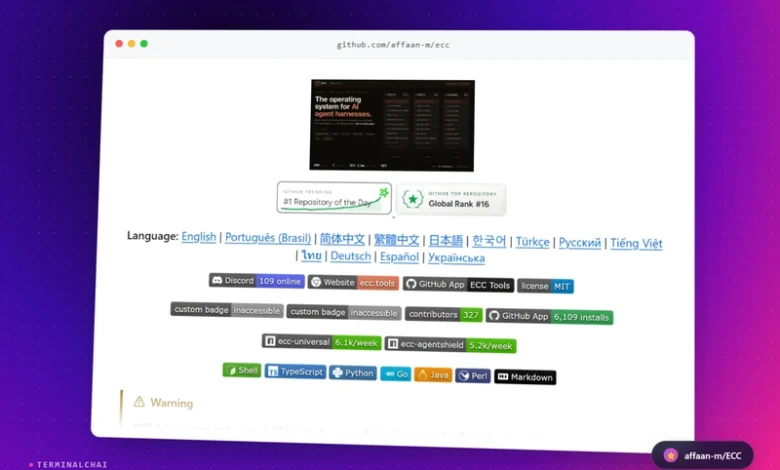
To bridge this operational gap, open-source developer affaan-m has introduced ECC (Everything Claude Code), an advanced performance harness and operating system explicitly designed for AI coding agents. ECC provides a coordinated engineering structure that enforces disciplined development lifecycles, manages cross-session contextual memory, and secures complex toolchain interactions, fundamentally shifting terminal-based AI assistants from isolated text generators into methodical development partners.
The Evolution of Terminal AI Assistants and the Single-Turn Bottleneck
The rapid adoption of AI coding assistants has fundamentally transformed how developers write, debug, and refactor software. Early iterations of these tools functioned primarily as sophisticated autocomplete engines or chat interfaces operating within isolated browser windows or integrated development environment (IDE) sidebars. However, the recent emergence of terminal-native agents—such as Anthropic’s Claude Code—has granted AI systems direct access to local file systems, shell commands, and package management toolchains.
While this deep integration significantly enhances the agent’s capability to execute complex, multi-file refactorings and run diagnostic test suites, it also exacerbates the risks associated with unstructured generation. Without a deterministic framework governing their actions, autonomous agents can inadvertently introduce security vulnerabilities, overwrite vital configuration files, or generate code that violates a project’s architectural paradigms.
Industry analysts note that as software engineering teams delegate higher levels of autonomy to AI agents, the industry requires standardized operating environments. ECC addresses this exact vulnerability by serving as an intelligence coordination layer that intercepts, structures, and validates agent operations before they are committed to a production codebase.
Core Architecture and the Disciplined SDLC Workflow
At its operational core, ECC functions as a deterministic orchestration layer running directly inside the developer’s terminal environment. Rather than allowing an agent to haphazardly modify source code upon receiving a user prompt, ECC enforces a strict, repeatable engineering sequence: plan, test, implement, review, verify, remember, and improve.

This lifecycle is systematically embedded into the agent’s runtime hooks and prompt profiles. When a developer submits a complex task, ECC mandates that the AI assistant first formulate a comprehensive architectural blueprint. This plan must account for existing dependencies, potential edge cases, and test requirements. Only after the execution plan undergoes internal validation does the agent proceed to implementation, followed by mandatory test execution and code review phases.
By automating this rigorous sequence, ECC minimizes the necessity for manual human intervention while drastically reducing the probability of regressions, syntax errors, and architectural drift.
Comprehensive Capability Suite: Specialized Agents and Advanced Skills
A defining characteristic of the ECC framework is its expansive library of pre-configured roles and engineering capabilities. The system bundles 68 specialized agents alongside 291 discrete technical skills. This modular design allows the operating system to dynamically assign tasks to the most appropriate functional persona—ranging from database migration specialists and security auditors to frontend performance tuners and automated testing engineers.
Rather than relying on a generalized model prompt to handle every facet of a multifaceted software project, ECC decomposes complex requests and routes them through specialized sub-agents. Each agent operates within tightly defined parameters, ensuring that domain-specific best practices are rigorously applied throughout the development lifecycle.
Mitigating Terminal Risks via AgentShield Security Scanning
Granting autonomous AI agents execution privileges over local shells, Model Context Protocol (MCP) servers, and sensitive file systems introduces severe security vectors. Malicious prompt injections, accidental execution of destructive shell commands (such as unregulated database drops), and the inadvertent exposure of API keys or environment variables represent critical threats to enterprise infrastructure.
To counteract these vulnerabilities, ECC incorporates AgentShield, a dedicated security auditing module. AgentShield continuously monitors and inspects prompt inputs, lifecycle hooks, MCP configurations, and local credentials. By intercepting unauthorized or suspicious toolchain interactions before execution, AgentShield provides a vital guardrail, enabling organizations to safely deploy terminal-native AI agents without compromising their security posture.
Continuous Learning and Memory Optimization
A persistent challenge in large-scale software engineering with AI assistants is context window degradation. As conversational history expands during prolonged debugging sessions, models frequently experience cognitive fatigue, losing track of initial project requirements, architectural constraints, and specific bug-fix observations.

ECC combats this phenomenon through advanced context window management and memory optimization protocols. The system actively prunes redundant conversational chatter while persistently caching high-value architectural lessons, project conventions, and diagnostic insights across separate working sessions. Consequently, the AI agent retains a cumulative, evolving understanding of the codebase, ensuring that solutions proposed weeks after project initialization remain aligned with the repository’s foundational architecture.
Deployment, Multi-Harness Compatibility, and Setup
Recognizing the diverse tooling preferences within the global developer community, ECC has been engineered for seamless integration across modern package management ecosystems. The framework supports universal guided installation, allowing developers to initialize the environment with minimal configuration overhead.
Engineers can deploy the operating system via universal node package execution or directly through native plugin managers. The standard deployment commands include:
# Recommended universal guided setup
npx ecc-universal setup

# Native integration via Claude Code's plugin manager
/plugin marketplace add https://github.com/affaan-m/ECC
/plugin install ecc@ecc
This flexibility ensures that development teams can adopt the ECC harness without disrupting their established toolchain configurations or forcing a migration to proprietary development environments.
Industry Implications and the Future of Autonomous Development
The introduction of ECC marks a significant maturation point in the deployment of artificial intelligence within software engineering. By shifting the paradigm from unstructured text generation to a disciplined, verified, and secure operational workflow, frameworks like ECC establish a new benchmark for how developers interact with autonomous coding agents.
As enterprise organizations increasingly look toward AI-driven automation to accelerate software delivery cycles, the demand for robust governance, security auditing, and cross-session memory persistence will only intensify. Tools that successfully reconcile the raw capability of large language models with the rigorous demands of enterprise software engineering are poised to define the next generation of development tooling.
For engineering teams seeking to harness the full potential of command-line AI assistants while maintaining strict control over code quality and security, ECC offers a comprehensive, open-source solution. Detailed documentation, contribution guidelines, and ongoing updates are publicly available via the official ECC GitHub repository.