Robot Salamander Evolution Mysteries Unveiled
Robot salamander helps unlock evolution mysteries, offering a revolutionary approach to understanding the intricacies of evolutionary biology. This innovative technology allows scientists to model and simulate evolutionary processes, shedding light on how species adapt and change over time. We’ll delve into the specifics of this robotic marvel, exploring its potential applications in developmental biology, environmental impact studies, and the ethical considerations surrounding its use.
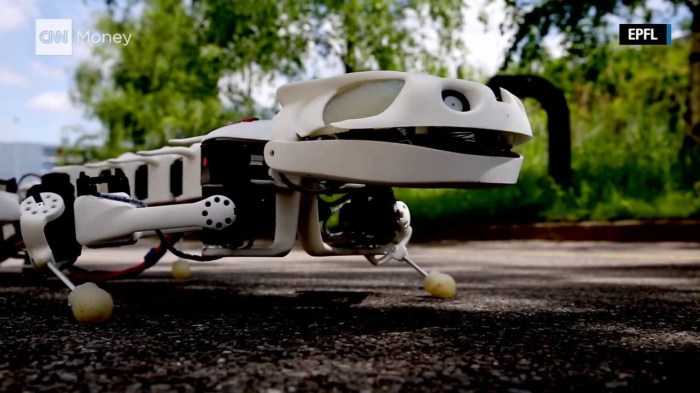
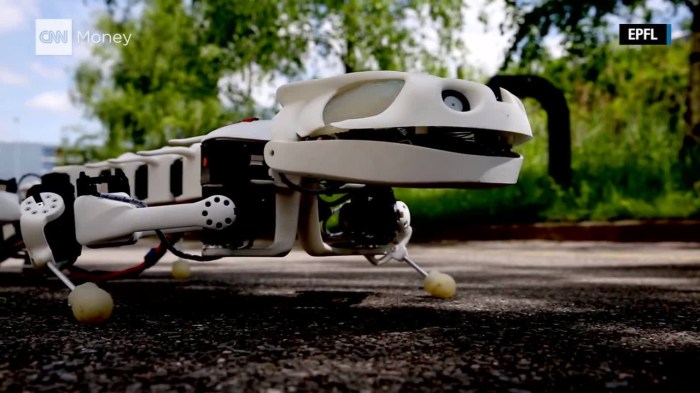
The robot salamander, a meticulously crafted machine, mimics the physical characteristics and behaviors of its biological counterpart. Its detailed design includes sensors to gather data on various environmental factors, allowing researchers to observe and record responses in real time. This robotic model can simulate natural selection, providing a new perspective on how species adapt to their surroundings. Further, it can explore a wide array of evolutionary scenarios, going beyond the limitations of traditional observational methods.
Introduction to Robot Salamander
A robot salamander is a sophisticated robotic model designed to mimic the physical characteristics and behaviors of a salamander, while also incorporating advanced sensors and actuators for scientific study. These robotic models are more than simple toys; they are powerful tools for understanding the intricate mechanisms of salamander evolution and development.This innovative technology combines cutting-edge robotics with the intricacies of evolutionary biology, enabling researchers to explore phenomena that are otherwise inaccessible to direct observation in biological systems.
By replicating specific aspects of salamander anatomy and physiology, these robots allow for controlled experiments and data collection, fostering a deeper understanding of the salamander’s evolutionary trajectory.
Key Components and Functionalities
The core components of a robot salamander often include a lightweight, articulated frame mimicking the salamander’s skeletal structure. This frame is equipped with sophisticated actuators that precisely control movement, replicating the salamander’s complex locomotion patterns. Embedded sensors, such as accelerometers, gyroscopes, and pressure sensors, allow the robot to gather data on its interactions with the environment. These data are crucial for understanding the mechanics of movement and sensory processing in the salamander.
Furthermore, the robot can be programmed to mimic specific behaviors, like foraging or navigating obstacles. Sophisticated control systems manage these behaviors, enabling complex interactions and providing researchers with valuable data.
Potential Applications in Evolutionary Biology
These robotic salamanders offer unparalleled opportunities for investigating the evolutionary processes that have shaped salamander morphology and behavior. Researchers can use them to test hypotheses about the relationship between form and function, and how evolutionary pressures have influenced the development of specific traits. The controlled experiments conducted using robot salamanders can help uncover the interplay between genetic and environmental factors in shaping evolutionary adaptations.
They also allow researchers to simulate different environments and observe the robot’s responses, providing insights into how salamanders might adapt to changing conditions.
Examples of Robotic Models in Similar Research
Various robotic models are employed in similar scientific studies. For instance, robotic fish are used to investigate hydrodynamic forces in aquatic environments. Robotic insects are utilized to understand the mechanisms of flight and sensory perception. These examples demonstrate the broader trend of using robotics to model biological systems and uncover hidden evolutionary principles. These models allow scientists to simulate various scenarios and observe the responses of these models in controlled settings, a crucial aspect of biological research.
Comparison of Biological and Robotic Salamanders
| Feature | Biological Salamander | Robotic Salamander |
|---|---|---|
| Structure | Naturally evolved anatomy with variations based on species | Programmable and adaptable structure designed to mimic a specific salamander species |
| Movement | Driven by biological mechanisms and muscle contractions | Driven by actuators and programmed control systems |
| Sensory Perception | Complex sensory systems (vision, smell, touch) evolving over time | Controlled by embedded sensors and programmed algorithms |
| Adaptation | Adapts to environmental changes through genetic evolution over generations | Adapts through programming and algorithmic adjustments to simulate environmental changes |
Evolutionary Biology Applications
The Robot Salamander project offers a novel approach to understanding evolutionary processes. By creating a physical model of a salamander capable of adapting to its environment, we can observe and quantify evolutionary mechanisms in a controlled, repeatable manner. This surpasses traditional methods by allowing for direct observation of how physical traits and behaviors change in response to environmental pressures.The robot’s design allows for a dynamic simulation of natural selection.
By varying environmental parameters and observing the robot’s adaptations, we can generate data on how populations respond to changing conditions. This data can be used to create models that predict the trajectory of evolution in real-world scenarios. Furthermore, the robot’s ability to learn and modify its behaviors provides insights into the development of complex behaviors in animals.
Robot salamanders, mimicking ancient evolutionary pathways, are fascinating tools for understanding how life adapts. This intricate research, however, isn’t immune to the broader economic climate. Navigating the potential pitfalls of another tech downturn, like those faced in previous cycles, requires careful consideration of investment and long-term strategies. For more insights into avoiding another recession in tech, check out this comprehensive guide: avoiding another recession in tech.
Ultimately, continued advancements in robotics, like the study of these robotic salamanders, will likely be crucial for future innovation, regardless of the economic fluctuations.
Modeling Evolutionary Processes
The Robot Salamander can model various evolutionary scenarios, enabling researchers to test hypotheses and gain a deeper understanding of the mechanisms driving evolution. By adjusting environmental factors like temperature, food availability, and predator presence, the robot can mimic the selective pressures encountered by real salamander populations. This allows for a more accurate and detailed study of how these pressures affect the development of new traits.
Robot salamanders are fascinating, helping us unravel the mysteries of evolution. Their intricate design, mimicking real salamanders, offers incredible insights into how species adapt. This cutting-edge research is intertwined with other technological advancements, like Microsoft’s Project Green, which aims to revolutionize computing in waves. Microsoft’s Project Green to roll out in waves could potentially lead to more sustainable and efficient computing, which in turn benefits the development of even more sophisticated robotic models.
Ultimately, this interdisciplinary approach to problem-solving through robotics, as exemplified by the salamander model, promises to further our understanding of evolutionary processes.
Simulating Natural Selection
The robot’s physical structure and motor control system allow for the simulation of natural selection. Its movements can be programmed to reflect the interplay between genetic variation, environmental pressures, and survival rates. For instance, a change in terrain can lead to a selection pressure for longer legs, and the robot’s adaptation can be observed and quantified. This direct observation of adaptation, in contrast to relying on fossils or historical data, provides a powerful tool for understanding evolutionary change.
Exploring Environmental Conditions
The robot can explore a wider range of environmental conditions than traditional methods. It can be exposed to different temperatures, humidity levels, and even different types of terrain, enabling us to study the interplay between these factors and evolutionary adaptation. By varying these parameters and analyzing the robot’s responses, we can gain insights into the complex relationship between the environment and evolution.
Robot salamanders are shedding light on evolutionary mysteries, revealing fascinating insights into how life forms adapt. This recent development in robotics, similar to how Circuit City and Verizon Wireless are expanding their partnership circuit city and verizon wireless expand relationship , highlights the interconnectedness of seemingly disparate fields. The intricate design of these robotic creatures, mimicking the salamander’s anatomy, provides invaluable data on adaptation and evolution, pushing the boundaries of our understanding of life’s journey.
The robot’s adaptability can also be compared across different environments, offering valuable data on how different species respond to diverse ecological pressures.
Studying Complex Behaviors
The Robot Salamander can be programmed to exhibit complex behaviors, allowing us to study the development of these behaviors in a controlled setting. For instance, it can be programmed to navigate obstacles, find food sources, or avoid predators. By observing how these behaviors evolve over generations, we can gain insights into the neural mechanisms underlying the development of complex animal behaviors.
Comparison with Traditional Methods
Traditional methods of studying evolution, such as fossil analysis and comparative anatomy, provide valuable historical context. However, they are limited in their ability to directly observe evolutionary processes in action. The Robot Salamander offers a unique approach, allowing for the direct observation of adaptation and the simulation of evolutionary processes in a controlled environment. This allows for a more detailed understanding of how different selective pressures influence evolutionary trajectories.
Potential Evolutionary Scenarios
| Scenario | Description | Method |
|---|---|---|
| Adaptation to Changing Temperatures | The robot’s physiology and behavior are adjusted to simulate adaptations to fluctuating temperatures. | Varying temperature parameters and observing changes in the robot’s morphology and behavior. |
| Competition for Resources | The robot’s interactions with other robots or simulated predators are adjusted to mimic competition for limited resources. | Simulating resource scarcity and observing competitive interactions between the robots. |
| Development of Specialized Feeding Strategies | The robot’s morphology and feeding behaviors are modified to simulate adaptations to specific food sources. | Introducing various food sources and observing changes in the robot’s feeding mechanisms. |
Unlocking Mysteries of Development: Robot Salamander Helps Unlock Evolution Mysteries
The robot salamander presents a unique opportunity to study the intricacies of organismal development. By replicating key features of biological systems, this robotic model allows for controlled experiments and data collection that would be impossible or ethically challenging with biological subjects. This allows researchers to explore the underlying mechanisms driving development with unprecedented precision.The robot’s physical attributes can be meticulously manipulated to simulate various developmental processes.
Imagine a system where the robot’s “skeleton” can be incrementally constructed, mimicking the formation of an organism’s structure. This allows for a detailed study of the interplay between genetic instructions and physical constraints during development. Such controlled environments facilitate the observation of subtle changes in morphology and the impact of different variables on the process.
Manipulating Physical Attributes for Developmental Studies
The robot’s physical design can be adjusted to investigate a wide array of developmental processes. For example, the robot’s limb growth can be simulated by altering the rate of material deposition in specific regions. This allows researchers to directly observe the effect of growth factors and signaling pathways on limb development. By changing the composition of the robot’s “cells,” the impact of cellular differentiation on the overall structure can be observed.
Employing Sensors for Data Collection
A network of sensors embedded within the robot provides real-time data on growth and adaptation. These sensors can monitor internal temperature, fluid pressure, and the rate of material deposition in different parts of the robot. This comprehensive data collection allows for a detailed understanding of the dynamic interactions during development. The robot’s sensors can also be calibrated to measure the mechanical stress on various structures, providing insights into the relationship between form and function during development.
Furthermore, sensors can detect changes in the robot’s environment, enabling investigations into the effects of environmental cues on development.
Studying Environmental Factors Affecting Development
The robot salamander can be placed in various controlled environments to study the impact of external factors on development. For instance, the robot can be exposed to different temperatures, light intensities, and nutrient levels. The impact of these factors on the robot’s development can be observed through the collected sensor data. These experiments can replicate real-world conditions, allowing researchers to understand how environmental pressures shape the developmental trajectory of organisms.
For example, by altering the availability of a specific nutrient in the robot’s environment, researchers can investigate how this affects the rate of cell division and differentiation.
Investigating Specific Developmental Processes
The robot can investigate a wide range of developmental processes, including:
- Cell differentiation: The robot’s “cells” can be programmed to undergo different types of differentiation, mimicking the process in biological organisms. Researchers can study how specific signaling pathways and transcription factors regulate this process.
- Morphogenesis: By altering the robot’s structure, researchers can observe how changes in shape and form arise from interactions between cells and tissues. The robot can be designed to model the complex interactions leading to the formation of limbs, organs, or other body structures.
- Growth and adaptation: The robot’s response to changes in the environment, such as alterations in nutrient availability or temperature, can be studied. This can provide insights into the adaptive mechanisms organisms employ during development.
- Regeneration: The robot’s design could incorporate mechanisms to model the ability of some organisms to regenerate lost body parts. Researchers can investigate the underlying cellular and molecular processes involved in this remarkable ability.
Exploring Environmental Impacts
The robot salamander offers a powerful tool for understanding how environmental factors influence the development and evolution of salamanders. By meticulously controlling and measuring various environmental parameters, researchers can gain insights into the intricate mechanisms that shape species’ traits. This approach provides a unique opportunity to study the long-term consequences of environmental change, helping predict the responses of species to future challenges.The ability to precisely control variables like temperature, oxygen levels, and food availability within a controlled laboratory setting allows for rigorous scientific study.
This contrasts with traditional field studies, which often face limitations in isolating specific environmental influences. The robot salamander’s capacity to collect detailed data on the salamander’s growth, behavior, and physiology over extended periods provides invaluable insights.
Environmental Factor Simulation
Precise simulation of environmental conditions is crucial for understanding their impact. The robot salamander can be programmed to maintain and monitor specific temperature ranges, mimicking natural fluctuations or extreme conditions. This includes creating gradients of temperature to observe how salamander development varies across different thermal regimes. Oxygen levels can be manipulated to reflect hypoxic or anoxic conditions, while food availability can be precisely controlled, mimicking periods of scarcity or abundance.
This allows researchers to examine the adaptive responses of salamanders to these environmental stressors.
Measurement of Environmental Stressors
The robot salamander is equipped with sophisticated sensors to accurately measure various physiological parameters. These measurements include changes in growth rate, metabolic activity, and behavioral patterns. For instance, changes in the salamander’s activity level, feeding rate, or overall morphology can be observed and correlated with specific environmental stressors. Furthermore, the robot can analyze the salamander’s gene expression patterns in response to environmental changes, providing insights into the molecular mechanisms underlying adaptation.
Detailed records of these data, combined with environmental parameters, facilitate a comprehensive understanding of the salamander’s response.
Evolutionary Trajectories, Robot salamander helps unlock evolution mysteries
Environmental changes can dramatically alter evolutionary trajectories. For example, a shift in temperature might favor certain genetic traits over others, leading to adaptations that enhance survival and reproduction in the new environment. Similarly, fluctuations in oxygen levels can select for individuals with higher oxygen-carrying capacity. The robot salamander can be used to study these evolutionary processes by observing how specific genetic variants respond to environmental changes across multiple generations.
This allows for a deeper understanding of the interplay between environmental pressures and evolutionary outcomes.
Comparison with Existing Techniques
| Feature | Robot Salamander | Traditional Techniques |
|---|---|---|
| Control of Environmental Variables | High precision, controlled manipulation of temperature, oxygen, and food availability | Limited control, often relying on natural variations or field observations |
| Data Collection | Continuous, high-resolution data on multiple physiological parameters and behavior | Discontinuous observations, potentially missing crucial details |
| Cost-Effectiveness | Potentially lower long-term costs for repeated experiments compared to some field studies | Costs can vary greatly depending on the scale and complexity of the field study |
| Scale of Experiments | Allows for larger-scale experiments, including the study of multiple generations | Often limited by time and resources, making it difficult to observe evolutionary processes over multiple generations |
| Data Analysis | Facilitates sophisticated data analysis, identifying correlations and patterns | Analysis may be less rigorous, lacking the same level of automation and data handling |
Ethical Considerations and Societal Impact
The development and deployment of robotic salamanders for evolutionary biology research presents a complex interplay of ethical considerations and potential societal impacts. While offering unprecedented opportunities to understand evolutionary processes, this technology also raises important questions about responsible use, potential biases, and the broader implications for conservation and human-nature interactions. The potential for both profound scientific advancements and unforeseen consequences demands careful consideration and proactive measures.The ethical implications of using robotic models to study evolution are multifaceted.
One crucial aspect concerns the potential displacement of traditional research methods. The ease and speed of robotic experimentation could lead to a shift in the focus of research, potentially overshadowing or underfunding other valuable approaches. Careful consideration must be given to ensure a balanced approach that complements, rather than replaces, existing methodologies.
Potential Societal Benefits
The use of robot salamanders can provide invaluable insights into biodiversity and facilitate the development of more effective conservation strategies. By providing detailed data on species’ behavior, genetics, and environmental responses, these models can aid in the preservation of endangered species and the management of ecosystems. Furthermore, the detailed understanding of evolutionary processes enabled by robotic models can inform conservation efforts aimed at maintaining genetic diversity and resilience in the face of environmental change.
The potential for early detection of environmental threats, through robotic monitoring, offers a unique proactive approach to conservation.
Potential Concerns Regarding Robotic Use
The use of robotics in scientific research, while offering significant advantages, also presents potential concerns. One concern is the potential for bias in data collection. Robot design and programming can unintentionally introduce biases if not carefully considered. These biases can influence the interpretation of results, potentially misrepresenting evolutionary processes. Furthermore, the increased reliance on robotic models might lead to a reduced understanding of the nuances of natural systems, diminishing the value of human observation and direct interaction with the environment.
It is crucial to ensure that robotic data is integrated with human expertise to prevent such issues.
Responsible Use in Conservation Efforts
The responsible deployment of robot salamanders in conservation efforts requires careful planning and ethical guidelines. These guidelines should encompass the development of standardized protocols for data collection and analysis to ensure the reliability and comparability of results across different studies. Furthermore, the need for transparency and open access to data is crucial to ensure that the benefits of this technology are shared with the wider scientific community and broader society.
The potential to misuse this technology, particularly for military applications, necessitates strict ethical oversight and regulatory frameworks.
Future Implications of Robotic Salamander Use
The future implications of using robot salamanders to study evolution are vast and potentially transformative. The advancement of robotic technology and the development of more sophisticated AI algorithms could lead to unprecedented insights into evolutionary processes, allowing us to address complex problems related to biodiversity loss and ecosystem resilience. The potential for predicting the impacts of environmental changes on species and ecosystems, using predictive models informed by robotic data, presents an exciting opportunity to mitigate future ecological crises.
Examples include developing effective conservation strategies, predicting species’ responses to climate change, and understanding the impact of pollution on biodiversity.
Illustrative Examples
The potential of robot salamanders extends far beyond simple mimicry. By meticulously designing their physical attributes, programming their responses, and observing their interactions with the environment, we can gain invaluable insights into the intricate mechanisms of evolution. These simulated experiments offer a unique opportunity to explore evolutionary processes in a controlled setting, providing valuable data for researchers and educators.This section presents a hypothetical robot salamander, illustrating its capabilities and how its responses can be analyzed to understand evolutionary pressures.
The robot’s design incorporates various sensors and actuators, allowing it to perceive and react to a range of environmental stimuli. Its adaptive strategies and responses provide a tangible example of how these principles might apply to biological systems.
Hypothetical Robot Salamander Design
The robot salamander, designated “Robo-Salamander 1.0,” is approximately 15 centimeters long and has a streamlined body resembling a real salamander. Its exoskeleton is composed of a lightweight, yet durable, polymer material. This allows for efficient movement and a close resemblance to the natural structure. The robot incorporates various sensors, including pressure sensors distributed across its body, allowing for a precise understanding of ground contact.
Infrared sensors provide visual information about nearby objects and potential threats, while chemical sensors detect varying concentrations of substances in the environment. Embedded microprocessors interpret the data received from these sensors, enabling the robot to respond to the environment in a dynamic way. The robot’s programming includes a core algorithm that promotes survival, focusing on maximizing energy efficiency and finding food sources.
Additional algorithms are in place for reproduction and predator avoidance. A learning module allows the robot to adjust its behavior based on experience.
Environmental Stimuli and Robot Responses
To illustrate the robot’s interaction with environmental stimuli, consider the following scenarios:
- Food Availability: When Robo-Salamander 1.0 encounters a region with a high concentration of nutrient-rich food sources, it displays increased foraging activity, moving more actively and spending more time in the area. The robot’s sensors detect the nutrients and the robot’s algorithm prioritizes consuming them. This demonstrates a crucial evolutionary aspect: adaptation to resource availability.
- Predator Presence: If Robo-Salamander 1.0 detects a predator, it exhibits a swift escape response. The infrared sensors identify the predator’s heat signature and initiate a rapid movement away from the threat. The robot’s programming prioritizes self-preservation. This exemplifies the role of natural selection in driving behavioral adaptations.
- Temperature Fluctuation: The robot’s temperature sensors detect significant shifts in ambient temperature. In response, Robo-Salamander 1.0 seeks out warmer or cooler microhabitats, depending on the shift. This response simulates how organisms adjust to temperature variations for survival.
Adaptive Strategies and Evolutionary Analysis
Robo-Salamander 1.0’s responses to these stimuli illustrate adaptive strategies. By analyzing the robot’s movement patterns, energy expenditure, and successful interactions with the environment, researchers can identify key evolutionary principles. For instance, the robot’s foraging strategy can be analyzed to understand how organisms optimize resource acquisition. Predator avoidance behaviors can reveal how organisms develop mechanisms for survival in the presence of threats.
Analysis of the robot’s responses to environmental changes offers insight into how organisms adapt to dynamic environments.
Importance of Illustrative Examples
The robot salamander serves as a valuable tool for understanding evolutionary processes. By providing a tangible model of these concepts, we can communicate the potential of this technology to a wider audience. Robo-Salamander 1.0’s interactions with the environment provide a simplified yet powerful demonstration of complex evolutionary phenomena. The potential for future robots to mimic biological systems allows us to investigate evolutionary principles in a way that was previously impossible.
Ultimate Conclusion
In conclusion, the robot salamander presents a powerful tool for investigating evolutionary processes and developmental biology. Its ability to simulate environmental pressures and track adaptations in real-time provides valuable insights into the mechanisms of evolution. While ethical considerations are important, the potential benefits for understanding and preserving biodiversity are significant. The future of evolutionary research may well be shaped by these remarkable robotic models.