The Evolution of Vision-Language-Action Models
The release of the OpenVLA paper in mid-2024 marked a turning point in open-source robotics. Trained on approximately 970,000 real-world robot demonstrations, OpenVLA is a 7-billion-parameter model designed to bridge the gap between high-level linguistic instructions and low-level robotic control. Unlike traditional robotic policies that are often hard-coded or trained for singular tasks, a VLA model takes a visual input from a workspace camera and a natural-language command—such as "place the black bowl on the plate"—and predicts the discrete action tokens required for the robot to execute the move.

The complexity of these models usually necessitates massive GPU clusters. However, the emergence of the OpenVLA-7B checkpoint has provided a standardized foundation for the community. The model represents a fusion of vision encoders and large language models (LLMs), specifically optimized to output action tokens that correspond to normalized seven-degree-of-freedom (7-DoF) end-effector commands. These commands cover the Cartesian coordinates (x, y, z), the orientation (roll, pitch, yaw), and the state of the robot’s gripper.
Technical Methodology: The LoRA Integration
The core challenge of fine-tuning a 7-billion-parameter model is the memory footprint. Full fine-tuning requires updating every weight in the network, which quickly exhausts the VRAM of standard hardware. The current methodology utilizes Low-Rank Adaptation (LoRA) to bypass this constraint. By freezing the majority of the pretrained OpenVLA weights and only training a small set of adapter matrices, researchers can reduce the trainable parameters to roughly 1.4 percent of the original total.

This approach is not merely a compromise for hardware limitations; it is a strategic choice supported by the OpenVLA project’s own findings, which suggest that LoRA can match the performance of full fine-tuning in specific robot adaptation tasks. In a controlled test environment using a Google Colab A100 High-RAM instance, this method allows for a "smoke test"—a short, 100-step training run that serves as an integration validation. This validation confirms that the dataset loads correctly, the GPU performs real work, and the model weights are actually being updated before a researcher commits to a more expensive, long-term training regime.
Chronology of the OpenVLA Fine-Tuning Workflow
The process of adapting OpenVLA for a specific task follows a precise sequence of events, designed to ensure reproducibility and auditability.

- Environment Initialization: Given that OpenVLA requires specific, often older, versions of machine learning libraries, the workflow begins by establishing a dual-environment setup. One environment is dedicated to the official OpenVLA training scripts (Python 3.10), while a secondary environment handles telemetry and synchronization with experiment tracking tools like Weights & Biases (W&B).
- Dataset Acquisition: The methodology utilizes the LIBERO benchmark, specifically the
libero_spatial_no_noopssplit. This dataset is formatted according to the Robot Learning Dataset Standard (RLDS), which organizes robot demonstrations into episodes containing observations, instructions, and actions. - The Training Execution: Using the
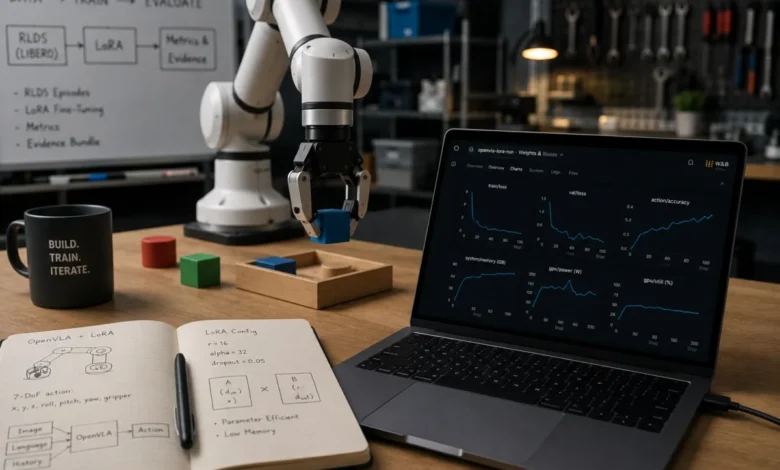
torchrunutility, the training command initiates thefinetune.pyscript. Key hyperparameters include a LoRA rank of 32 and a learning rate of 0.0005. To manage memory, a batch size of 2 is paired with gradient accumulation steps of 8, resulting in an effective batch size of 16. - Telemetry and Logging: Throughout the 100-step run, the system logs three critical metrics: training loss, L1 action loss, and action-token accuracy. Simultaneously, hardware telemetry—including GPU power wattage and VRAM utilization—is recorded to prove the "physicality" of the training run.
- Evidence Synthesis: Upon completion, the system generates a verified evidence folder containing the training logs, the W&B run URL, and the final adapter weights.
Supporting Data and Metric Analysis
The results of the 100-step validation run provide clear indicators of a successful learning signal. In the documented experiment, the train_loss began at approximately 11.0 and dropped sharply to 3.42 by the end of the run. This supervised training error measures how well the model is learning the distribution of the training data.
More specific to robotics is the L1_loss, which measures the absolute error between the predicted continuous action and the demonstrated action. In this run, the L1 loss fluctuated but trended downward from 0.46 to 0.22. Furthermore, action_accuracy—the frequency with which the model’s predicted tokens match the ground truth tokens in the dataset—rose from a baseline of 0.09 to a peak of 0.35.

System telemetry provided by W&B confirmed that the A100 GPU was active, with power usage consistently between 165 and 195 watts and utilization hovering around 40 percent. These data points are crucial for distinguishing a successful training run from a "phantom" run where a script might finish without actually updating weights or processing data.
Addressing the Embodiment Shift
A primary reason for the necessity of this fine-tuning path is the problem of "embodiment shift." In robotics, a policy trained on one robot (the "source") often fails when moved to another (the "target"). These shifts can be caused by:

- Visual Variation: Changes in camera angles, lighting, or workspace background.
- Kinematic Differences: Different arm lengths or joint limits.
- Sensor Mismatch: Different camera resolutions or focal lengths.
- Action Space Scaling: Different ways of normalizing the 7-DoF commands.
By providing a reproducible path for LoRA fine-tuning, researchers can take the "generalist" knowledge of OpenVLA and specialize it for their specific "embodiment" in a matter of hours rather than weeks.
Official Responses and Research Implications
While the developers of OpenVLA have provided the official training recipes, the community response has focused on making these recipes more "inspectable." Researchers in the field have noted that the "black box" nature of large model training often leads to skepticism regarding claims of robot performance. The move toward "verifiable evidence"—where every training run is accompanied by a public experiment tracker link—is being hailed as a step forward for scientific transparency in AI.

Dr. Arsalan Mousavian and other contributors to the Open X-Embodiment project have previously emphasized that the goal of these foundation models is to provide a "starting point" for robotics, not a finished product. This fine-tuning methodology fulfills that vision by providing the "last mile" of adaptation.
Broader Impact and Future Outlook
The ability to run these experiments on platforms like Google Colab suggests a future where robotics research is no longer tethered to massive local server racks. This democratization allows smaller labs to iterate on complex tasks like "language-conditioned manipulation" without the overhead of building their own VLA from scratch.

However, the 100-step run is only a "smoke test." The real test for these models remains "rollout evaluation"—testing the model in a real or simulated environment to see if the robot actually completes the task. While the metrics (loss and accuracy) provide a learning signal, they do not guarantee task success. The next phase of this research involves connecting these fine-tuned LoRA adapters to simulation environments like RoboSuite or Isaac Gym to bridge the gap between "token prediction" and "physical execution."
Ultimately, the significance of this workflow lies in its honesty. It does not claim to create a perfect robot controller in 100 steps. Instead, it provides a rigorous, measurable, and reproducible foundation. In an era of AI hype, the ability to prove that a training run was real, that the dataset was loaded, and that the hardware was utilized is perhaps the most valuable tool a researcher can have. As OpenVLA continues to evolve, this pattern of verifiable fine-tuning will likely become the standard for those seeking to push the boundaries of what open-source robotics can achieve.