The Expanding Power of the CIO A Corporate Role Evolution
The expanding power of the cios corporate role – The expanding power of the CIO’s corporate role is reshaping the modern business landscape. Once primarily focused on technical infrastructure, the CIO has evolved into a strategic partner, deeply involved in digital transformation, data analytics, cloud computing, cybersecurity, and driving organizational change. This evolution is crucial to understanding the pivotal role CIOs play in today’s complex business environment, impacting everything from innovation to overall business performance.
This insightful exploration delves into the historical progression of the CIO role, highlighting the key factors driving its transformation. We’ll examine the strategic impact of CIOs, their crucial role in data and analytics, the complexities of cloud computing, the rising importance of cybersecurity, and the CIO’s emergence as a powerful change agent. We’ll conclude by looking at future trends and how the CIO role will continue to evolve.
Evolution of the CIO Role
The CIO role has undergone a dramatic transformation over the past few decades. Initially perceived as a technical overseer of IT infrastructure, the CIO has evolved into a strategic partner, deeply involved in shaping the overall business strategy. This evolution reflects the increasing importance of technology in today’s business landscape and the CIO’s crucial role in navigating this digital transformation.The rise of technology has fundamentally altered the business landscape.
Organizations now rely heavily on technology for everything from customer interactions to internal operations. This reliance necessitates a CIO who can not only manage IT infrastructure but also anticipate and respond to evolving technological trends, ensuring that the organization remains competitive and innovative.
Historical Progression of the CIO Role
The CIO’s role has transitioned from a largely technical function to a strategic leadership position. In the early days of computing, the CIO was primarily responsible for maintaining and upgrading computer systems. Their focus was on operational efficiency and ensuring the smooth running of IT infrastructure. As technology advanced and businesses became more reliant on computers, the CIO’s responsibilities expanded to include areas such as network management, database administration, and systems development.
Key Factors Driving the Evolution
Several factors have driven the evolution of the CIO role. Technological advancements have necessitated a more sophisticated understanding of technology’s application across different business functions. Business needs, particularly in terms of data analysis, automation, and customer experience, have also pushed the CIO role into a more strategic realm. Organizational structures have also evolved, with a greater emphasis on collaboration and integration between IT and other departments.
CIOs are increasingly wielding significant power within corporations, impacting everything from strategy to security. This expanding influence is evident in recent decisions like Google Earth agreeing to blur sensitive images of India, a decision demonstrating the growing importance of data privacy and geopolitical considerations. Ultimately, this demonstrates how CIOs are now key players in navigating complex global landscapes, highlighting their crucial role in corporate success.
This integration requires a CIO capable of understanding business processes and translating technology into tangible business value.
Shifting Skillsets of Modern CIOs
The modern CIO requires a diverse skillset extending beyond technical expertise. A deep understanding of business strategy, financial modeling, and risk assessment are critical to effectively advise executive leadership on technological investments and their impact on overall business goals. Strong communication, leadership, and collaboration skills are essential to effectively navigate organizational complexities and foster alignment across different departments.
Responsibilities of a CIO (1990-2023)
| Year | Primary Responsibilities (1990) | Key Responsibilities (2023) |
|---|---|---|
| 1990 | Managing IT infrastructure, ensuring system uptime, and maintaining hardware and software. | Developing and implementing technology strategies aligned with overall business objectives, fostering innovation, and managing large-scale digital transformations. |
| 1990 | Troubleshooting system issues and resolving technical problems. | Identifying and mitigating potential risks associated with technology implementations, overseeing security measures, and ensuring data privacy. |
| 1990 | Maintaining and updating existing systems. | Leading the organization’s digital transformation initiatives, driving innovation, and collaborating with business units to identify technology opportunities. |
| 2023 | Leading the IT department and ensuring its efficient operation. | Championing technology adoption and overseeing the development and implementation of new technologies. |
This table highlights the significant expansion of the CIO’s role over the past three decades. The responsibilities have shifted from primarily technical to encompass strategic planning, innovation, and leadership.
CIO as a Strategic Partner
The CIO’s role has evolved to become a crucial strategic partner to the CEO and other C-suite executives. CIOs now actively participate in developing and executing the overall business strategy, identifying opportunities for leveraging technology to drive growth, and ensuring alignment between technology and business objectives. Their expertise in technology and understanding of business needs make them essential advisors for senior management.
Strategic Impact of the CIO
The CIO role is evolving beyond its traditional IT management focus. Today’s CIOs are critical strategic partners, deeply involved in shaping an organization’s digital future and driving significant business value. They are no longer just responsible for maintaining systems; they are actively leading the charge in digital transformation, ensuring IT investments align with the overall business strategy, and driving innovation and operational efficiency.CIOs are integral to a company’s success in the modern digital landscape.
They act as a bridge between the business needs and the technical capabilities, ensuring the organization effectively leverages technology to achieve its goals. This strategic partnership is crucial for sustained growth and competitive advantage.
CIOs and Digital Transformation Strategy
CIOs are now actively involved in defining and executing the organization’s digital transformation strategy. They understand the technological advancements and their potential impact on the business, leading initiatives that leverage these advancements to create new products, services, and business models. This proactive approach ensures the organization stays ahead of the curve and capitalizes on emerging opportunities.
Leading Initiatives for Innovation and Efficiency
CIOs are leading numerous initiatives that drive innovation and operational efficiency. These initiatives often involve implementing new technologies, optimizing existing processes, and fostering a culture of digital adoption within the organization. For instance, a CIO might spearhead the implementation of cloud-based solutions to improve agility and reduce costs, or they might lead the development of data analytics platforms to gain deeper insights into customer behavior and market trends.
Alignment of IT Investments with Business Objectives
The CIO plays a vital role in aligning IT investments with business objectives. They assess the strategic value of various IT projects, ensuring they contribute to the overall business goals and contribute to measurable returns on investment. This alignment is critical for maximizing the value derived from IT investments and ensuring that they support the company’s strategic priorities. A successful CIO understands the business context, and can translate business needs into actionable IT strategies.
Strategic Initiatives Led by CIOs
| Strategic Initiative | Description | Successful Outcomes |
|---|---|---|
| Cloud Migration | Transitioning critical applications and data to cloud platforms. | Reduced IT infrastructure costs, improved scalability and agility, enhanced disaster recovery capabilities. |
| Data Analytics Implementation | Developing and deploying data analytics platforms to extract insights from data. | Improved customer segmentation, enhanced product development, optimized marketing campaigns, resulting in increased sales and customer retention. |
| Cybersecurity Enhancement | Implementing robust security measures to protect sensitive data and systems. | Reduced security breaches, minimized financial losses, improved customer trust and confidence, which ultimately increased customer loyalty. |
| Automation of Processes | Automating repetitive tasks and processes using software robots. | Improved efficiency and productivity, reduced operational costs, freed up staff for more strategic initiatives, leading to improved employee satisfaction. |
CIO Contribution to Business Performance and Growth
CIOs contribute significantly to the overall business performance and growth by leveraging technology to improve operational efficiency, enhance customer experiences, and foster innovation. By driving strategic IT initiatives, they create a foundation for sustainable business growth and a competitive advantage in the market. CIOs are vital in enabling organizations to adapt to a rapidly changing technological landscape and capitalize on emerging opportunities.
For example, a CIO successfully implementing a cloud-based platform could result in a significant reduction in IT operating costs, allowing the company to reinvest in growth initiatives.
The CIO’s Role in Data and Analytics
The CIO’s role is rapidly evolving, no longer confined to IT infrastructure management. The increasing importance of data and analytics has thrust the CIO into a central position in driving strategic decision-making and business transformation. This evolution requires a deep understanding of data management, analytics, security, and emerging trends. CIOs are now expected to be data strategists, translating raw data into actionable insights.The CIO’s role in data and analytics is intrinsically linked to the organization’s ability to leverage data for competitive advantage.
This means overseeing the entire data lifecycle, from acquisition and storage to analysis and application. They must build a robust data infrastructure that supports the organization’s data needs, ensuring that data is readily available and accessible to the right people at the right time. This data-centric approach is crucial for enhancing operational efficiency, improving customer experiences, and driving innovation.
Building and Managing Data Infrastructures
The CIO is responsible for creating and maintaining a robust data infrastructure. This includes selecting the right technologies for data storage, processing, and analysis, and ensuring the infrastructure is scalable and adaptable to future needs. The infrastructure should be designed to support various data types, from structured transactional data to unstructured data like text and images. Furthermore, the CIO needs to ensure compliance with data governance policies and regulations.
This often includes developing data catalogs, implementing data quality measures, and ensuring data security. Maintaining data integrity and ensuring data accessibility are critical.
Utilizing Data for Decision-Making
The CIO plays a pivotal role in translating raw data into actionable insights. This involves working closely with business stakeholders to understand their needs and translate them into data-driven solutions. The CIO guides the development of data-driven strategies, enabling informed decisions across the organization. This might include creating dashboards, implementing predictive modeling, or using machine learning to automate tasks.
The ability to extract meaningful insights from data is crucial for a successful business strategy.
Improving Business Processes and Customer Experiences
Data analytics is crucial for optimizing business processes. By identifying bottlenecks and inefficiencies in existing workflows, organizations can streamline operations and reduce costs. Data analytics can also be leveraged to enhance customer experiences. By analyzing customer data, organizations can tailor products and services to individual needs, personalize marketing campaigns, and improve customer service. This personalization can increase customer satisfaction and loyalty.
Data Security and Privacy
Data security and privacy are paramount in the CIO’s expanded role. The CIO must implement robust security measures to protect sensitive data from unauthorized access, breaches, and misuse. This includes implementing encryption, access controls, and intrusion detection systems. Furthermore, the CIO must ensure compliance with relevant data privacy regulations, such as GDPR and CCPA. Maintaining the trust and confidence of customers and stakeholders is essential.
Emerging Trends in Data Analytics
The field of data analytics is constantly evolving. Emerging trends like artificial intelligence (AI), machine learning (ML), and the Internet of Things (IoT) are significantly impacting the CIO’s responsibilities. These technologies are enabling the development of more sophisticated analytical models and the creation of more intelligent business applications. The CIO needs to stay abreast of these trends to leverage their potential and ensure the organization remains competitive.
The integration of AI and ML into data analysis pipelines allows for more efficient processing and more accurate predictions, offering significant business advantages.
CIOs and Cloud Computing
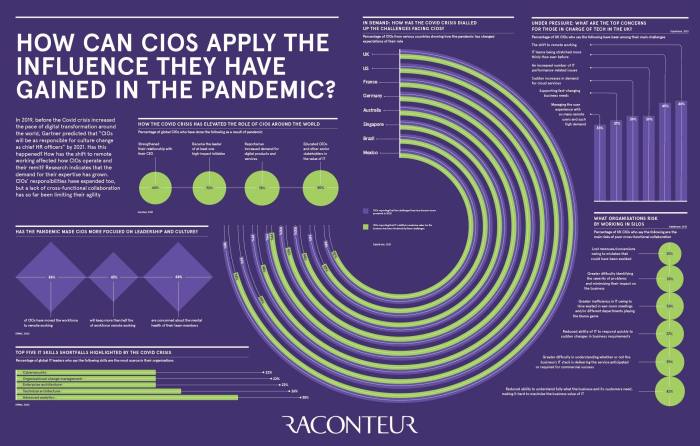
The CIO’s role is undergoing a significant transformation, and cloud computing is a central driver of this evolution. No longer simply a technology enabler, the CIO now acts as a strategic architect and a critical decision-maker in the cloud journey of their organization. This involves navigating the complexities of various cloud models, understanding the security and compliance implications, and ultimately, ensuring the cloud strategy aligns with overall business objectives.The strategic importance of cloud computing is undeniable.
It offers significant advantages in scalability, agility, and cost-effectiveness, but also presents challenges that CIOs must proactively address. CIOs are responsible for developing and implementing cloud strategies that maximize these benefits while mitigating risks. This requires a deep understanding of the nuances of different cloud platforms, a keen eye for security and compliance, and a commitment to ensuring that the cloud environment is integrated seamlessly into the overall IT infrastructure.
Cloud Computing Strategy and Adoption
CIOs play a pivotal role in developing and executing cloud strategies. This involves careful planning, thorough analysis, and effective communication across the organization. Organizations often begin with a phased approach, starting with specific applications or workloads that are well-suited to the cloud environment. This strategic approach prioritizes the most critical business functions, allowing for incremental cloud adoption.
This also includes creating a detailed roadmap that Artikels the steps for cloud migration, including data migration, application modernization, and security assessments.
Cloud Computing Models and Implications
Different cloud computing models cater to various organizational needs and preferences. The primary models include Infrastructure as a Service (IaaS), Platform as a Service (PaaS), and Software as a Service (SaaS). Understanding the strengths and weaknesses of each model is essential for the CIO to select the appropriate model for specific business requirements. For example, IaaS provides maximum flexibility but requires significant technical expertise.
CIOs are increasingly crucial in modern businesses, wielding significant influence across departments. Their expanding power is evident in initiatives like NTT Docomo’s work with Motorola to improve mobile network coverage, a project like ntt docomo motorola connect for coverage showcasing the strategic importance of seamless connectivity. This highlights the CIO’s pivotal role in shaping the technological backbone of a company, demonstrating their expanded influence on the bottom line.
PaaS simplifies development and deployment, while SaaS offers the easiest deployment and management but typically has limited customization options. CIOs must evaluate the advantages and disadvantages of each model, considering factors like data security, compliance needs, and long-term scalability.
Security and Compliance Considerations in Cloud Computing
Cloud computing introduces new security and compliance challenges. CIOs must implement robust security measures to protect sensitive data stored and processed in the cloud. This includes employing encryption, access controls, and intrusion detection systems. Compliance with relevant industry regulations, such as GDPR or HIPAA, is paramount. CIOs must ensure that the chosen cloud provider adheres to these regulations and that the organization’s cloud environment meets all compliance requirements.
Data loss prevention (DLP) strategies and incident response plans are critical components of the cloud security strategy.
Scalability, Agility, and Cost-Effectiveness in Cloud Computing
Cloud computing offers significant advantages in scalability, agility, and cost-effectiveness. Organizations can easily scale resources up or down based on demand, reducing the need for significant upfront capital investments in hardware. This agility allows for faster deployment of new applications and services, enabling faster time-to-market and quicker response to changing business needs. Cloud computing can also lead to significant cost savings through reduced hardware costs, pay-as-you-go pricing models, and optimized resource utilization.
The ability to dynamically scale resources is crucial for businesses facing fluctuating demand. The ongoing optimization of cloud spending is a continuous effort that CIOs must manage effectively.
The CIO and Cybersecurity

The modern business landscape is increasingly reliant on digital technologies, making cybersecurity a paramount concern for organizations of all sizes. This dependence on interconnected systems and data necessitates a robust security posture, and the CIO plays a critical role in ensuring the safety and integrity of the organization’s digital assets. Protecting sensitive information and maintaining operational continuity are no longer optional but essential for survival and success.The CIO’s responsibility in cybersecurity extends far beyond simply installing firewalls.
It encompasses the development and implementation of comprehensive security strategies, proactive threat identification, and fostering a culture of security awareness across the entire organization. A strong cybersecurity framework is no longer a luxury but a fundamental requirement for long-term business sustainability.
The Growing Importance of Cybersecurity
The increasing sophistication and frequency of cyberattacks demand a proactive and adaptable approach to cybersecurity. Organizations face threats from ransomware attacks that cripple operations, data breaches that expose sensitive customer information, and phishing campaigns that attempt to exploit vulnerabilities. The cost of a successful cyberattack can be devastating, ranging from financial losses to reputational damage and legal liabilities.
This underscores the critical need for CIOs to prioritize cybersecurity as a core business function.
The CIO’s Responsibility in Ensuring Security
The CIO is accountable for establishing and maintaining a robust cybersecurity posture. This involves not only implementing technical safeguards but also cultivating a security-conscious culture within the organization. They must understand the organization’s vulnerabilities, develop mitigation strategies, and regularly assess the effectiveness of implemented security measures. This necessitates a deep understanding of the latest threats and technologies, as well as the ability to adapt to the ever-evolving cybersecurity landscape.
This requires a significant investment in cybersecurity expertise and tools.
CIOs are increasingly crucial in today’s tech-driven world, wielding significant influence over company strategy. Their expanding power reflects the growing importance of digital infrastructure and data management. This is exemplified by recent news about Yahoo opening a window to the deep web, yahoo opens window to deep web , highlighting the critical need for sophisticated cybersecurity measures.
Ultimately, CIOs must now be proactive and insightful, constantly adapting to these evolving landscapes to remain effective leaders.
Developing and Implementing Cybersecurity Strategies
A successful cybersecurity strategy is a multi-faceted approach. The CIO must first conduct a thorough risk assessment to identify potential vulnerabilities. This assessment should involve analyzing current systems, data flows, and potential attack vectors. Based on this assessment, the CIO develops a comprehensive strategy encompassing various security measures, including firewalls, intrusion detection systems, encryption protocols, and access controls.
Regular security audits and penetration testing are crucial for validating the effectiveness of the strategy.
Proactive Threat Identification and Mitigation
The CIO’s role is not just reactive to threats; it’s proactive in identifying and mitigating them. This involves staying abreast of emerging threats, participating in industry best practice discussions, and implementing security awareness training programs for employees. Monitoring security logs, analyzing network traffic patterns, and regularly updating security software are critical components of proactive threat mitigation. The CIO should establish clear incident response plans and procedures for handling security breaches.
Collaboration with Other Departments
Building a strong security posture necessitates collaboration across all departments. The CIO must work closely with IT, operations, legal, and compliance teams to ensure alignment on security policies and procedures. This involves developing clear communication channels and fostering a shared understanding of security risks and responsibilities. Security awareness training for all employees is crucial for fostering a security-conscious culture, reducing the risk of human error, and strengthening the organization’s defenses.
For example, regular phishing simulations can help identify and address potential vulnerabilities in employee behavior. The CIO should lead these initiatives and ensure all departments understand and adhere to security policies.
CIO as a Leader and Change Agent: The Expanding Power Of The Cios Corporate Role
The CIO role is rapidly evolving beyond its traditional focus on IT infrastructure. Today’s CIOs are increasingly expected to be strategic leaders, driving innovation and change across the entire organization. This shift reflects the growing importance of technology in shaping business outcomes and the need for leaders who can effectively navigate the complex technological landscape.CIOs are no longer simply managing IT departments; they are becoming influential voices in shaping the future of their organizations.
This evolution necessitates a strong understanding of business strategy, a deep knowledge of emerging technologies, and the ability to lead and inspire teams across different departments. They are expected to translate technological opportunities into tangible business value, fostering a culture of innovation and collaboration.
Influence and Innovation
CIOs are becoming influential leaders by demonstrating their ability to translate technological opportunities into concrete business value. They achieve this by aligning IT strategies with overall business objectives and by fostering innovation within the organization. This involves identifying and implementing solutions that address critical business challenges, improve operational efficiency, and enhance customer experience. For example, a CIO might spearhead the implementation of a new cloud-based platform that streamlines customer service processes, resulting in faster response times and higher customer satisfaction scores.
This direct impact on business performance establishes the CIO as a key strategic partner.
Fostering Collaboration
The modern CIO understands that technology is not an isolated function but a powerful enabler of cross-functional collaboration. CIOs are instrumental in bridging the gap between different departments, encouraging the sharing of knowledge, and facilitating joint projects. This collaborative approach can be seen in the implementation of new technologies, such as enterprise resource planning (ERP) systems. By actively engaging with other departments, the CIO can ensure that the technology aligns with their needs and that all stakeholders are involved in the process.
This collaborative effort creates a unified vision for leveraging technology to achieve shared organizational goals.
Driving Cultural Change, The expanding power of the cios corporate role
Technology adoption often requires a shift in organizational culture. CIOs play a crucial role in fostering a culture of continuous learning, experimentation, and adaptability. This involves creating a supportive environment where employees feel empowered to embrace new technologies and contribute innovative ideas. For instance, a CIO might introduce a program that encourages employees to participate in hackathons, fostering a culture of creativity and problem-solving.
This proactive approach ensures the organization can adapt to the evolving technological landscape.
Communication and Collaboration Skills
Effective communication and collaboration are essential for CIOs to excel in their leadership roles. They must be able to articulate complex technical concepts to non-technical audiences and build strong relationships with stakeholders across the organization. This requires active listening, clear articulation, and a commitment to open dialogue. The ability to present compelling arguments for technology investments and explain their strategic implications is crucial to securing buy-in from leadership and other departments.
Qualities of a Successful CIO Leader
A successful CIO leader in today’s dynamic environment possesses a unique blend of technical expertise, business acumen, and leadership qualities.
- Strategic Vision: The ability to foresee how technology can support and shape future business strategies. This includes understanding market trends, anticipating future needs, and developing long-term technology roadmaps.
- Business Acumen: A deep understanding of business operations, market dynamics, and the impact of technology on various business functions. This allows CIOs to align IT initiatives with overall organizational objectives.
- Technical Proficiency: A strong command of current and emerging technologies, allowing them to make informed decisions and guide the implementation of innovative solutions.
- Leadership and Communication Skills: The ability to inspire and motivate teams, effectively communicate complex technical information to non-technical audiences, and build strong relationships with stakeholders across the organization.
- Change Management Expertise: The ability to lead and manage organizational change effectively, ensuring that technology adoption is seamless and that employees adapt to new processes and tools.
Future Trends and the CIO
The CIO role is undergoing a profound transformation, moving beyond traditional IT management to encompass strategic business alignment and innovation. This evolution is driven by rapid technological advancements and changing business needs. This shift demands a CIO who can not only understand these technologies but also translate their potential into tangible business value.The future CIO will need to embrace a more proactive and anticipatory role, going beyond simply reacting to business demands to actively shaping the future of the organization.
This requires a deep understanding of emerging technologies, a willingness to experiment, and the ability to inspire and lead change within the organization.
Emerging Technologies and Their Impact
The rapid advancement of technologies like Artificial Intelligence (AI), Machine Learning (ML), and the Internet of Things (IoT) is dramatically altering the business landscape. These technologies are creating new opportunities for automation, personalization, and data-driven decision-making, impacting everything from customer experiences to operational efficiency. The CIO must become a fluent user and advocate of these technologies, helping to integrate them into the organization’s strategy.
Examples include using AI for predictive maintenance in manufacturing, optimizing supply chains with ML, or leveraging IoT for real-time monitoring and control in various industries.
Evolution of the CIO Role
The CIO role will increasingly focus on strategic partnerships and collaborations. This means working closely with business units, product development teams, and external partners to leverage technology for achieving shared goals. The CIO will be expected to demonstrate strong leadership skills to foster innovation and collaboration across the organization.
Future Scenarios and CIO Responses
Consider a scenario where a company faces a sudden surge in demand for its products. A proactive CIO, armed with real-time data and predictive analytics, can use AI-powered tools to scale resources, optimize production, and maintain customer satisfaction. Another example is a company experiencing supply chain disruptions. A forward-thinking CIO can leverage data from IoT sensors and blockchain technology to identify and mitigate potential risks, ensuring business continuity.
Comparison of Present and Future CIO Roles
| Characteristic | Present CIO | Future CIO |
|---|---|---|
| Primary Focus | IT infrastructure management, system administration | Strategic business alignment, technology innovation, data-driven decision making |
| Key Skills | Technical expertise, project management | Strategic thinking, leadership, data analysis, AI/ML proficiency |
| Relationship with Business Units | Often viewed as a support function | Strategic partner, collaborator, innovator |
| Technology Focus | Traditional IT systems, legacy applications | Emerging technologies, AI/ML, IoT, cloud |
The Increasing Importance of AI and Automation
AI and automation are reshaping the CIO’s responsibilities, shifting focus from operational tasks to strategic decision-making and value creation. AI-powered tools can automate routine tasks, freeing up CIOs to focus on more complex strategic initiatives. The CIO must ensure that AI implementations align with the company’s values and ethical considerations. For instance, automated systems in customer service, HR, or finance can handle repetitive tasks, allowing CIOs to concentrate on long-term strategy and overall business growth.
Ending Remarks
In conclusion, the CIO role has undergone a dramatic transformation, moving from a purely technical function to a critical strategic partner within the organization. The CIO’s expanded responsibilities encompass digital transformation, data management, cloud strategy, cybersecurity, and leadership. As technology continues to evolve, the CIO will remain a key driver of innovation, operational efficiency, and business growth. This evolution underscores the importance of adaptable skills, strategic thinking, and a forward-looking approach for CIOs in the years ahead.