Bitcoin Holders Face Mounting Losses as Major Investors Retreat and Demand Stagnates

Nearly 40% of all Bitcoin in circulation was acquired at prices exceeding its current trading value, a stark indicator of the growing financial strain on a significant portion of its holders. This pervasive unrealized loss is contributing to a cautious market sentiment, as large-scale investors exhibit a marked reduction in purchasing activity, while demand shows little sign of a robust recovery. The current market dynamics suggest a period of consolidation and potential price discovery, with significant implications for both retail and institutional participants.
The Slowdown of Whale Activity and Its Market Impact
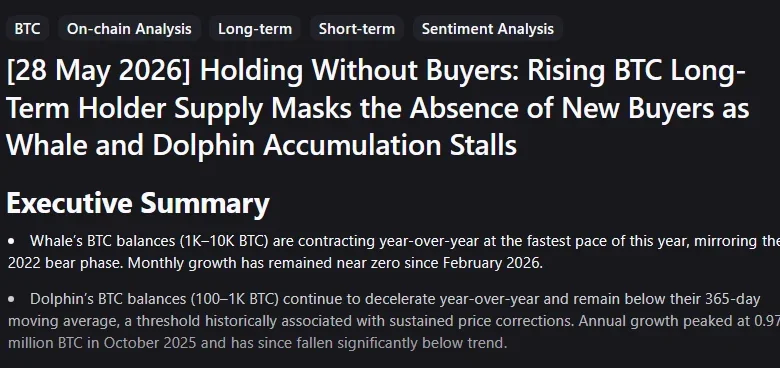
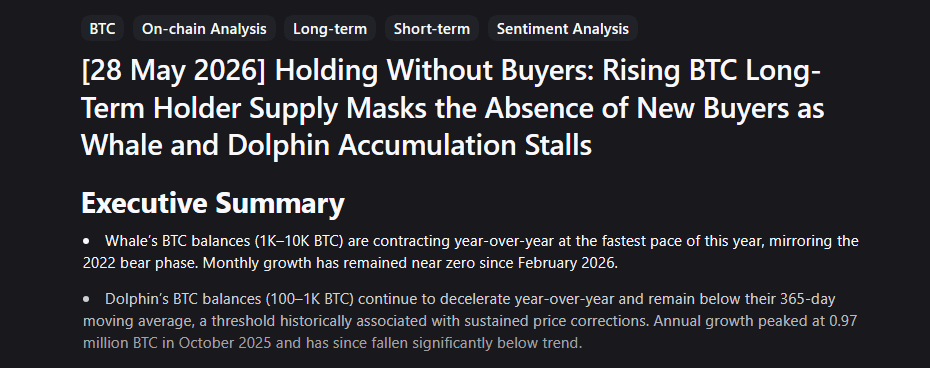
Analysis from industry observers, including the on-chain analytics firm CryptoQuant, reveals a significant shift in the behavior of major Bitcoin holders. Whale-sized accounts, defined as those possessing between 1,000 and 10,000 BTC, have experienced a negative annual balance growth. This signifies that these large entities are, on average, selling more Bitcoin than they are acquiring over a year-long period.
Furthermore, the monthly balance growth for this cohort has been largely stagnant since February. CryptoQuant points out that this pattern bears a striking resemblance to the conditions observed during the 2022 bear market, a period characterized by sharp and sustained price declines. The cessation of accumulation by these influential players can have a cascading effect on market psychology, potentially signaling a lack of confidence in near-term price appreciation.
Even slightly smaller, yet still substantial, holders, often referred to as "dolphins" (holding between 100 and 1,000 BTC), are exhibiting a similar trend. This category includes significant market participants such as exchange-traded funds (ETFs) and corporate treasury accounts. While their annual balances are still showing some growth, the rate of this expansion has decelerated considerably. Monthly growth for dolphins has hovered near zero, and their upward trajectory has posted lower highs since September 2025, indicating a tempered appetite for acquisition.
CryptoQuant emphasizes that these two investor groups—whales and dolphins—collectively represent the bedrock of structural demand in the Bitcoin market. Their reduced purchasing activity and, in the case of whales, net selling, therefore, presents a significant challenge to upward price momentum. The slowdown in their participation suggests a lack of conviction in the immediate future of Bitcoin’s price trajectory, contributing to the prevailing market uncertainty.

The Paradox of Long-Term Holder Supply Amidst Missing Buyers
A seemingly positive on-chain metric that belies the current market sentiment is the record high in long-term holder supply, which has reached an impressive 15.8 million BTC. Typically, an increase in the supply held by long-term investors is interpreted as a sign of strong conviction, indicating that holders are choosing to HODL through market volatility. However, in the current environment, CryptoQuant interprets this data differently. They suggest that the surge in long-term holder supply is not necessarily a reflection of new capital entering the market but rather an indication that existing holders are choosing to retain their positions, perhaps unwilling to realize losses. Crucially, this phenomenon occurs while new buyers remain absent, leading to a market that lacks the fresh demand necessary to absorb existing supply and drive prices higher.
This divergence between increased long-term holding and a lack of new buyer interest creates a delicate balance. The market is essentially experiencing a situation where the supply side is robust due to conviction from existing holders, but the demand side is anemic, preventing any significant price appreciation. This scenario can lead to extended periods of price stagnation or even gradual declines as sellers, even those holding for the long term, may eventually capitulate if their unrealized losses become too burdensome or if they anticipate further price drops.
Expert Analysis and Potential Price Floors
Tim Sun, a researcher at HashKey Group, corroborates the sentiment of widespread unrealized losses. He notes that the proportion of Bitcoin supply sitting at an unrealized loss has, at times, approached 50%. This is a level not witnessed since the trough of the 2022 downturn, underscoring the severity of the current market conditions for many investors.
Sun identifies a potential absolute bottom range for Bitcoin between $40,000 and $45,000. However, he considers a more realistic floor to be in the range of $55,000 to $60,000. This latter estimate is contingent on a stable geopolitical landscape, specifically the absence of escalating tensions between the United States and Iran, and a measured approach from the Federal Reserve regarding interest rate hikes. Any adverse developments on these fronts could, in Sun’s view, push Bitcoin below this more optimistic floor.
Crypto analyst Darkfost, whose insights are frequently cited in market commentary, described the current market as navigating a "difficult range." He observes that excitement momentarily emerges when Bitcoin approaches the upper bounds of this trading channel, but pessimism quickly reasserts itself as the price retreats. This pattern of fleeting optimism followed by renewed pessimism is characteristic of a market struggling to establish a clear direction.
Darkfost’s commentary, shared on social media platforms, highlights the ongoing battle between buyers and sellers within a distribution cluster, typically observed between $66,000 and $80,000. The current trading price, hovering around $73,510, places Bitcoin squarely within this contentious zone, indicating that neither bulls nor bears have established decisive control. The market’s inability to decisively break out of this range suggests a fundamental imbalance in supply and demand dynamics, or perhaps a collective pause as participants await clearer economic signals.
What a Genuine Recovery Would Entail
For a sustainable and genuine recovery in Bitcoin’s price, market analysts emphasize that a shift in macroeconomic conditions is paramount. Tim Sun is unequivocal that a turnaround hinges on more than just price action. He asserts that a definitive move towards more accommodative monetary policies and a loosening of financial conditions globally would need to precede or coincide with any significant price resurgence.
A period of easing monetary policy, such as interest rate cuts by major central banks, would typically lead to increased liquidity in financial markets. This increased liquidity can often find its way into riskier assets, including cryptocurrencies like Bitcoin. Conversely, a continuation of restrictive monetary policies or further interest rate hikes would likely dampen investor appetite for speculative assets, exacerbating the current market pressures.
The current environment, marked by cautious optimism regarding inflation but also by persistent concerns about economic growth and geopolitical stability, creates a complex backdrop for Bitcoin. The cryptocurrency, often perceived as a risk-on asset, is highly sensitive to shifts in global economic sentiment and monetary policy. Without a clear signal of easing financial conditions, the market may remain in a state of flux, characterized by price volatility and a struggle to establish new, sustained upward trends.
The implications of the current market situation are far-reaching. For individual investors, the prevalence of unrealized losses necessitates a re-evaluation of their risk tolerance and investment horizons. For institutional players, the slowdown in accumulation among whales and dolphins could signal a more cautious approach to the asset class, potentially delaying further widespread institutional adoption until clearer market signals emerge. The continued dominance of long-term holders, while indicative of resilience, also underscores the immediate challenge of attracting new capital to fuel significant price appreciation. The path forward for Bitcoin will likely be shaped by a confluence of on-chain data, macroeconomic trends, and evolving investor sentiment.
The data, as it stands, paints a picture of a market still actively searching for its footing. The trading range, the behavior of large holders, and the composition of supply all point towards a period of uncertainty. While the long-term conviction of existing holders provides a degree of support, the absence of robust new demand presents a significant hurdle to overcome. The coming months will be crucial in determining whether Bitcoin can navigate these challenges and re-establish a trajectory of sustainable growth, or if it will remain mired in a period of consolidation and price discovery. The interplay between global economic policy, geopolitical events, and the intrinsic dynamics of the Bitcoin network will ultimately dictate the market’s direction.