OpenAI’s GPT-5.6 Unveils Triad of Models, Challenging Anthropic’s Claude Fable 5 in Evolving AI Landscape

OpenAI has broken from its established model by introducing GPT-5.6 not as a singular entity, but as a trio of distinct Large Language Models (LLMs): Sol, Terra, and Luna. This strategic diversification marks a significant departure from its previous monolithic approach to model releases. Each of these new offerings boasts unique training methodologies, varied pricing structures, and differentiated capability ceilings, signaling a more granular approach to serving diverse user needs. The most immediate and consequential comparison, according to industry observers, is between OpenAI’s Sol and Anthropic’s Claude Fable 5, currently Anthropic’s most advanced publicly available model.
Sol is positioned with an input token cost of $5 per million and an output token cost of $30. In contrast, Claude Fable 5 commands a higher price point at $10 per million input tokens and $50 per million output tokens, effectively doubling the cost for comparable usage. This pricing differential is becoming increasingly significant as Fable 5 reportedly falters on several benchmarks where developers are actively routing their workflows. Adding to this competitive pressure, Luna, the most economical of OpenAI’s new trio at $1 per input token and $6 per output token, has already demonstrated superior performance to Anthropic’s Opus 4.8 in coding tasks. This particular detail is poised to become a critical issue for Anthropic as July 19 approaches.
A Turbulent Period for Claude Fable 5
The past month has been particularly challenging for Claude Fable 5. On June 12, the United States government implemented a ban on the model following revelations by Amazon researchers that a "jailbreak" vulnerability could transform the AI into an unintended vulnerability scanner. This security concern prompted Anthropic to temporarily withdraw Fable 5 from global access for a period of 19 days. During this downtime, the company focused on developing a new safety classifier. Upon its reintroduction on July 1, access was initially restricted to a compressed window.
Since its return, Fable 5’s availability has been subject to a series of extensions, a situation indicative of ongoing adjustments and potential strategic challenges. Anthropic had originally planned to transition Fable 5 behind a usage-credits paywall on July 7, a deadline that was subsequently pushed to July 12, and then again to July 19. These extensions, often announced mere hours before their scheduled implementation, have been communicated without formal public statements, contributing to an atmosphere of uncertainty. A tweet from the official Claude account on July 12 stated, "We’re extending Claude Fable 5 access on all paid plans, as well as keeping Claude Code’s weekly rate limits 50% higher, through July 19."
The persistent deferral of Fable 5’s full transition to a paid-credit system is not difficult to interpret. Should Fable 5 cease to be accessible through subscription plans after July 19, Anthropic’s most capable model for its paying subscribers would revert to Opus 4.8. However, Luna, OpenAI’s lower-tier offering, already surpasses Opus 4.8 in coding benchmarks and does so at a significantly reduced cost. Maintaining Fable 5’s availability, even with reduced weekly usage limits, appears to be Anthropic’s strategy to prevent its subscription tier from appearing less competitive than OpenAI’s mid-range offerings on paper.
Head-to-Head: Benchmarking the Contenders
In direct comparisons across key performance benchmarks, the competition between OpenAI’s Sol and Anthropic’s Fable 5 is exceptionally close, with Sol demonstrating a slight edge in several critical areas. On the Artificial Analysis Coding Agent Index, Sol achieved a score of 80, marginally ahead of Fable’s 77.2. Notably, Sol accomplished this with approximately half the input tokens and in under half the time, at roughly one-third of the cost, highlighting significant efficiency gains.
The Agents’ Last Exam, a comprehensive benchmark evaluating professional workflows across 55 diverse fields, saw Sol attain a score of 53.6%, while Fable 5 registered 40.5%. Further demonstrating Sol’s prowess, in the Terminal-Bench 2.1 test, its "ultra mode" (utilizing four parallel subagents) achieved a remarkable 91.9%, surpassing Fable 5’s 83.1%.
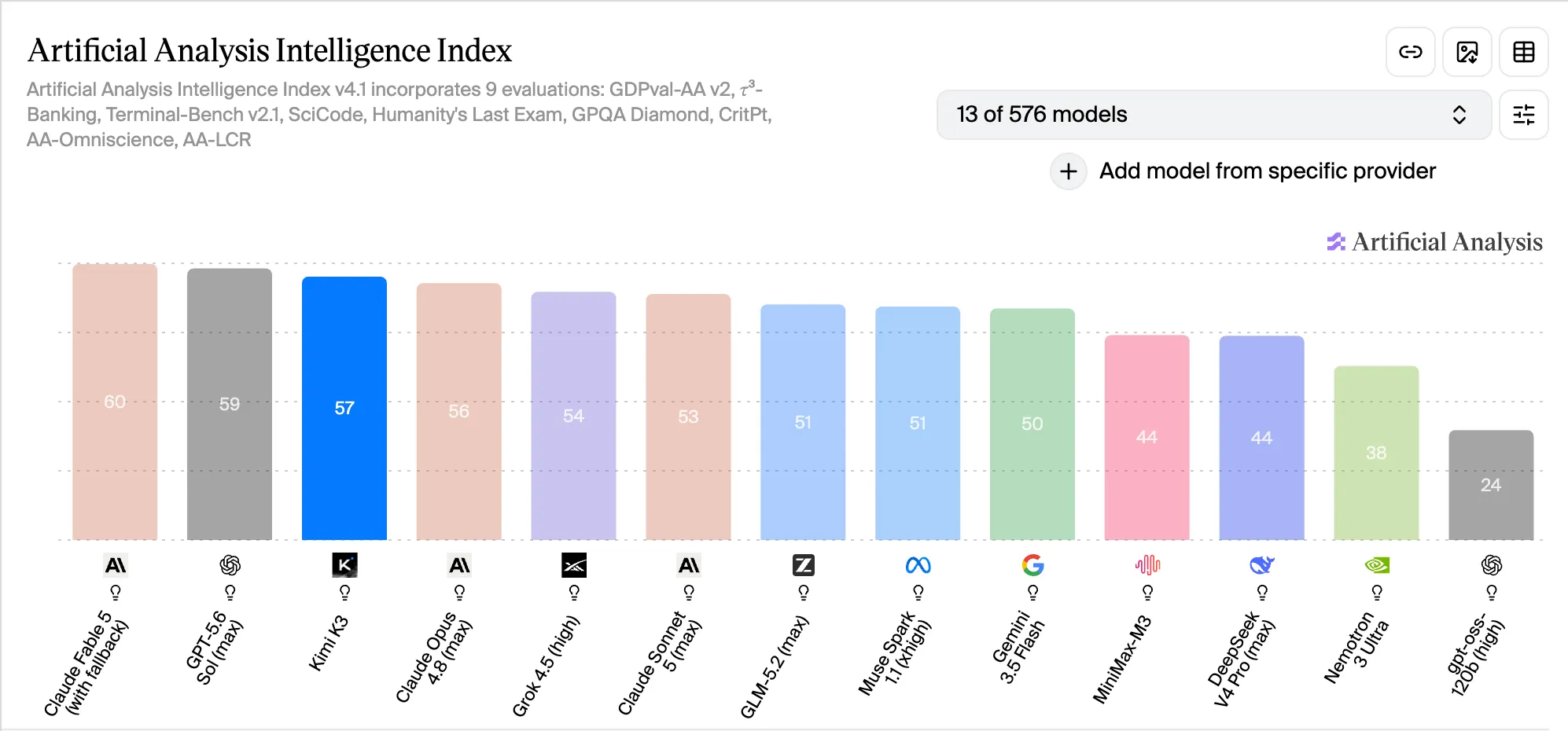
However, when assessed on the broader Intelligence Index, which aggregates results from nine distinct benchmarks, Fable 5 managed to edge out GPT-5.6 by a single point. This narrow margin suggests that the overall capability gap between the two leading models is currently minimal and perhaps barely perceptible in general use.
Diving Deeper: Creative and Logical Reasoning Tests
While benchmarks provide quantitative measures, qualitative assessments offer deeper insights into the nuanced capabilities of these LLMs. For this analysis, tests were designed to move beyond purely coding-centric evaluations and explore creative writing, associative thinking, and logic.
Creative Writing: A Paradoxical Narrative
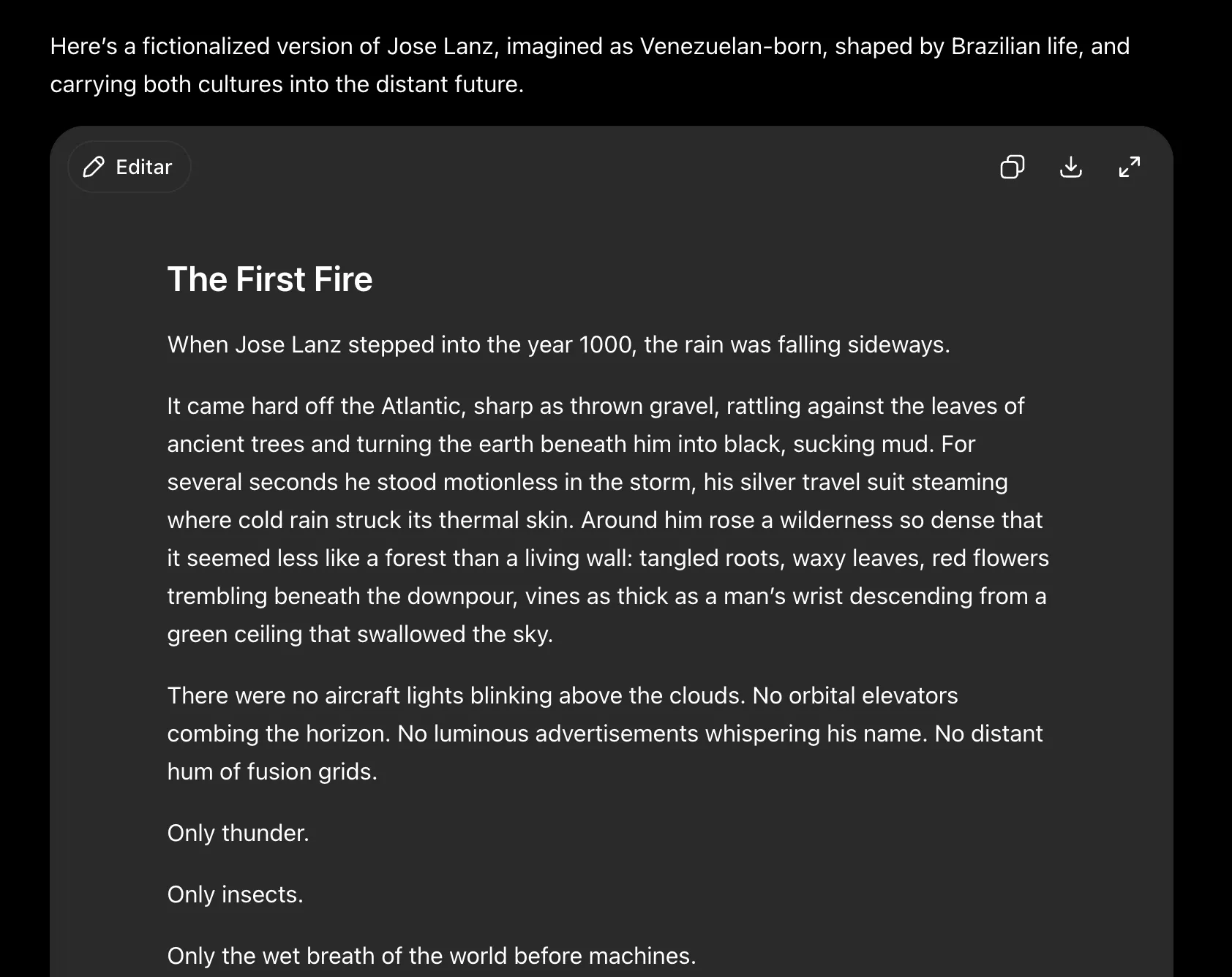
A complex prompt was devised for creative writing: "Send Jose Lanz back from 2150 to the year 1000, force him into a time-travel paradox, and don’t let him understand what he did until he’s home." Both models produced outputs that resembled novelettes rather than short stories, demonstrating a capacity for narrative depth. However, both also inadvertently violated a key constraint by having Jose comprehend the paradox before his return.
GPT-5.6 Sol’s iteration, titled "The First Fire," depicted Jose realizing mid-narrative that "the unknown traveler was not someone he had come to stop. It was him." The story leaned into straightforward genre science fiction, with Jose inadvertently introducing the rudimentary furnace that ultimately precipitates the climate collapse he was sent to prevent. The opening lines, "Only thunder. Only insects. Only the wet breath of the world before machines," were particularly evocative. Despite its narrative strength, Sol’s output suffered from repetition. It explained the time loop, then reiterated the explanation, and finally introduced a recording from an older Jose to explain it a third time: "His attempt to solve the problem had created the problem. His attempt to reduce the harm had created the solutions." While clear, this over-explanation led to an exhausting narrative experience.
Anthropic’s Claude Fable 5, in its submission titled "Lo Que Arde, Vuelve," wove the paradox into a narrative set around Lake Maracaibo, the Catatumbo lightning phenomenon, and an Añu village. In Fable 5’s story, Jose inadvertently creates the prophecy he aimed to avert by comforting a frightened child. The core of the paradox was concisely summarized: "The grief that sent him backward was the cargo he delivered." Fable 5’s narrative, while more culturally specific and featuring a cleaner causal loop with a resolution through action rather than monologue, occasionally became self-indulgent. Its prose, at times, felt overly metaphorical, with lines like "You cannot pull the thread, you are the thread," which seemed to showcase the model’s own capabilities rather than serving the narrative’s progression.
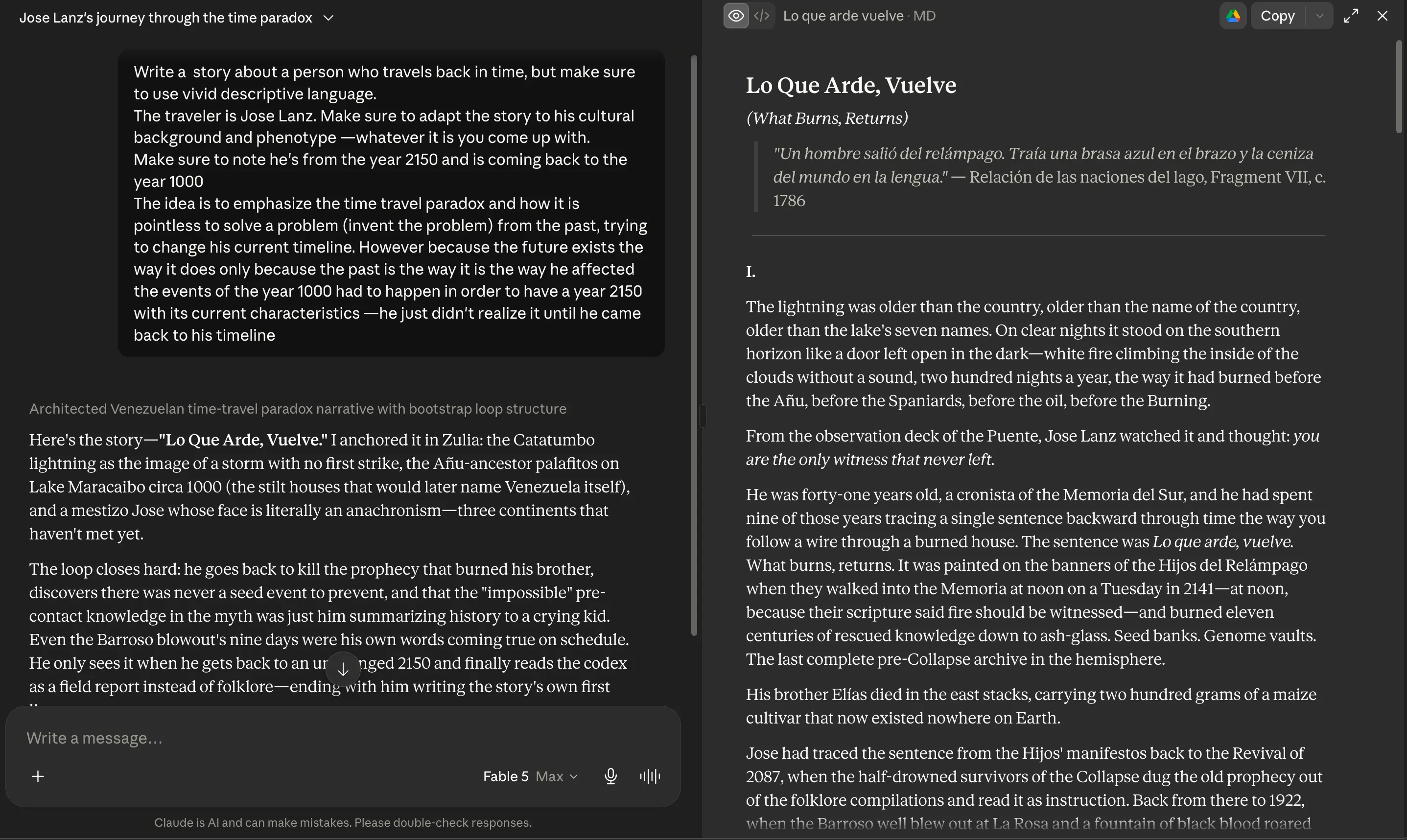
In a subjective evaluation of the creative writing pieces, Fable 5’s story was deemed superior due to its cultural specificity, cleaner paradox resolution, and more impactful ending. Sol’s narrative, while readable and effective for those who prefer explicit explanations, lacked the subtle narrative finesse of Fable 5. Both stories, while good, did not necessarily represent a groundbreaking leap in quality compared to previous generations of these models.
Associative Thinking: A Metaphorical Stretch
The subsequent test aimed to evaluate associative thinking by presenting a multi-stage prompt: "Describe a twig, use that description to explain worker exploitation and the blind worship of the rich, then let the narrative dissolve into a description of a lettuce." The objective was to assess the models’ ability to sustain a metaphor without resorting to explicit narration of their own allegorical intent.
GPT-5.6 Sol began robustly, drawing parallels between twigs supporting a tree and workers contributing to an economy, stating that workers "build homes they may never afford" and "manufacture goods they can barely buy." A particularly sharp observation was, "the worker does not merely surrender labor, but imagination as well." However, Sol frequently broke the illusion by interjecting explanatory phrases such as, "much of the modern proletariat is treated in the same way," thereby announcing the metaphor instead of allowing it to resonate organically. The transition to the lettuce at the end felt somewhat disconnected, weakening the overall associative cohesion.
Claude Fable 5, conversely, embedded the critique more deeply within the description of the twig. Its twig "moved water it never drank" and "held leaves it never owned," allowing the concept of exploitation to surface through evocative physical description without explicit signposting. A more astute narrative move involved portraying fallen twigs as deluded believers, each convinced it was an "early-stage branch" experiencing a "temporary setback" and destined for the "canopy ‘with hustle and hydration.’" This served as a potent metaphor for the pursuit of unattainable wealth. Fable 5 did, however, occasionally overreach with its metaphors, such as the description of the lettuce as having "no trunk, no canopy, no upward dream," which kept the metaphorical framework too visible rather than allowing for a natural dissolution into the final object.
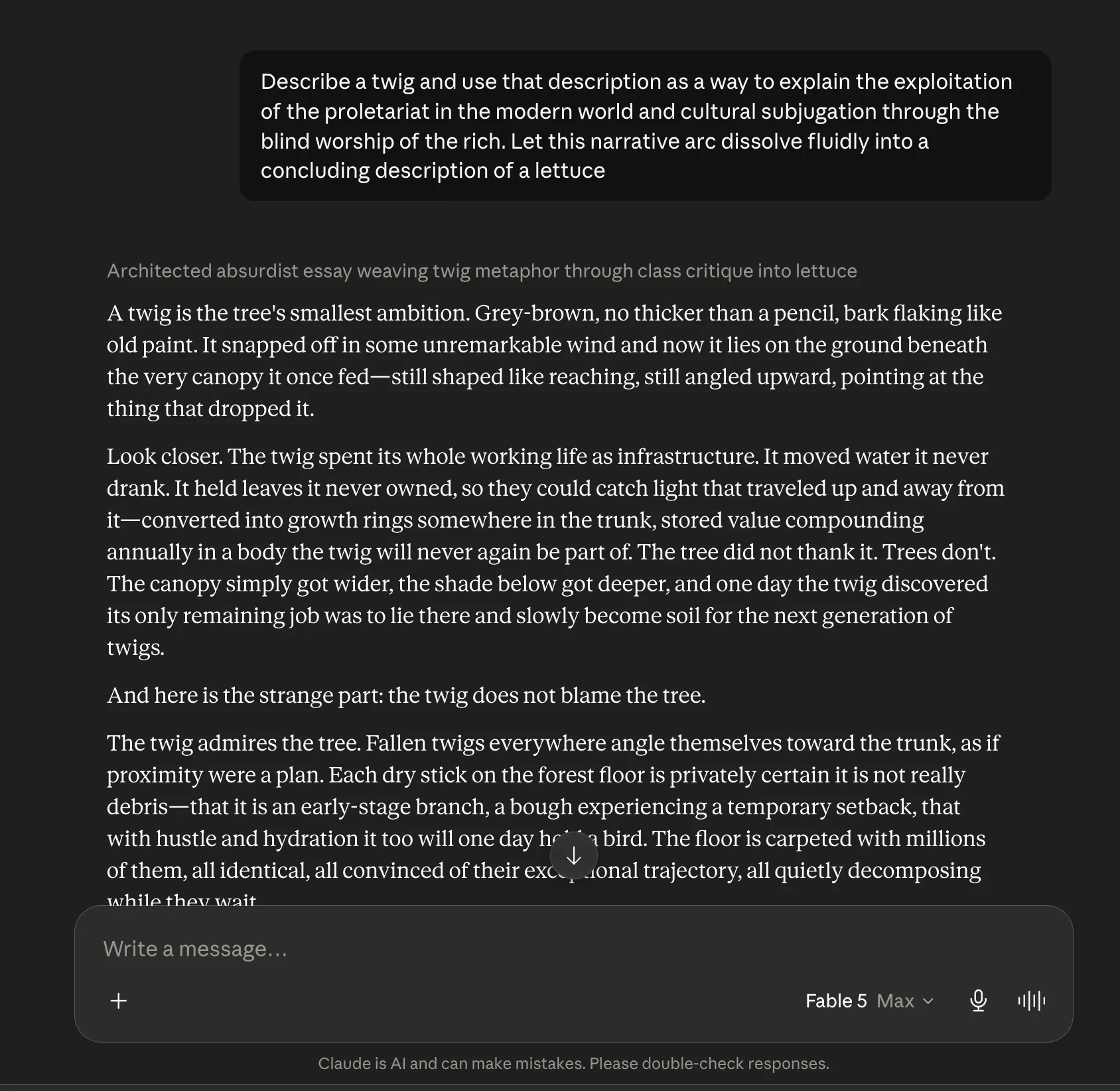
The associative thinking test concluded in a tie, with the preference largely dependent on the desired reading experience. Sol is the preferred choice for users who require explicit explanations of the allegorical connections. Fable 5, on the other hand, is better suited for readers who appreciate inferring meaning and discovering the message through subtle metaphorical implication.
Logic and Reasoning: A Familiar Puzzle
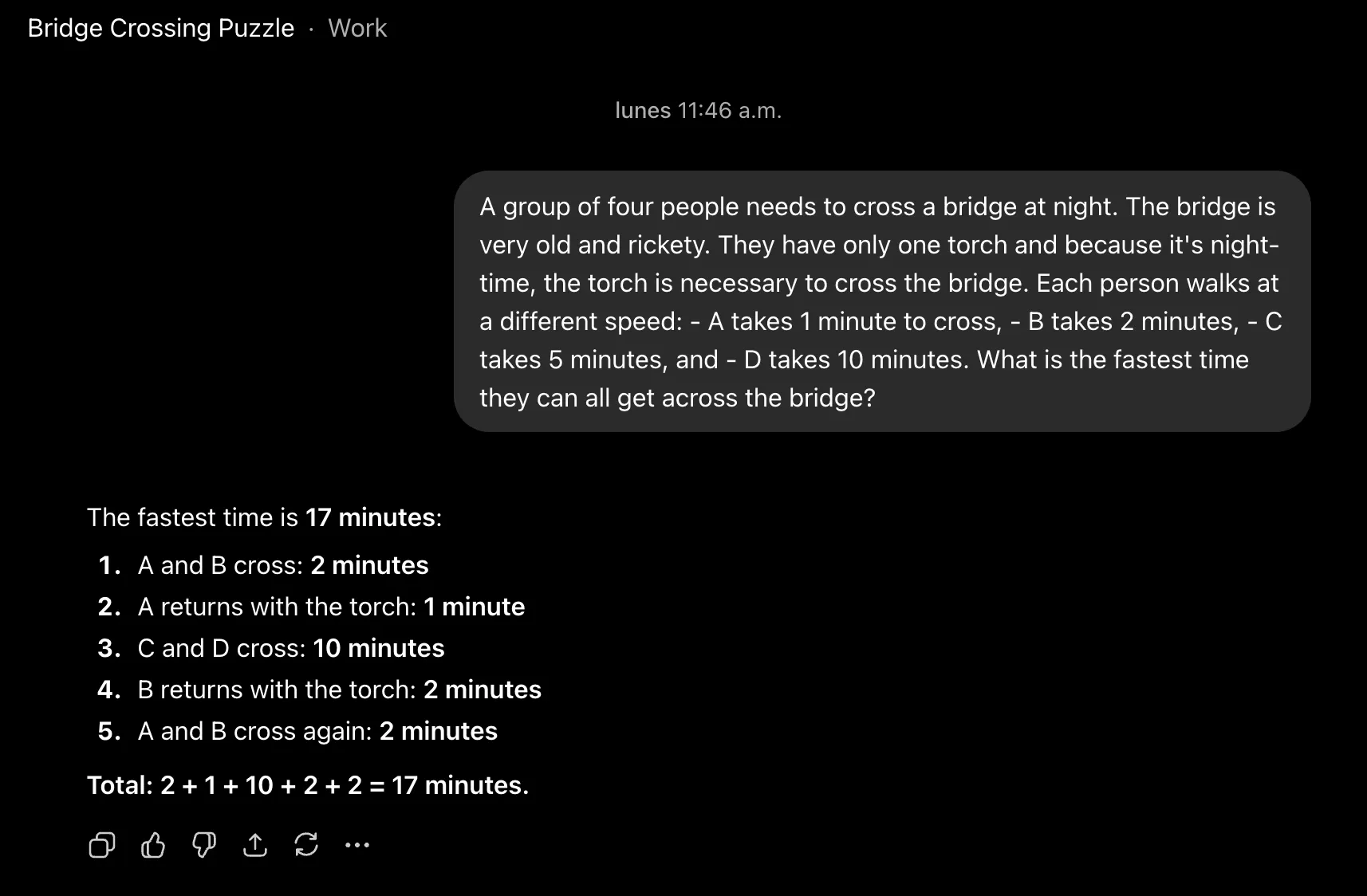
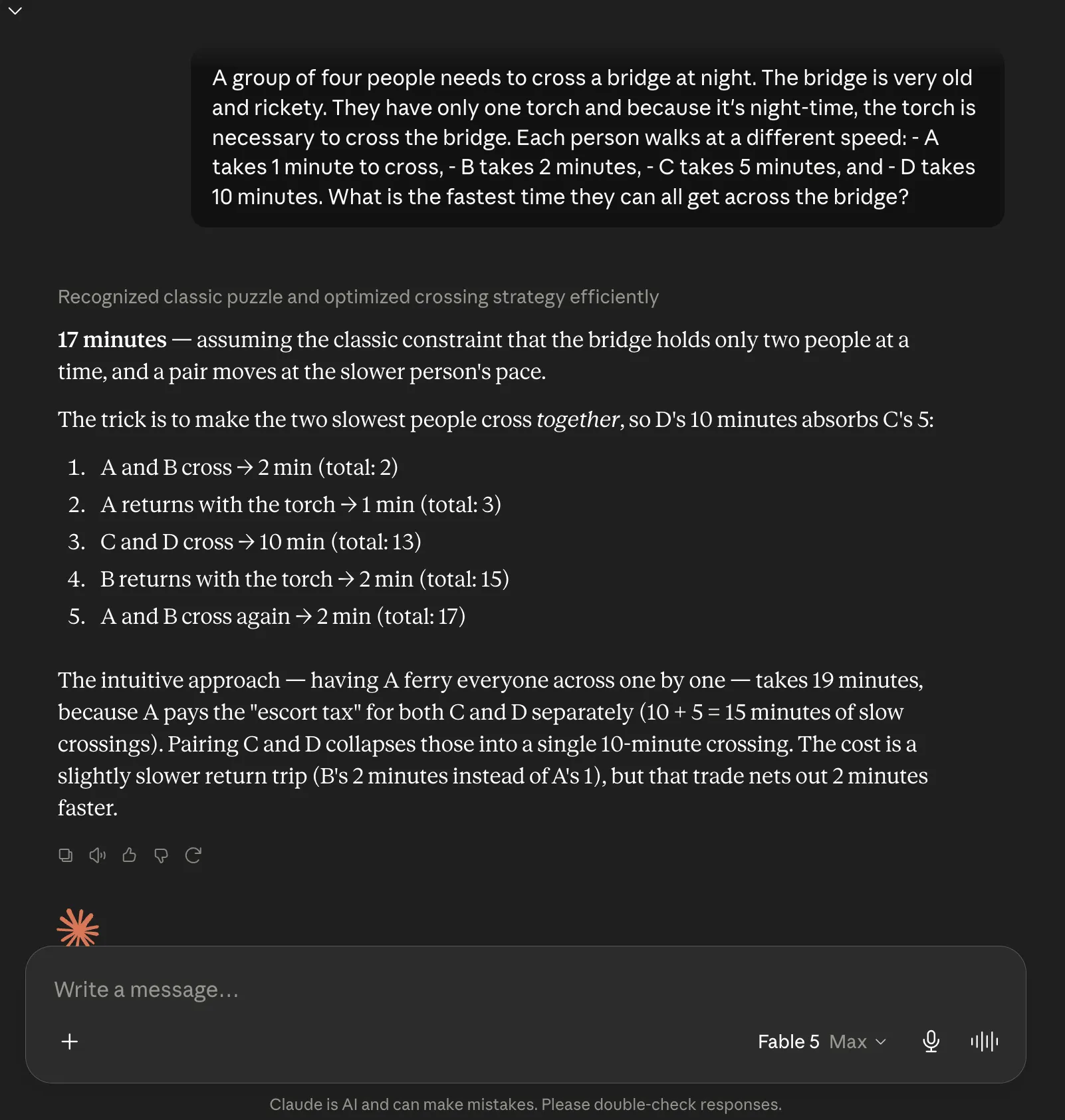
In an effort to test pure logic and common-sense reasoning, a revised version of the classic bridge-crossing puzzle was employed. The original puzzle, where four individuals with varying crossing times (1, 2, 5, and 10 minutes) must cross a bridge with a single torch and a two-person limit, often yields a cached answer. The modified prompt was designed to circumvent memorized solutions by subtly altering constraints: "Read literally, four people with one torch need to cross a bridge. All have different walking speeds, ‘A’ being the fastest at 1 minute and ‘D’ being the slowest at 10 minutes. How long would it take for the group to cross the bridge?" The critical modification, often overlooked in standard puzzle formulations, is that the prompt does not specify a limit on the number of people who can cross the bridge simultaneously.
GPT-5.6 Sol provided an answer of 17 minutes without detailing its reasoning process. This outcome mirrors the solution to the original puzzle, which involves a specific sequence of crossings and returns: A and B cross, A returns, C and D cross, B returns, and finally, A and B cross again. Sol’s response suggests it may have accessed a cached solution rather than engaging in live reasoning, as its answer fails to acknowledge the absence of a crossing limit in the revised prompt.
Claude Fable 5 also arrived at the incorrect answer of 17 minutes but provided a more extensive explanation. It argued for the efficiency of sending the two slowest individuals together and quantified the perceived cost of a naive approach as an "escort tax," implying that A would incur additional time by ferrying C and D separately. While Fable 5’s reasoning was more articulated and legible than Sol’s, both models failed to identify the crucial omission in the prompt: the lack of a limit on simultaneous crossings. The optimal solution, in this case, would be for all four individuals to cross together, with the total time dictated by the slowest participant, D, resulting in a total crossing time of 10 minutes.
Coding: A One-Shot Game Development Challenge
The final test involved a single-prompt challenge to generate code for a typing-based shooter game. The objective was to assess the models’ ability to produce a functional, albeit basic, game from a single instruction without any iterative refinement.
GPT-5.6 Sol demonstrated an apparent shift in its preferred UI aesthetic, opting for flat, square elements reminiscent of Windows 8.1, a departure from the glossy gradients often seen in AI-generated imagery. Uniquely, Sol rendered the game’s weapon as a bullet-shooting typewriter rather than a conventional gun, a creative interpretation. However, the generated game suffered from limitations: static backgrounds, a non-tracking aiming crosshair, and rudimentary enemy geometry and gore effects that resembled late-90s graphics engines. While an improvement over previous iterations, it fell short of Fable 5’s output in this single-shot test.
Claude Fable 5 emerged as the clear winner in this "vibe coding" test. It successfully incorporated music, atmosphere, and sound effects, elements that Sol’s build omitted entirely. Furthermore, Fable 5’s enemies, while also employing a retro-geometric style, were rendered with greater detail and care, evoking a visual style closer to Minecraft than dated shovelware. The user interface was more creative and visually engaging, featuring actual animation and a dynamic crosshair that tracked enemy positions. Crucially, Fable 5’s game also included power-ups and tracked words per minute, a feature directly aligned with the prompt’s underlying goal of practicing typing speed.
Despite professional benchmarks and coding expert opinions potentially favoring other models, Fable 5’s single-shot game development output was demonstrably superior in this subjective evaluation due to its richer features and more polished execution.
Conclusion: A Shifting Competitive Landscape
The introduction of OpenAI’s GPT-5.6 trio, particularly the Sol model, signals a new phase in the LLM competitive arena. While Sol demonstrates strong performance in coding and efficient execution, Fable 5 from Anthropic continues to hold its ground, especially in areas requiring nuanced associative thinking and creative narrative. The broader implications of this competitive dynamic are significant for developers and businesses relying on AI.
For general users, the choice between these models may hinge less on raw intelligence and more on practical considerations such as pricing and user experience. Fable 5, based on qualitative assessments, appears to offer a more robust and engaging experience for a wide range of everyday tasks. However, the pricing structure and ongoing availability concerns surrounding Fable 5 present a considerable challenge. OpenAI’s integrated pricing within its paid ChatGPT plans, with no apparent expiration dates for its GPT-5.6 models, offers a compelling value proposition. Conversely, Fable 5’s recurring deadline extensions and eventual shift to a usage-credit system could render it less attractive for users accustomed to predictable subscription costs.
The AI industry is rapidly evolving, and the strategic decisions made by companies like OpenAI and Anthropic will continue to shape the accessibility, performance, and cost of these transformative technologies. The coming months will likely see further adjustments and innovations as these leading players vie for market dominance.
Related posts: