Panasonic Automotive and Google Cloud Forge a New Era in Software-Defined Vehicle Cockpit Development

The automotive industry’s rapid transition towards software-defined vehicles (SDVs) is fundamentally reshaping the in-cabin experience, placing Cockpit Domain Controllers (CDCs) at the epicenter of innovation. The critical need for agile development, rigorous testing, and efficient validation of CDC software in a flexible, hardware-agnostic environment is paramount for accelerating time-to-market and fostering breakthrough advancements. However, global development teams have long grappled with the inherent limitations of physical hardware and the demanding requirements of high-performance graphics. Addressing these persistent challenges, Panasonic Automotive has unveiled its vSkipGen™ platform, a next-generation CDC virtualization solution that has now achieved validation on Google Cloud’s C4A-metal instances, part of its Axion bare-metal offering. This pivotal integration merges Panasonic Automotive’s sophisticated Unified HMI™ remote GPU offload technology with robust support for Android Automotive OS (AAOS) and Android Software Defined Vehicle (SDV), presenting a potent, cloud-native solution engineered to empower development and validation teams to innovate without the constraints of traditional hardware dependencies.
Google Cloud, a recognized leader in providing workload-optimized infrastructure, ensures that its C4A-metal instances are meticulously engineered to deliver the precise resources required for demanding automotive workloads. These instances are built upon Google Cloud’s proprietary Arm-based Axion architecture, mirroring the performance characteristics of the broader Axion virtual machine family. The C4A-metal offering boasts an impressive 96 vCPUs, dual DDR5 memory configurations of 384GB and 768GB, and a substantial networking bandwidth of up to 100Gbps. Furthermore, it provides comprehensive support for Google Cloud’s advanced Hyperdisk options, including Balanced, Extreme, Throughput, and ML types, catering to a wide spectrum of storage performance needs. Underpinning this robust infrastructure is Google Cloud’s Titanium technology, a cornerstone for multi-tier offloads and security, crucial for the integrity and performance of the entire bare-metal portfolio.
High Performance for Demanding Automotive Workloads
The C4A-metal instances are particularly adept at handling complex computational tasks, such as the creation of highly accurate digital twins of vehicle cockpits. In such scenarios, the performance of the virtual environment must precisely mirror real-world automotive behavior to ensure the fidelity of simulations and testing. Historically, the shift towards SDVs has been hampered by the expense and scarcity of physical prototypes. C4A-metal effectively circumvents these limitations by delivering the high performance and direct hardware-level access characteristic of bare-metal solutions, all within the elastic scalability of the cloud.
Panasonic Automotive is strategically leveraging C4A-metal to circumvent these traditional hardware bottlenecks. This enables their engineering teams to execute intricate virtualization tasks with unprecedented efficiency, thereby accelerating the development lifecycle for next-generation cockpit software. Andrew Poliak, CTO of Panasonic Automotive Systems America, articulated the transformative impact of this collaboration: "Google Cloud’s Axion Bare Metal has been a game-changer for our vSkipGen™ platform. By providing scalable, high-performance Arm-based infrastructure, C4A-metal allows our teams to develop and test production-intent software in the cloud with behavior that closely matches target automotive hardware. This cloud-to-car bit parity reduces dependence on costly physical prototypes, improves validation efficiency, increases test coverage, and accelerates time-to-market for next-generation cockpit platforms."

This synergy between vSkipGen and Unified HMI, operating on the C4A-metal infrastructure, empowers automotive manufacturers to construct, test, and validate entire AAOS stacks within a hardware-independent, cloud-native environment. This marks a significant departure from reliance on physical hardware, paving the way for scalable and sophisticated digital twin solutions.
Virtualizing the Cockpit: The Mechanics of vSkipGen
At its core, Panasonic Automotive’s vSkipGen functions as a sophisticated digital twin for physical Cockpit Domain Controller hardware. To facilitate a hardware-agnostic environment for Android virtual machines, vSkipGen integrates key components from Android Cuttlefish, a well-established Android emulator. The platform’s foundational element is a cloud-optimized Virtual Machine Monitor (VMM), engineered using crosvm. Crosvm, a security-focused VMM originally developed for Chrome OS, harnesses the power of Linux KVM (Kernel-based Virtual Machine) for efficient hardware-assisted virtualization. The VMM backend itself is meticulously implemented in Rust, a programming language renowned for its emphasis on security, scalability, and high performance. By running the complete software stack on C4A-metal, as illustrated in Figure 2, Panasonic enables developers to boot a full AAOS image in the cloud that precisely replicates the behavior of software executing on physical vehicle hardware.
The vSkipGen platform virtualizes all essential peripherals crucial for a modern in-cabin system. This includes audio, GPU, sensors, cameras, Controller Area Network (CAN) bus communications, Bluetooth, and Wi-Fi, all managed through the industry-standard VirtIO interface. This VirtIO-native approach ensures that developers can interact with these virtualized devices in precisely the same manner as they would with their physical counterparts. Furthermore, vSkipGen offers seamless integration with automotive simulators and Software-in-the-Loop (SiL) environments. This integration is vital for comprehensive scenario and edge-case validation, enabling development teams to conduct extensive software validation and execute automated test suites without the prerequisite of early access to physical prototypes. This capability significantly de-risks the development process and accelerates the testing phase.
Accelerating Graphics with Unified HMI
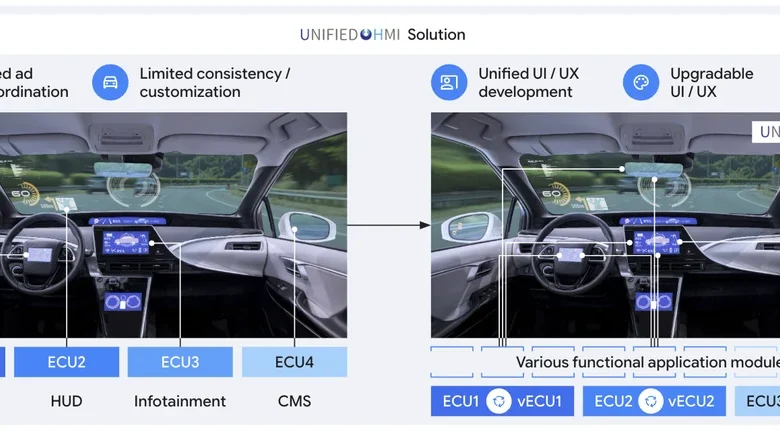
The provision of high-performance graphics is an indispensable element of the contemporary driving experience. However, rendering these complex visual elements within a virtualized environment has traditionally presented significant hurdles. Panasonic’s Unified HMI™ technology provides an elegant solution by decoupling HMI rendering from specific hardware dependencies. A streamlined Unified HMI component operates independently of the virtual machine. Its primary function is to offload OpenGL ES commands – the specific instructions that dictate what is rendered – from the Cuttlefish instance to GPU-equipped compute resources available on Google Cloud. These cloud-based resources, benefiting from hardware acceleration, efficiently process these rendering workloads. The resulting rendered user interface is then streamed to any standard web browser utilizing low-latency WebRTC (Web Real-Time Communication) technology. This innovative approach ensures that development teams, irrespective of their geographical location, can experience high-fidelity visuals in real-time, fostering seamless global collaboration.
Unified HMI establishes a unified virtual display layer that spans across multiple Electronic Control Units (ECUs) and virtual machines. This architectural design allows applications to render their output to different displays from any point within the system, providing unparalleled flexibility and a consistent user experience across diverse display configurations.

Benefits for Software-Defined Vehicle Development
The strategic alliance between Google Cloud’s C4A-metal instances and Panasonic Automotive’s vSkipGen platform offers a suite of compelling advantages for manufacturers engaged in the development of software-defined vehicles:
- Accelerated Time-to-Market: By eliminating the need for physical prototypes in the early stages of development and validation, teams can significantly shorten development cycles. This allows for quicker iterations and faster deployment of new features and updates.
- Reduced Development Costs: The reliance on expensive, scarce physical hardware is substantially reduced, leading to considerable cost savings in prototyping, testing, and validation.
- Enhanced Global Collaboration: The cloud-native nature of the solution allows distributed development teams to access and work on the same virtualized environment simultaneously, fostering seamless collaboration regardless of location.
- Improved Software Quality and Reliability: The ability to perform extensive testing in a highly realistic virtual environment, including complex edge cases and fault injection, leads to more robust and reliable software. The bit-parity between cloud environments and target hardware minimizes integration issues.
- Increased Innovation Velocity: With the foundational development and validation hurdles mitigated, engineering teams can focus more on innovation and the development of advanced features that differentiate their vehicles.
- Scalable Validation: The cloud infrastructure provides virtually limitless scalability, allowing for the execution of massive test suites and the validation of complex software configurations efficiently.
- Hardware Agnosticism: Developers can build and test software without being tied to specific hardware revisions or availability, providing greater flexibility and future-proofing.
Looking Ahead: The Future of In-Cabin Experiences
The collaboration between Panasonic Automotive and Google Cloud represents a significant leap forward in the evolution of automotive software development. The validation of Panasonic’s vSkipGen on Google Cloud’s C4A-metal instances is not merely a technological achievement; it is a strategic enabler for the entire automotive industry as it navigates the complex transition to software-defined vehicles. The ability to create, test, and validate sophisticated cockpit experiences in a high-performance, scalable, and accessible cloud environment will undoubtedly accelerate the delivery of innovative, safer, and more engaging in-cabin experiences for consumers worldwide.
The industry has been steadily moving towards this paradigm shift for several years. As far back as the late 2010s, major automotive OEMs began investing heavily in software capabilities, recognizing that the future of the automobile lay not just in mechanical engineering but increasingly in its digital brain. The COVID-19 pandemic further underscored the need for remote development and collaboration tools, accelerating the adoption of cloud-based solutions. This partnership builds upon that momentum, providing a concrete, high-performance platform for the next generation of automotive software.
The implications extend beyond just the development teams. As SDVs become more prevalent, the ability to deliver over-the-air (OTA) updates for infotainment, advanced driver-assistance systems (ADAS), and even core vehicle functions will become standard. A robust and efficient development and validation pipeline, as enabled by vSkipGen and Google Cloud, is essential to ensure the security and reliability of these critical updates. This ultimately translates to a better and more continuously evolving ownership experience for the end-user.
Getting Started with the Next Generation of Cockpit Development
C4A-metal instances are currently generally available worldwide. Interested parties can access comprehensive details and specifications in the public documentation concerning bare-metal instances. Panasonic Automotive’s vSkipGen, integrated with Unified HMI for Google Cloud, is expected to be available for evaluation access in the near future. To explore how these powerful solutions can expedite your cockpit software development initiatives, prospective clients are encouraged to contact the Panasonic Automotive team directly at [email protected]. This direct line of communication will facilitate discussions on specific project needs and deployment strategies, ensuring a smooth integration and maximum benefit from these cutting-edge technologies.

The industry is at an inflection point, and solutions like vSkipGen on Google Cloud are poised to define the future of how vehicles are conceived, developed, and experienced. The promise of faster innovation, reduced costs, and superior in-cabin experiences is now within closer reach, marking a new chapter in automotive engineering and design.
Disclaimer: All trademarks, tradenames, and service marks used herein are the property of their respective owners.
Related posts: