AWS CloudFormation Introduces Express Mode, Revolutionizing Infrastructure Deployment Speed by Up to Four Times

Amazon Web Services (AWS) has unveiled AWS CloudFormation Express mode, a significant advancement designed to dramatically accelerate infrastructure deployments for developers, AI tools, and organizations engaged in rapid iteration cycles. This new deployment mode streamlines the provisioning process by completing deployments once resource configurations are confirmed, rather than adhering to extended stabilization checks. The result is a reduction in deployment times by as much as four times, offering substantial benefits for both iterative development workflows and demanding production environments.
The introduction of Express mode addresses a long-standing need for faster feedback loops in cloud infrastructure management. Historically, CloudFormation deployments have included stabilization checks to ensure that newly provisioned resources are fully operational and ready to serve traffic before a deployment is considered complete. While crucial for scenarios demanding absolute certainty of resource readiness, these checks can introduce delays, particularly in development and testing phases where frequent changes are the norm. Express mode offers a pragmatic solution by allowing deployments to conclude once the configuration is applied, with resources continuing their operationalization in the background.
Understanding the Mechanics of Express Mode
At its core, CloudFormation’s standard deployment process involves a sequence of steps: resource provisioning, configuration application, and then stabilization checks. These stabilization checks are designed to verify that resources like web servers, databases, or load balancers have successfully started, are healthy, and are capable of handling incoming requests. This meticulous approach ensures that when a deployment is reported as complete, the underlying infrastructure is robust and ready for immediate use.
However, not all infrastructure deployments require this level of immediate, post-provisioning validation. Many development and testing scenarios benefit from faster iteration cycles. For instance, developers building and refining application components might deploy infrastructure incrementally, making small changes and redeploying frequently. In these situations, waiting for extensive stabilization checks can hinder productivity. Similarly, AI-driven infrastructure development, which often relies on rapid feedback loops to refine resource configurations and optimize performance, can be significantly hampered by prolonged deployment times.
Express mode addresses these use cases by redefining the completion criteria for a CloudFormation stack. Instead of waiting for the full suite of stabilization checks, Express mode signals deployment completion as soon as CloudFormation confirms that the resource configuration has been applied. This shift in focus allows developers to receive near-instantaneous confirmation that their infrastructure changes have been registered and are being processed by AWS.
Crucially, Express mode does not compromise the integrity or eventual operability of the provisioned resources. While the deployment itself concludes faster, AWS continues to work in the background to bring all resources to a fully operational state. Furthermore, CloudFormation has built-in resilience mechanisms that automatically retry dependent resources experiencing transient failures during the provisioning phase within the same stack. This inherent capability ensures that timing issues between resources as they stabilize are managed without requiring manual intervention from the customer. The fundamental principle of provisioning remains the same; only the timing of the deployment’s reported completion has been altered.
Quantifiable Performance Gains: Real-World Examples
The impact of CloudFormation Express mode is best illustrated through concrete examples. According to AWS, provisioning an Amazon Simple Queue Service (SQS) queue with a dead-letter queue (DLQ) that might typically take 64 seconds in standard mode can be completed in as little as 10 seconds using Express mode. This represents a significant acceleration, freeing up developer time and reducing the friction associated with infrastructure updates.
Another striking example is the deletion of an AWS Lambda function that includes network interface attachments. In standard mode, this operation can often take between 20 to 30 minutes due to the complexities of detaching network interfaces and ensuring all associated resources are properly cleaned up. With Express mode, this same deletion process can be completed in up to 10 seconds. This drastic reduction in deletion time is particularly beneficial for automated cleanup processes, testing scenarios involving frequent function updates, or environments where rapid teardown of resources is a necessity.
These performance improvements translate directly into increased developer productivity, faster release cycles, and more efficient resource utilization, especially in dynamic cloud environments. The ability to iterate on infrastructure configurations with such speed empowers teams to experiment more freely, optimize their architectures more effectively, and respond more agilely to changing business requirements.
Activation and Integration Across Development Tools
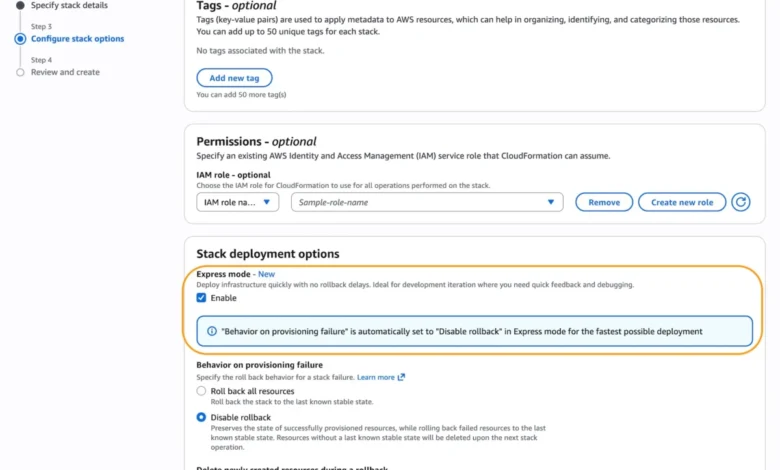
Implementing CloudFormation Express mode is designed to be straightforward and requires minimal changes to existing workflows. Users can enable Express mode directly within the AWS Management Console when creating a new CloudFormation stack. Under the "Stack deployment options," a simple toggle or selection for "Express mode" is available.
For those who prefer programmatic management, Express mode is fully supported via the AWS Command Line Interface (AWS CLI), AWS SDKs, and Infrastructure as Code (IaC) tools like the AWS Cloud Development Kit (CDK). When using the AWS CLI, Express mode is activated by setting the --deployment-config parameter to EXPRESS. For instance, a command to create a stack might look like this:
aws cloudformation create-stack
   --stack-name my-app
   --template-body file://template.yaml
   --deployment-config '"mode": "EXPRESS", "disableRollback": true'
It is important to note the disableRollback parameter. Express mode disables rollback by default to achieve the fastest possible iteration. However, for production environments where stability is paramount, it is recommended to re-enable rollback by setting disableRollback to false within the deployment-config. Alternatively, robust monitoring and cleanup mechanisms should be implemented for failed deployments.
The flexibility extends to incremental infrastructure development. For example, when building a microservice architecture, developers can use Express mode to add resources iteratively:
# Iteration 1: Deploy IAM role
aws cloudformation create-stack
--stack-name my-microservice
--template-body file://iteration1-iam.yaml
--deployment-config '"mode": "EXPRESS"'
--capabilities CAPABILITY_IAM
--role-arn arn:aws:iam::123456789012:role/CloudFormationDeployRole

# Iteration 2: Add Lambda function
aws cloudformation update-stack
--stack-name my-microservice
--template-body file://iteration2-lambda.yaml
--deployment-config '"mode": "EXPRESS"'
--capabilities CAPABILITY_IAM
--role-arn arn:aws:iam::123456789012:role/CloudFormationDeployRole

# Iteration 3: Add SQS queue and event source mapping
aws cloudformation update-stack
--stack-name my-microservice
--template-body file://iteration3-sqs.yaml
--deployment-config '"mode": "EXPRESS"'
--capabilities CAPABILITY_IAM
--role-arn arn:aws:iam::123456789012:role/CloudFormationDeployRole
For users of the AWS CDK, activating Express mode is as simple as appending the --express flag to the cdk deploy command:
cdk deploy --expressThis command automatically generates the CloudFormation template and deploys it using Express mode, ensuring that resources are provisioned efficiently.

Broader Implications and Availability
The introduction of CloudFormation Express mode signifies a strategic move by AWS to cater to the evolving needs of cloud-native development and the increasing adoption of AI in infrastructure management. By reducing deployment friction, AWS is empowering developers to build and iterate on complex cloud architectures with greater agility.
The implications for AI-assisted infrastructure development are particularly profound. Tools like Kiro, which leverage AI to assist in infrastructure design and deployment, can now benefit from sub-minute feedback loops. This allows AI models to learn and adapt more rapidly, leading to more optimized and efficient infrastructure configurations.
Express mode is compatible with all existing CloudFormation templates and supports all CloudFormation features, including change sets and nested stacks. When Express mode is enabled on a parent stack, all nested stacks within it will also automatically adopt Express mode, ensuring a consistent deployment experience across complex, multi-layered infrastructures.
AWS emphasizes that for scenarios where resources must be fully operational and validated before proceeding with traffic shifting or critical testing, the default deployment behavior remains available. This ensures that organizations can choose the deployment strategy that best aligns with their specific risk tolerance and operational requirements.
AWS CloudFormation Express mode is available starting today in all AWS commercial Regions at no additional cost. This widespread availability ensures that organizations across the globe can immediately leverage the benefits of faster infrastructure deployments. AWS has also provided resources for checking regional availability and exploring the future roadmap for this feature.
For developers seeking to integrate AI tools with CloudFormation, AWS offers guidance on using the AWS MCP Server and plugins, enabling seamless API calls, documentation searches, and troubleshooting for new features like Express mode.
In conclusion, AWS CloudFormation Express mode represents a significant leap forward in cloud infrastructure deployment efficiency. By intelligently rebalancing the trade-off between immediate deployment confirmation and extended stabilization checks, AWS is providing developers and AI tools with the speed and agility needed to thrive in today’s dynamic cloud landscape. This innovation is poised to accelerate development cycles, foster greater experimentation, and ultimately drive more efficient and cost-effective cloud operations. Organizations are encouraged to explore this new mode and provide feedback through AWS re:Post or their usual AWS Support channels.
Related posts: