Amazon DynamoDB Introduces Native Vector Search to Eliminate Database Complexity and Accelerate Generative AI Applications

Amazon Web Services has officially announced the general availability of native vector search capabilities within Amazon DynamoDB, marking a significant evolution for the widely utilized fully managed NoSQL database service. This long-awaited integration allows developers to store high-dimensional vector embeddings directly alongside traditional operational data within their existing DynamoDB tables. By eliminating the necessity to provision, manage, and synchronize a separate specialized vector database, the new feature seeks to drastically simplify the architectural overhead associated with building modern artificial intelligence applications, including retrieval-augmented generation (RAG), semantic search engines, and agentic memory frameworks.
The announcement addresses a persistent engineering challenge in cloud-native application design. Over the past several years, the rapid proliferation of generative artificial intelligence and large language models has driven organizations to adopt vector databases to enable semantic, similarity-based search queries. However, this architectural paradigm traditionally forced engineering teams to decouple their data layers, maintaining operational records in transactional databases like DynamoDB while replicating vector embeddings into dedicated vector stores. Maintaining these synchronization pipelines introduced substantial engineering complexity, increased data movement costs, heightened security and compliance perimeters, and created latency hurdles at scale.
With this update, Amazon DynamoDB natively bridges the gap between structured operational records and unstructured semantic representations. The service now supports single-digit millisecond latency while maintaining a 99 percent or higher recall rate, engineered to scale seamlessly to accommodate trillions of vectors without requiring capacity provisioning, manual software patching, or scheduled maintenance windows.
Technical Architecture and Operational Mechanics

Under the hood, vector search in DynamoDB is designed to integrate cleanly into existing table schemas without demanding sweeping data model overhauls. Developers generate vector embeddings using machine learning models of their choice—such as Amazon Bedrock Titan Text Embeddings, Cohere Embed, or various OpenAI text embedding models—and inject these numerical representations directly into their standard database items utilizing familiar operations like the PutItem or UpdateItem APIs.
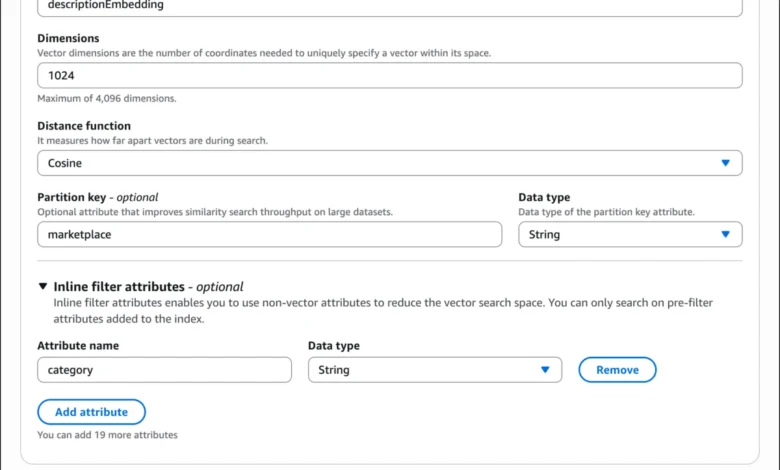
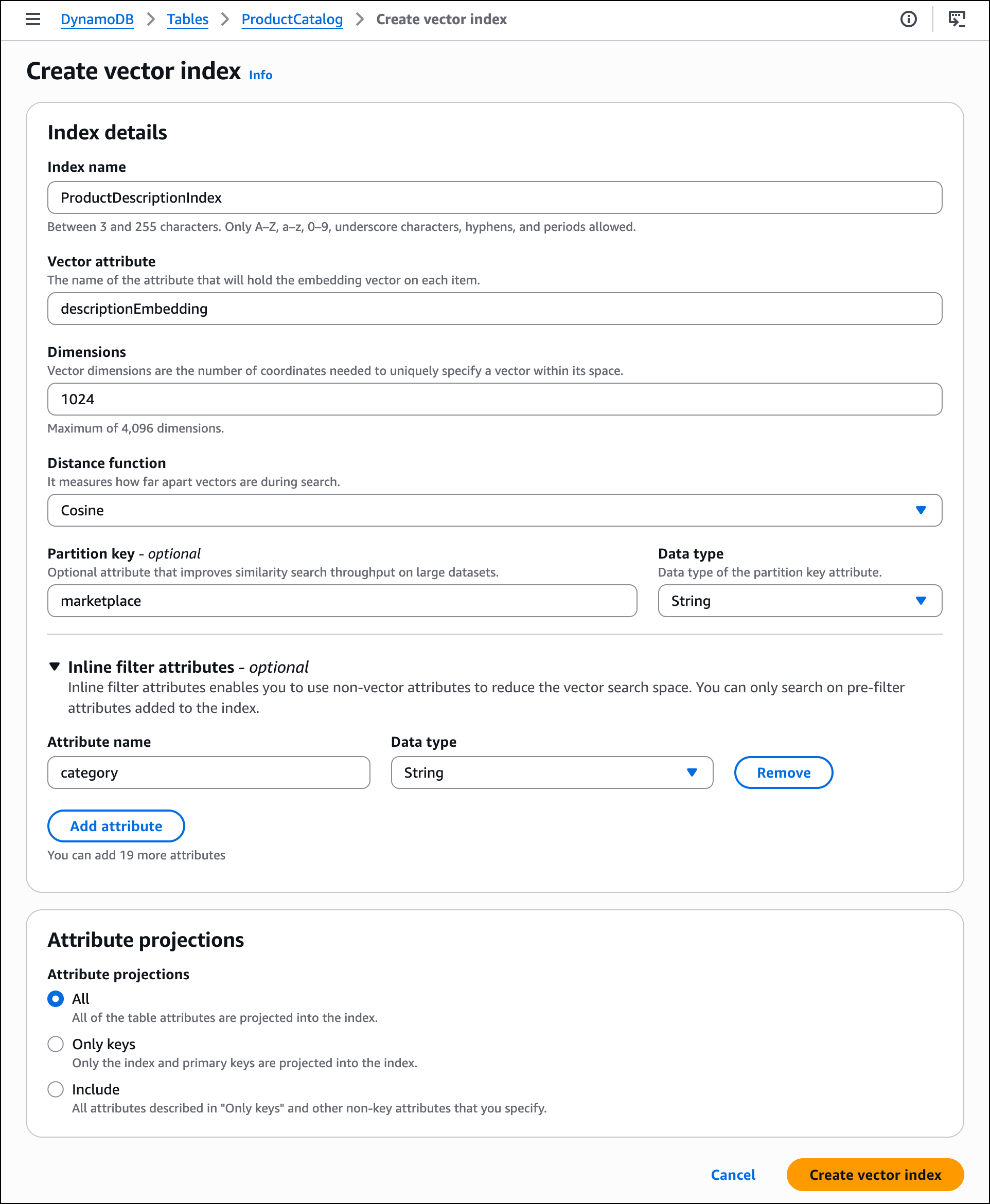
DynamoDB stores these vector embeddings using its pre-existing List data type, where each element in the list represents an individual floating-point number. To execute searches, administrators configure a newly introduced vector index type directly on the attribute containing the vector embeddings. During index creation, engineers specify the precise number of dimensions—up to a maximum of 4,096 dimensions—and choose among three supported distance functions: Cosine similarity, Euclidean distance, and Dot product.
Furthermore, the architecture allows for the incorporation of optional partition keys and inline filter attributes. By designating a partition key within the vector index, DynamoDB intelligently distributes vectors across distinct physical partitions, enabling the index to scale horizontally while ensuring that queries remain tightly scoped. For instance, a global e-commerce enterprise managing a multi-region product catalog can confine semantic searches to a specific geographic marketplace and filter results by precise categorical attributes—such as narrowing down footwear options—without scanning the entire global dataset. Once the index reaches an active state, applications can execute the new SearchVectors API, passing a query vector, a top-K results parameter up to 100, and optional filter conditions to receive a similarity-ranked response.
Industry Context and the Evolution of NoSQL Databases
The introduction of vector capabilities into DynamoDB reflects a broader industry-wide consolidation trend among cloud providers and database vendors. As enterprise adoption of generative AI transitions from experimental prototypes to mission-critical production systems, infrastructure costs and architectural simplicity have emerged as primary concerns for Chief Technology Officers and enterprise architects.

Historically, specialized vector search engines gained prominence due to the specialized hardware acceleration and indexing algorithms—such as Hierarchical Navigable Small World graphs or Inverted File indexes—required to compute high-dimensional mathematical distances efficiently. However, maintaining these standalone systems often resulted in fragmented data estates. Operational data lived in one silo, analytical data in a data warehouse, and vector embeddings in a dedicated vector database.
By embedding high-performance vector search directly into a serverless, pay-per-request transactional database, AWS is attempting to redefine the boundaries of what a NoSQL database can achieve. Industry analysts note that this capability positions DynamoDB to compete more aggressively not only with other managed NoSQL platforms but also with specialized vector database startups that have captured significant market attention over recent years. By keeping operational attributes—such as product pricing, inventory levels, and customer identifiers—physically co-located with their corresponding vector embeddings, developers can retrieve complete object payloads in a single database round-trip, significantly optimizing network overhead and application response times.
Practical Implementation: A Walkthrough of the Retail Catalog Scenario
To demonstrate the practical utility of the new feature, AWS outlined a reference architecture involving an online sporting goods retailer managing a robust product catalog table. In a conventional setup, shoppers relying on natural language queries like “lightweight running shoes for summer” would struggle to find relevant items unless their search terms matched exact keywords stored in the product descriptions.
By transitioning to DynamoDB vector search, the implementation unfolds across three primary phases: table preparation, index creation, and query execution.
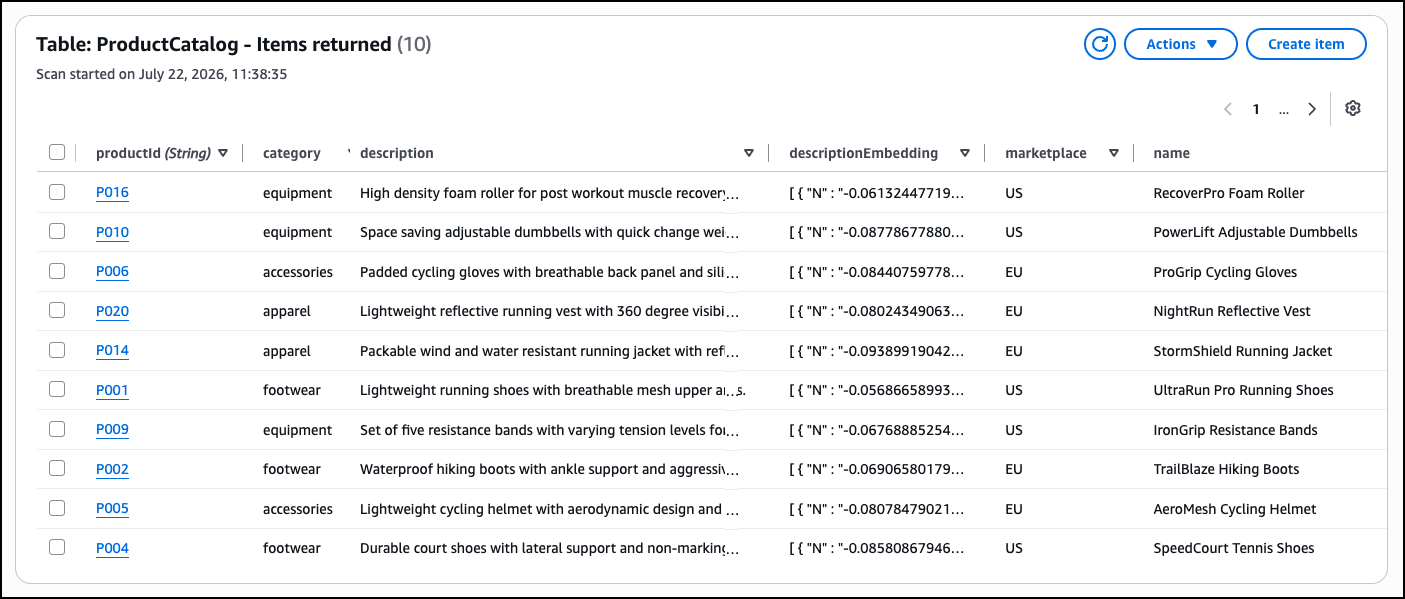
First, the enterprise prepares its existing ProductCatalog table by generating vector embeddings for historical product descriptions. Using Amazon Bedrock or an alternative embedding model, developers transform textual descriptions into numerical vectors that capture the semantic essence of the items. These vectors are then appended to each database item as a new attribute, such as descriptionEmbedding, utilizing standard write operations.
Second, administrators navigate to the DynamoDB management console to establish the ProductDescriptionIndex. Within the indexing configuration interface, they designate the vector attribute, select the appropriate dimension count, and set the distance function to Cosine, which measures the mathematical angle between vectors to determine semantic relatedness. To optimize performance at scale, the marketplace attribute is assigned as the partition key, while the product category is defined as an inline filter attribute for exact-match criteria.
Third, when a consumer inputs a natural language search query, the application generates a query vector using the same underlying machine learning model. By calling the vector search interface, the system queries the ProductDescriptionIndex, scopes the search parameters to the appropriate marketplace, applies the footwear category filter, and requests the top five most relevant results. DynamoDB evaluates the distance metrics, ranks the outcomes, and returns both the similarity scores and the associated operational attributes—such as product name, pricing, and availability—in a unified, low-latency response.
Broader Implications and Enterprise Availability
The general availability of vector search in Amazon DynamoDB spans all commercial AWS Regions, as well as AWS GovCloud (US) Regions, ensuring that enterprises operating under strict regulatory and compliance frameworks can immediately leverage the functionality. Pricing for the feature is fully integrated into DynamoDB’s existing serverless pay-per-request model, ensuring that organizations do not incur separate licensing fees or complex provisioning charges for their vector workloads.
For developers seeking to integrate these capabilities programmatically, AWS has also introduced support via the AWS MCP Server and dedicated plugins designed for modern AI coding assistants. These tooling enhancements allow engineering teams to interact with vector search APIs and consult updated developer documentation directly within their integrated development environments.
As organizations continue to scale their artificial intelligence deployments, the ability to perform semantic retrieval on transactional data without managing auxiliary infrastructure represents a notable leap forward in cloud database engineering. By collapsing multiple data tiers into a single, cohesive serverless platform, Amazon Web Services has substantially lowered the barrier to entry for developers aiming to infuse semantic intelligence into everyday enterprise applications.
Related posts: