Security Researcher Discovers Quartet of Critical Linux Kernel Flaws Enabling Local Privilege Escalation to Root

The security landscape surrounding open-source operating systems has faced a significant test following the public disclosure of four severe Linux kernel vulnerabilities. Security researcher Asim Manizada released working proof-of-concept (PoC) exploit code targeting a quartet of memory-safety flaws. Each of these vulnerabilities allows a local, unprivileged user to escalate their privileges to root—the highest administrative level on a Unix-like system.
Kernel maintainers, working in coordination with major Linux distributions, have already developed and released patches for all four security issues over the past few weeks. Systems operating on up-to-date kernels are protected against these specific vectors. However, because the exploit code is now publicly accessible, administrators running older, unpatched kernel builds face heightened risks, particularly on multi-user systems where lower-privileged accounts share hardware resources.
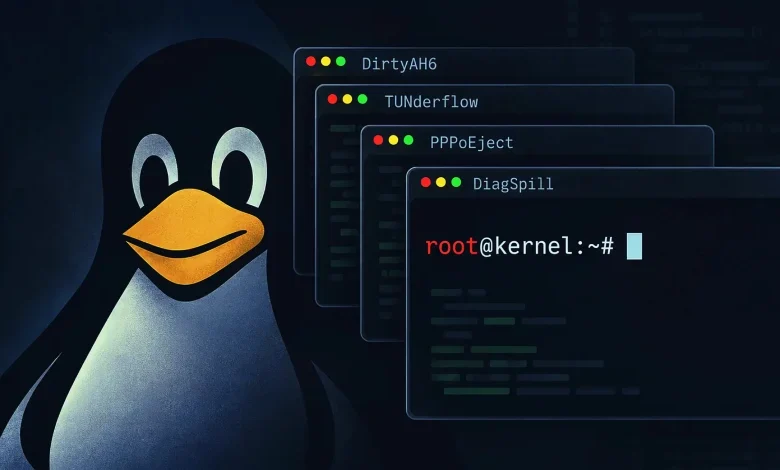
The newly disclosed vulnerabilities have been cataloged as DirtyAH6 (CVE-2026-80844), TUNderflow (CVE-2026-81000), PPPoEject (CVE-2026-68121), and DiagSpill (CVE-2026-74469). These discoveries underscore the ongoing challenges of securing legacy networking codebases within complex operating system kernels, as well as the evolving methodology of vulnerability discovery through automated and artificial intelligence-assisted techniques.
Chronology of Discovery and Coordinated Disclosure
The timeline of these vulnerabilities highlights a structured approach to responsible disclosure between independent researchers and the open-source community. The sequence of events unfolded over several months:
- Mid-July 2026: Security researcher Asim Manizada discovers the four memory-safety flaws during an audit of Linux kernel networking subsystems and reports them privately to the Linux kernel security team.
- July 2026: Manizada independently discloses a related Open vSwitch flaw, designated OVSwrap, drawing attention to recurring structural issues in networking drivers.
- Throughout August and Early September 2026: Linux kernel maintainers collaborate with major Linux distributions—including Debian, Ubuntu, Red Hat, and SUSE—to develop, test, and stage security patches.
- September 18, 2026: Following a coordinated disclosure hold, Manizada publishes a comprehensive technical write-up alongside working exploit code under the moniker "LPE Quartet."
To date, cybersecurity monitoring organizations and incident response teams have received no reports of these four vulnerabilities being exploited in active, real-world cyberattacks. The published exploits are finely tuned to specific kernel builds and run the risk of causing kernel panics or system crashes if deployed improperly, meaning they are currently suited primarily for isolated laboratory environments and security testing.
Detailed Breakdown of the Vulnerability Quartet
All four vulnerabilities originate from deep-seated memory-safety flaws within the kernel’s networking stack. The underlying design errors in these subsystems range from 10 to 21 years of age, demonstrating how dormant bugs can persist in critical codebases for decades until advanced analysis techniques uncover them.

The mechanism of each flaw centers on kernel memory corruption, which the researcher manipulated to execute arbitrary code and spawn a root shell. Despite sharing a similar ultimate impact—local privilege escalation—the prerequisites and affected kernel components vary significantly across the group.
The following data outlines the technical attributes of each discovered flaw:
- DirtyAH6 (CVE-2026-80844): Located in the IPv6 IPsec AH6 (Authentication Header) subsystem. It requires unprivileged user namespaces locally. Remotely, it can trigger a system crash, but only if the host acts as an IPv6 router or gateway utilizing an Authentication Header in transport mode.
- TUNderflow (CVE-2026-81000): Resides within the TUN/TAP virtual network device driver. Exploitation requires local unprivileged user namespaces and cannot be reached remotely.
- PPPoEject (CVE-2026-68121): Affects the Point-to-Point Protocol over Ethernet (PPPoE) subsystem. Like TUNderflow, it relies on unprivileged user namespaces and lacks any remote attack vector.
- DiagSpill (CVE-2026-74469): Found in the SCTP (Stream Control Transmission Protocol) diagnostic module (
sctp_diag). Notably, this is the only flaw in the quartet that does not require user namespaces or special local prerequisites, provided the SCTP networking module is loaded. It can cause a remote crash only if non-default SCTP options are actively enabled.
Analysis of Attack Vectors and Local Prerequisites
A critical factor in understanding the severity of these vulnerabilities is the role of unprivileged user namespaces. In modern Linux distributions, user namespaces are enabled by default. This feature allows ordinary, unprivileged users to create a private sandbox where they possess administrative capabilities internally, facilitating containerization technologies like Docker and LXC.
For three of the four flaws—DirtyAH6, TUNderflow, and PPPoEject—an attacker requires unprivileged user namespaces to be active in order to obtain the network privileges necessary to trigger the kernel bugs. Without this feature enabled, local execution is significantly restricted.
The exception to this rule is DiagSpill, which requires no user namespaces or pre-existing elevated privileges, provided the SCTP module is present on the host. However, realizing a full local privilege escalation via DiagSpill requires precise memory manipulation conditions.
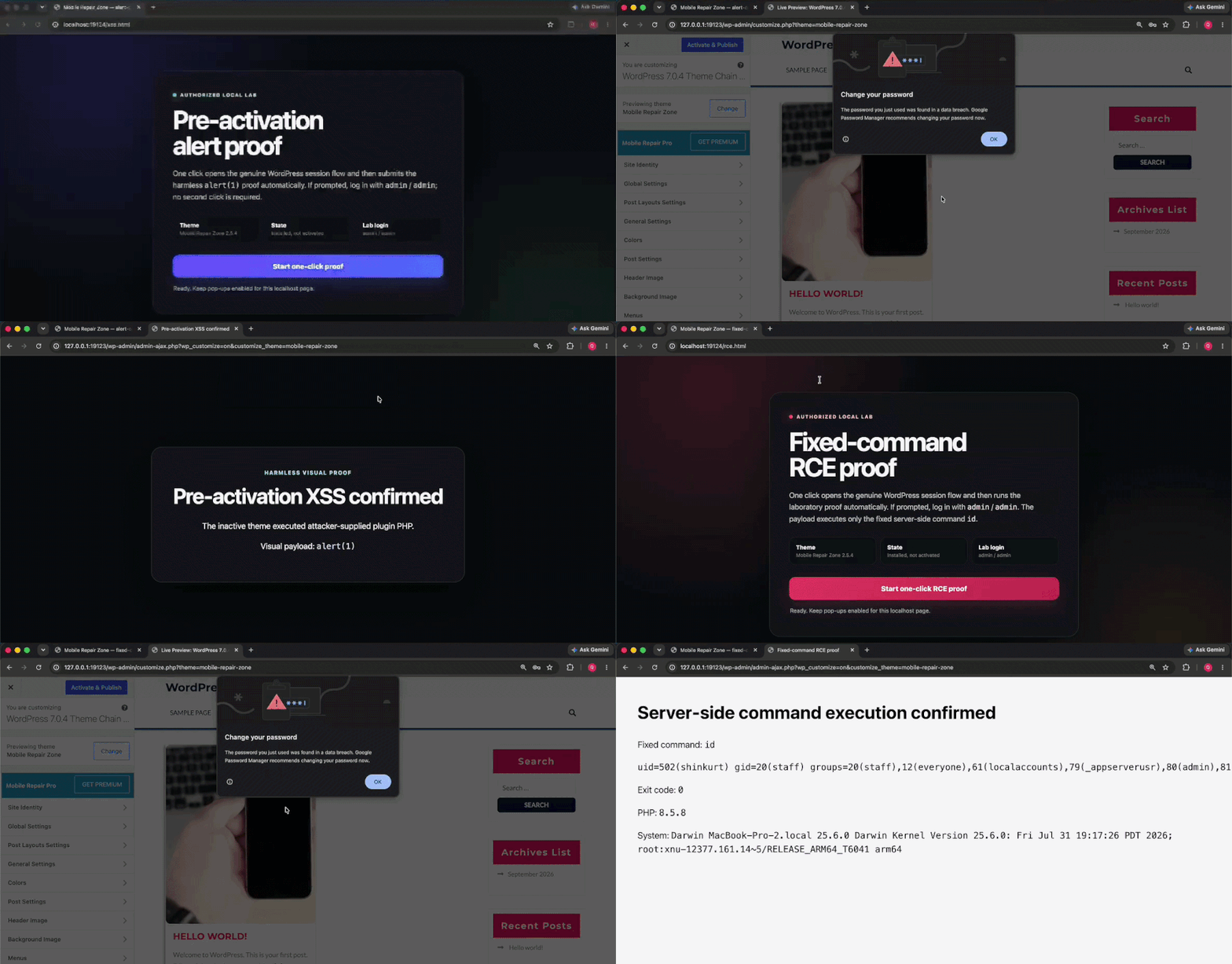
Regarding remote exploitation, Manizada noted that two of the flaws (DirtyAH6 and DiagSpill) could theoretically be triggered across a network interface, but their utility is strictly limited to causing denial-of-service (DoS) conditions through kernel crashes. While Manizada successfully achieved remote root execution using DirtyAH6 in a controlled lab setting, doing so required complex memory shaping on the target beforehand. He concluded that executing such an attack purely from a remote position without prior local access is exceptionally difficult. Furthermore, the researcher observed that these flaws could theoretically facilitate container escape scenarios, although explicit container escape exploits were not constructed during his testing.
The Role of Artificial Intelligence in Modern Vulnerability Research
A notable aspect of this disclosure is the methodology behind the discovery process. Manizada utilized an AI-assisted framework designed to construct comprehensive maps of how the Linux kernel manages memory and to reason about complex memory layouts.

This development aligns with a broader trend observed through 2026, wherein security researchers increasingly leverage large language models (LLMs) and specialized automated analysis tools to navigate millions of lines of source code. The integration of AI tools in identifying subtle memory-safety bugs has accelerated the discovery of deep-seated vulnerabilities that traditional fuzzing tools and manual code reviews frequently miss.
The efficiency of this approach is formally acknowledged within the open-source ecosystem. Specifically, the official Linux kernel commit patch addressing the DirtyAH6 vulnerability includes an "Assisted-by" attribution line crediting Manizada’s custom AI-driven tooling. This discovery follows other notable AI-assisted vulnerability disclosures earlier in the year, such as the OVSwrap flaw in July and technical techniques borrowed from the "Dirty Frag" vulnerability disclosed in May. Manizada has indicated that this comprehensive batch of discoveries likely marks the conclusion of this particular phase of his AI-assisted bug-hunting initiatives.
Remediation and Mitigation Strategies
System administrators and enterprise IT departments are urged to apply official kernel patches immediately. Because the vulnerability fixes have been backported by the primary Linux kernel development community and downstream vendors, administrators should consult the specific security advisories issued by their respective Linux distributions—such as Debian, Ubuntu, Red Hat, or SUSE—to ensure their systems are running kernel builds that incorporate all four patches.
Relying solely on version number comparisons with the mainline Linux kernel project can lead to inaccuracies, as commercial distributions manage their own release labeling and patch integration schedules.
In environments where immediate patching is operationally impossible, security teams can implement specific mitigating controls to reduce exposure:
- Restricting Unprivileged User Namespaces: Because three of the four exploits rely on unprivileged user namespaces to gain necessary network privileges, disabling this feature where containerization is not required significantly minimizes the local attack surface. This can often be configured via kernel runtime parameters (sysctl), such as setting
kernel.unprivileged_userns_clone=0on systems that support it. - Unloading Unused Kernel Modules: Disabling or blacklisting unnecessary networking modules, such as SCTP and PPPoE, prevents the exploitation of components like DiagSpill and PPPoEject.
Security experts emphasize that mitigation steps involving feature deactivation should be viewed strictly as temporary stopgaps. Permanent remediation requires applying comprehensive vendor updates, as alternative, undiscovered code paths leading to the same underlying memory-safety issues may still exist within unpatched kernels.