WordPress Core Vulnerability Click2Shell Exposes Millions to Remote Code Execution Through Forced Theme Installation

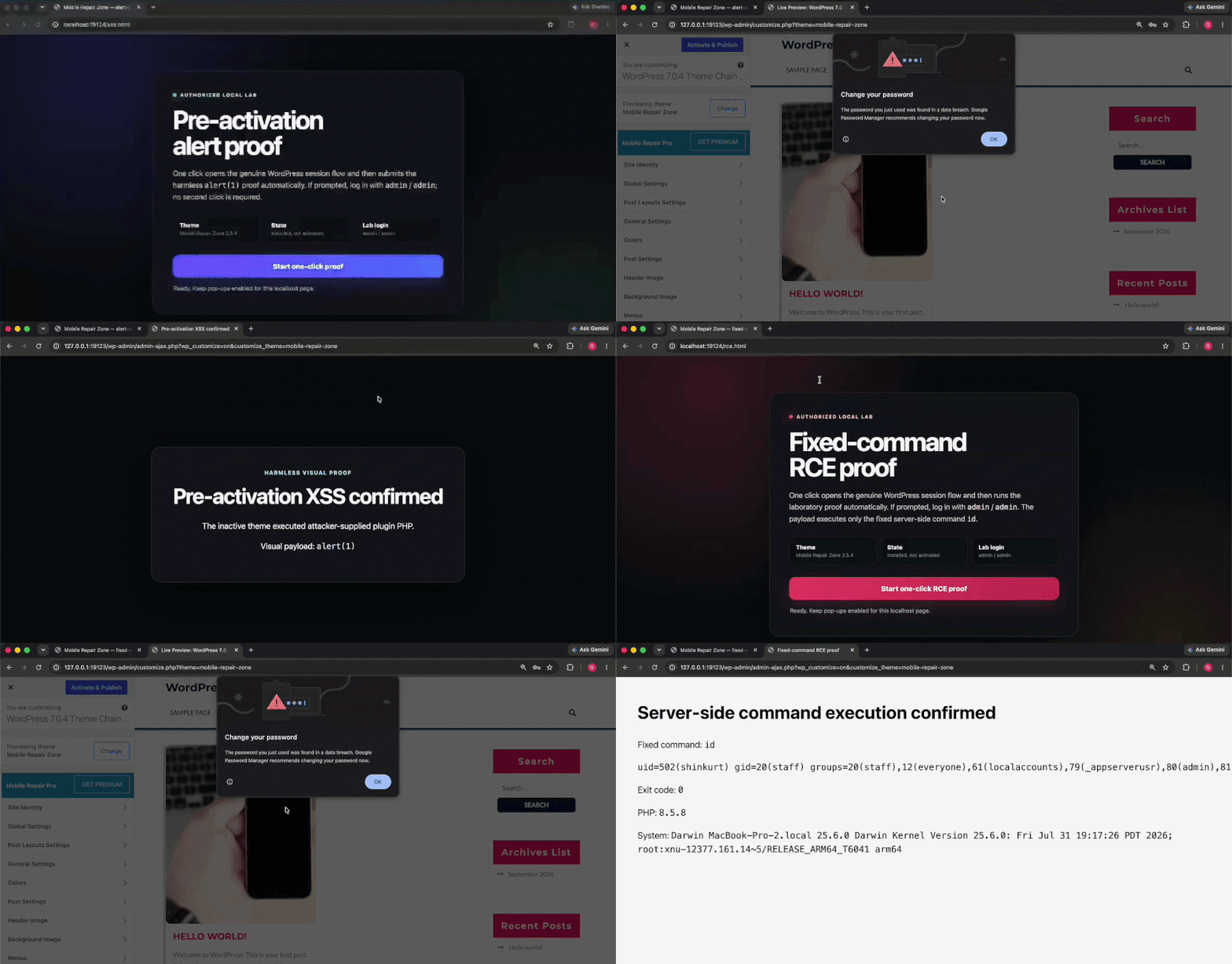
WordPress has rolled out emergency security patches addressing a critical vulnerability within its core software that could allow malicious actors to silently install themes and potentially achieve remote code execution (RCE) on targeted websites. Discovered and detailed by the security research firm pwn.ai, the attack chain has been dubbed "Click2Shell." The flaw exploits a subtle discrepancy in how WordPress components handle incoming URLs, enabling an attacker to trick a logged-in administrator into involuntarily executing malicious administrative actions simply by opening a crafted link.
The security update was officially deployed on September 17, 2026, alongside the release of WordPress version 7.1.1. Because the implications of the vulnerability stretch from unauthorized theme installations to full server compromise when combined with secondary weaknesses, maintainers and security experts are strongly urging web administrators to apply the patches immediately. While no active exploitation of the Click2Shell attack chain has been observed in the wild as of the patch release date, the potential risk profile remains severe due to the widespread deployment of WordPress across the global digital ecosystem.
Understanding the Mechanics of Click2Shell
The foundation of the Click2Shell vulnerability lies in a parsing misalignment between how the official WordPress.org directory processes parameters versus how an administrator’s web browser renders and executes interface scripts. According to pwn.ai’s technical breakdown, an attacker can construct a maliciously engineered hyperlink designed to interact with the WordPress dashboard. When an authenticated administrator—someone possessing sufficient privileges to install plugins or themes—clicks and opens this link, the WordPress.org repository interprets the payload as a legitimate request for a specific, publicly available theme.
Simultaneously, however, the administrator’s browser mishandles specific characters, punctuation, and parameters embedded within the URL string. This quirk redirects native interface scripts, effectively hijacking the dashboard’s Document Object Model (DOM) to locate and automatically activate the "Install" button for the requested theme. Crucially, because the target administrator is already logged into the backend session, their active authentication token and security privileges are automatically applied to the transaction. Consequently, the installation process requires no manual confirmation, credentials, or administrative interaction beyond the initial click of the malicious link.

On its own, the core vulnerability is bounded by certain limitations. The Click2Shell mechanism cannot accept arbitrary or malicious ZIP archives directly; it is restricted to pulling valid themes hosted within the official WordPress.org directory. Furthermore, once installed, the rogue theme remains inactive by default, meaning the visual frontend appearance of the affected website does not immediately change, leaving site owners oblivious to the unauthorized addition in their dashboard.
Escalating to Critical: The Theme Chain Vector
While a forced, invisible theme installation represents a notable security breach on its own—rated by researchers with a high severity CVSS score of 7.1—the true danger of Click2Shell is unlocked when it is chained with a secondary vulnerability residing within the newly installed theme.
To demonstrate the full potential of the exploit, the pwn.ai research team paired the core installation flaw with a separate, unauthenticated background handler vulnerability discovered in a third-party theme named Mobile Repair Zone. In WordPress architecture, certain themes execute background operational routines or utilize preview mechanisms via the Customizer tool that can load and evaluate a theme’s PHP source code even before that theme is officially activated.
The Mobile Repair Zone theme contained a dangerous flaw: a background handler that accepted an arbitrary web address directly from incoming HTTP requests, downloaded an external package, and subsequently executed the contained code without performing any permission checks or validating security nonces. By chaining the Click2Shell core vulnerability with this theme-specific weakness, an attacker could seamlessly transition from a silent, forced theme installation to complete remote code execution on the underlying hosting server. This composite escalation elevated the maximum severity rating of the attack chain to a critical 9.6 on the Common Vulnerability Scoring System (CVSS).
Chronology and Response Timeline

The disclosure and remediation of the Click2Shell vulnerability follow a coordinated vulnerability disclosure lifecycle, highlighting an ongoing trend of rigorous security auditing by third-party research entities targeting the world’s most popular content management system.
The timeline of events surrounding the incident unfolds as follows:
- Late August 2026: Security researchers at pwn.ai identify and analyze the input parsing discrepancy in WordPress core, conceptualizing the Click2Shell attack methodology.
- Early September 2026: The research team formulates a complete exploit chain by discovering the supplementary background handler flaw in the Mobile Repair Zone theme, establishing the path to remote code execution.
- September 17, 2026: WordPress security engineers officially release version 7.1.1, incorporating patches designed to neutralize the input handling flaw across supported core branches.
- Mid-September 2026: pwn.ai publishes its technical advisory detailing the vulnerability mechanics, complete with conceptual diagrams and risk assessments.
In its official security advisory, WordPress described the scope of the fix more narrowly than the third-party researchers, characterizing the bug as an issue where "Specially crafted URLs can automatically install and preview an inactive theme from WordPress.org." While WordPress has not yet assigned a dedicated CVE (Common Vulnerabilities and Exposures) identifier at the time of publication, industry tracking anticipates one will be integrated into the official database. The patches extend historically across supported software branches, retroactively securing versions dating back to WordPress 4.7, with the primary core vulnerability affecting versions 6.0 up to the immediate pre-patch releases.
Broader Industry Context and Trend Analysis
The discovery of Click2Shell does not occur in a vacuum; rather, it underscores a rising frequency of complex, multi-stage vulnerability chains targeting the core infrastructure of content management systems. The security posture of WordPress has faced heightened scrutiny throughout mid-2026, marked by several high-profile disclosures involving sophisticated input manipulation and administrative privilege abuse.
Only weeks prior to the Click2Shell disclosure, in August 2026, WordPress patched a pre-authentication Cross-Site Scripting (XSS) vulnerability on the login screen that was similarly discovered by pwn.ai and could be leveraged to achieve code execution. Furthermore, an unrelated core vulnerability designated as "wp2shell" emerged in July 2026. Unlike Click2Shell—which requires an authenticated administrator to click a specialized link—the wp2shell flaw permitted unauthenticated remote exploitation without any user interaction. Notably, the U.S. Cybersecurity and Infrastructure Security Agency (CISA) added the wp2shell flaw to its Known Exploited Vulnerabilities catalog following active cyberattacks in the wild, distinguishing it from Click2Shell, which has no documented record of exploitation prior to patch deployment.

Implications for Site Administrators and Web Security
The emergence of Click2Shell serves as a stark reminder of the inherent risks associated with administrative session management and the complex interdependencies of modern web applications. Even when software components are designed to restrict operations to privileged users, malicious actors continue to innovate methods of weaponizing native administrative workflows against themselves through social engineering and crafted input vectors.
For website administrators, the immediate directive is unambiguous. Sites configured to accept automatic background updates will receive version 7.1.1 natively, but manual interventions remain necessary for environments with automated updates disabled or those utilizing custom deployment pipelines. Furthermore, administrators are advised to conduct routine audits of their installed themes and plugins, immediately removing any inactive, deprecated, or unmaintained assets that could potentially serve as a bridge for secondary exploit chains.
In the absence of a localized workaround for the core flaw, updating WordPress core remains the sole comprehensive defense against the Click2Shell attack vector, regardless of which themes are currently active on a given instance. As threat actors increasingly pivot toward sophisticated multi-vector exploit chains, maintaining rigorous patch management protocols remains the cornerstone of enterprise web security.