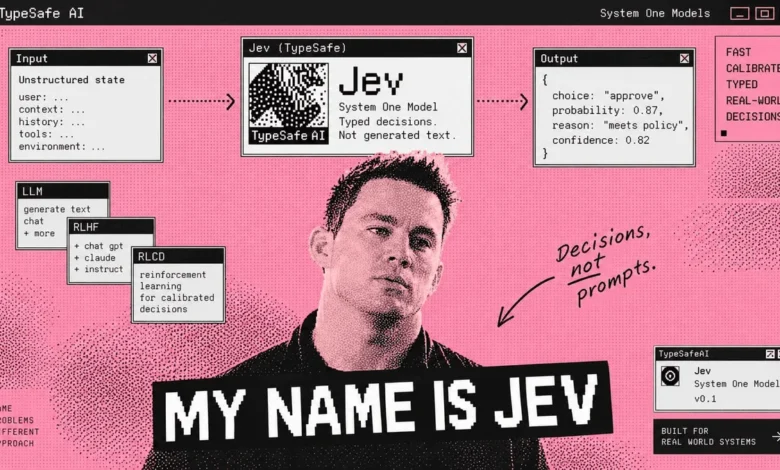
The artificial intelligence landscape has spent the past several years dominated by open-ended, general-purpose large language models (LLMs) like OpenAI’s GPT series, Anthropic’s Claude, and Google’s Gemini. These models are engineered to generate human-like text, write complex code, and solve multi-step reasoning problems. However, their broad capabilities often come with significant trade-offs: exorbitant inference costs, high latency, and unpredictable outputs that require rigorous prompt engineering to constrain. Enter Jev, a specialized model developed by TypeSafe AI that shifts focus away from text generation entirely. Designed specifically for structured decision-making, classification, and intent detection, Jev has sparked intense discussion across social media, YouTube, and technical forums. While industry influencers have frequently heralded the model as an entirely unprecedented breakthrough in artificial intelligence, a closer examination reveals a more nuanced reality: Jev is not a novel category of artificial intelligence, but rather a highly optimized, purpose-built architecture addressing a well-established machine learning problem.
The Core Mechanics: What Makes Jev Different?
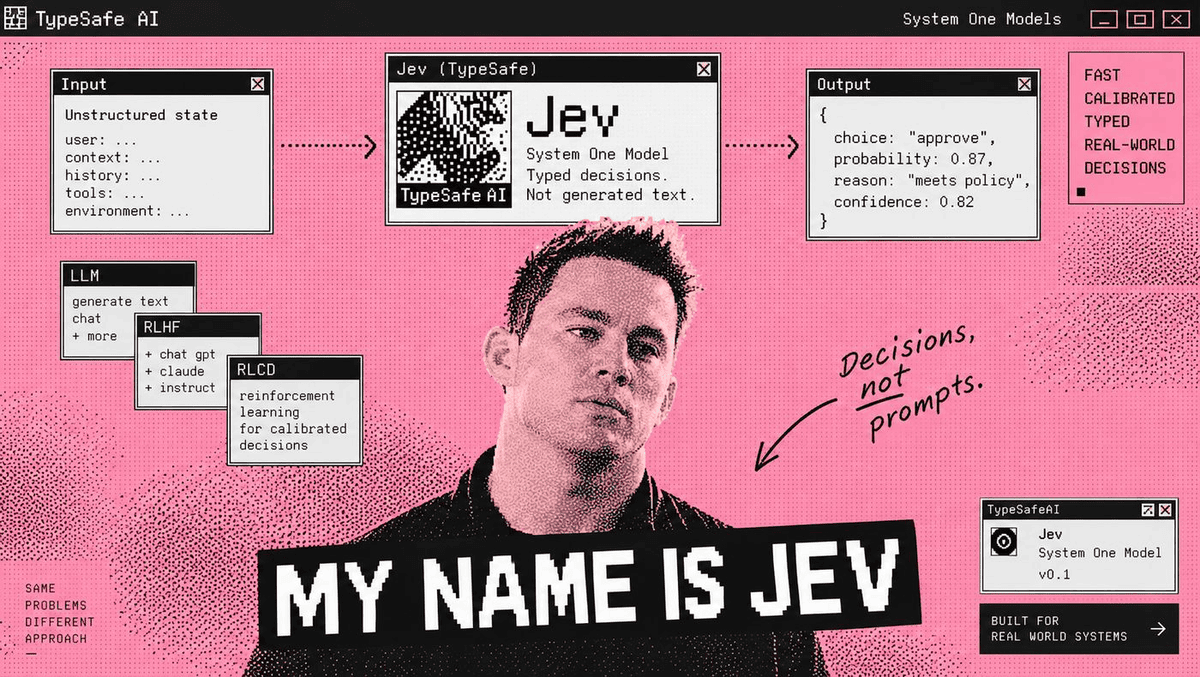
To understand Jev, it is necessary to examine how it processes inputs compared to traditional LLMs. When a standard LLM receives a prompt, it generates a response token by token, constructing a natural language output. In contrast, Jev is classified by its creators as a "System One Model," a term inspired by behavioral psychology describing rapid, instinctive cognitive processing.
When presented with a customer service message—such as a complaint regarding a failed software feature upgrade—Jev does not draft a support reply. Instead, it evaluates the input against a predefined schema of categorical choices and outputs a probabilistic distribution. For example, a query regarding inaccessible features might return a quantitative breakdown: 64 percent probability for Technical, 23 percent for Sales, 13 percent for Billing, and zero percent for Cancellation.
This architectural choice allows software applications to utilize not only the primary classification decision but also the model’s confidence score. If confidence is high, a workflow can execute an automated response or ticket routing; if confidence is ambiguous, the system can escalate the case to human review. By restricting outputs to structured schemas, TypeSafe AI eliminates the risk of open-ended generation errors, though the model remains susceptible to misclassification if the underlying data is ambiguous.
Historical Context and Evolution of Zero-Shot Classification
To evaluate the true novelty of Jev, machine learning practitioners must look back at the evolution of natural language processing (NLP). The core capabilities exhibited by Jev—such as text classification, scoring, routing, and intent detection—are foundational concepts in data science.
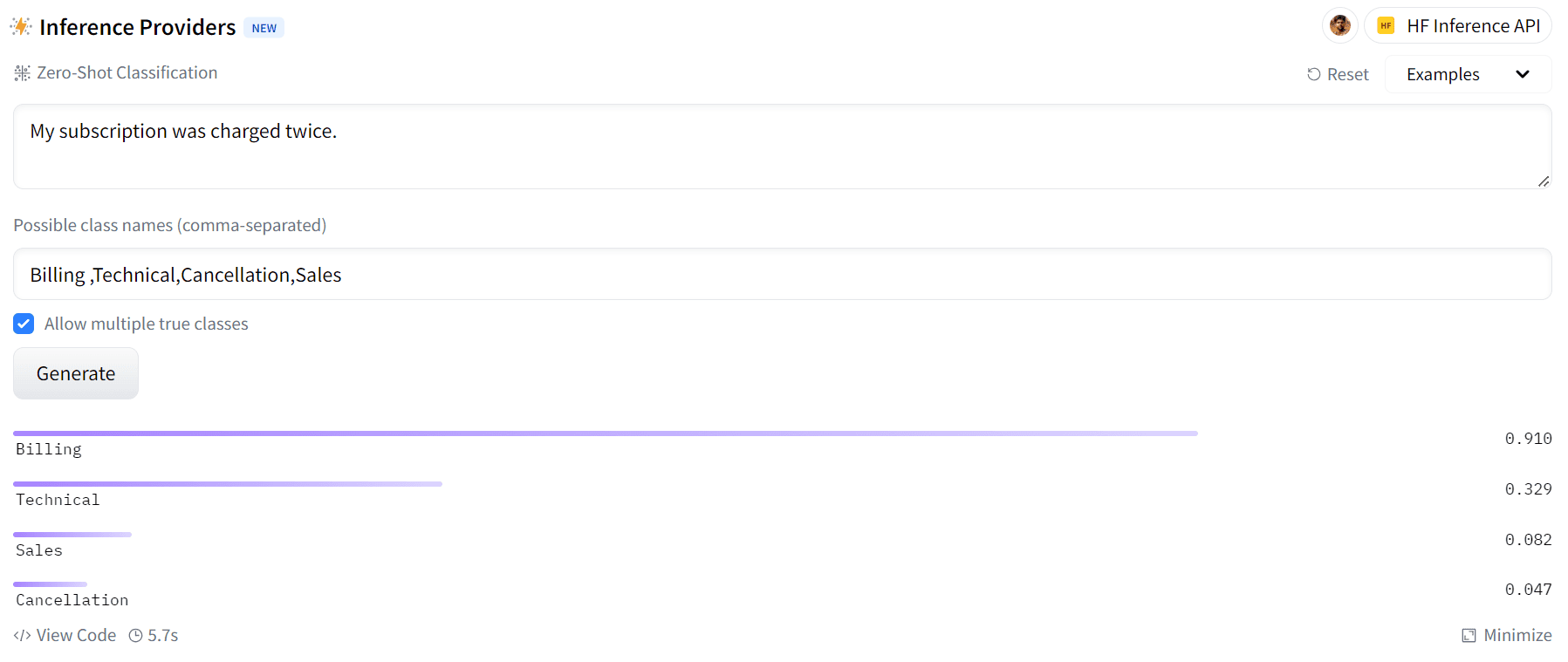
Specifically, Jev bears a striking functional resemblance to zero-shot text classification. Modern natural language inference (NLI) zero-shot classifiers gained widespread adoption between 2019 and 2020, allowing developers to feed text and arbitrary candidate labels into a model without requiring dedicated training data for those precise categories. For years, models like Meta’s bart-large-mnli have successfully performed lightweight zero-shot classification tasks across industries.
Consequently, defining Jev as a radical departure from existing technology is technically inaccurate. The problem it solves is old; however, TypeSafe AI has refined the delivery mechanism. Rather than forcing a general-purpose LLM to behave like a classifier via constrained decoding, function calling, or structured JSON outputs, TypeSafe AI has built an inference engine dedicated exclusively to typed, probabilistic decisions from the ground up.
Behind the Training: Understanding RLCD
A critical component of TypeSafe AI’s marketing for Jev is its proprietary training methodology: Reinforcement Learning for Calibrated Decisions (RLCD). While reinforcement learning from human feedback (RLHF) has become the industry standard for aligning LLMs with human preferences and conversational tones, RLCD targets a different optimization metric entirely: calibration.
Model calibration refers to a system’s ability to ensure that its predicted probabilities accurately reflect the true likelihood of correctness. In an uncalibrated model, a prediction accompanied by a 90 percent confidence score might actually be wrong 30 percent of the time. With rigorous calibration, decisions made with high statistical confidence should correlate directly with higher empirical accuracy.

This statistical reliability is what makes Jev appealing for backend software integration. By outputting well-calibrated probability distributions alongside categorical decisions, developers can establish precise programmatic thresholds. Software can safely automate actions when model certainty crosses specific boundaries, thereby minimizing operational friction while maintaining risk management controls.
Performance, Accuracy, and the Hallucination Debate
A major point of contention surrounding Jev involves claims of "zero hallucinations." From a structural perspective, this claim is technically correct but semantically misleading. Because Jev operates within a strictly defined schema—evaluating text only against the specific labels provided by the developer, such as Billing, Technical, and Sales—it cannot generate an out-of-bounds response like Legal.
However, operating within a schema does not guarantee correctness. Jev can still select the wrong category, attributing a technical issue to billing if the context is ambiguous. Therefore, "zero hallucinations" equates to zero out-of-schema outputs rather than absolute infallibility.
Evaluating Jev’s overall accuracy remains challenging due to a lack of comprehensive, independent benchmarks. TypeSafe AI has reported an accuracy rate of approximately 68 percent on its internal workflow evaluations. However, reference answers in these tests were generated by frontier models rather than independently verified ground-truth datasets. While early independent trials—including limited fact-checking assessments and small document classification tests—have shown promising results with high rates of agreement, data scientists emphasize that rigorous, large-scale empirical testing is required before definitive conclusions can be drawn regarding its general performance.
Economic and Operational Implications
The most compelling argument for Jev lies not in groundbreaking theoretical computer science, but in economics and computational efficiency. Frontier LLMs are massive, resource-intensive models designed to handle coding, creative writing, multi-turn reasoning, and complex tool use. Deploying them for simple classification tasks is computationally wasteful and cost-prohibitive at enterprise scale.
Because Jev is purpose-built for narrow, structured decision-making, it requires significantly less compute power and produces minimal output tokens. This structural specialization translates directly into lower operational costs and drastically reduced latency. For enterprises processing millions of customer support tickets, automated routing requests, or content moderation flags every day, substituting expensive frontier LLM API calls with a fast, lightweight decision layer could yield substantial cost savings.
Industry Reception and Broader Impact
The discourse surrounding Jev highlights a recurring cycle in the technology sector: the tension between marketing hyperbole and engineering reality. Social media influencers and content creators frequently lean toward sensationalism, framing iterative architectural optimizations as paradigm-shifting revolutions. Conversely, veteran machine learning engineers often lean toward skepticism, quickly pointing out that underlying mathematical concepts have existed in academic literature for years.
The truth regarding Jev rests in the synthesis of both viewpoints. TypeSafe AI has not invented a new form of artificial intelligence, nor has it rewritten the foundational laws of machine learning. What the company appears to have successfully accomplished is the packaging of mature NLP concepts into a streamlined, highly efficient product designed specifically for modern developer workflows.
As artificial intelligence matures, the industry is increasingly moving away from the "one model fits all" philosophy popularized by early generative AI milestones. The introduction of specialized, narrow-task models like Jev suggests that the future of enterprise AI architecture may rely on hybrid systems—combining massive, slow System 2 reasoning models for complex problem-solving with fast, inexpensive System 1 decision layers for automated operational workflows. Whether Jev ultimately becomes an industry standard will depend on the results of forthcoming independent benchmarks and real-world enterprise deployments, but its arrival signals a pragmatic shift toward efficiency in applied machine learning.