The Accountability Gap: Why AI Coding Tools Are Hitting a Regulatory Wall in Critical Infrastructure

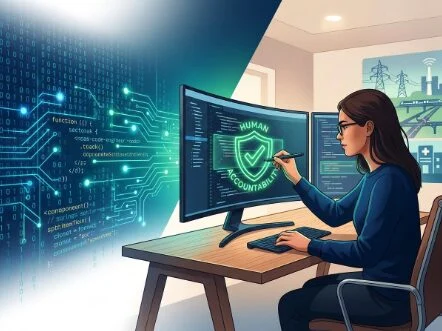
Artificial intelligence has rapidly ascended to the position of the most disruptive force in modern software engineering, fundamentally altering the economics of development. By automating the generation of boilerplate code, accelerating unit testing, and streamlining debugging processes, AI tools have enabled a velocity of production that seemed theoretical only a few years ago. However, beneath the surface of this productivity surge, a significant rift is forming between the tech industry’s push for speed and the rigorous demands of safety-critical sectors. Inside organizations responsible for healthcare, national defense, power grids, and financial markets, the narrative is shifting from unbridled adoption to cautious, and sometimes restrictive, governance.
The Conflict Between Velocity and Liability
At the core of this tension is a fundamental disconnect between machine-generated speed and human-centered accountability. While Large Language Models (LLMs) demonstrate an impressive capacity to produce functional code, they operate on probabilistic patterns rather than deterministic reasoning. When a human engineer writes code, they possess a cognitive map of the system’s logic and a vested professional interest in its success. When an AI generates that same code, it does so by predicting the next token in a sequence based on vast training datasets. This method frequently introduces "shadow vulnerabilities"—subtle security flaws or unstable dependencies that may function correctly during standard testing but fail under edge-case conditions or cyberattacks.
In industries where downtime or security failures equate to life-or-death consequences, the lack of an identifiable "author" for AI-generated code represents an existential risk. Engineering leaders in high-stakes environments are increasingly establishing policies that mirror the aviation industry’s "pilot-in-command" doctrine: no AI-generated code enters a production environment without a human engineer who is willing to stake their professional reputation on its integrity.
Chronology of a Technological Shift
The rapid adoption of AI coding assistants, such as GitHub Copilot, Amazon Q, and Tabnine, occurred in three distinct phases over the last several years:
- The Proliferation Phase (2021–2022): Initial adoption was driven by massive productivity gains, with studies from platforms like GitHub suggesting that AI-assisted developers could complete tasks 55% faster than their counterparts. During this time, the focus was almost exclusively on throughput.
- The Discovery Phase (2023–2024): Organizations began to uncover the "hallucination" problem in code generation. Security audits revealed that AI often suggested deprecated libraries or insecure coding patterns derived from outdated public repositories, leading to a surge in CVEs (Common Vulnerabilities and Exposures) tied to AI-authored snippets.
- The Governance Phase (2025–Present): The current landscape is defined by institutional retrenchment. Major financial and healthcare entities have begun implementing "AI-restricted zones," where code generated by machines must undergo mandatory, multi-stage manual verification and forensic tracing before it can be integrated into core systems.
Supporting Data and Economic Incentives
The paradox of the current AI boom lies in the irresistible economic incentive. According to industry reports from firms like Gartner, the cost-benefit analysis of AI integration is difficult to ignore. Developers using AI tools can reduce the time spent on "toil"—repetitive, low-value tasks—by up to 40%. For a global enterprise, this translates to millions of dollars in saved man-hours and faster product-to-market cycles.
However, these economic benefits are being weighed against the rising costs of risk mitigation. A 2024 survey of Chief Information Security Officers (CISOs) in the Fortune 500 revealed that 68% of respondents have either paused or limited the use of AI coding assistants in backend production environments due to fears surrounding "black-box" code. The implication is clear: while AI lowers the cost of creation, it significantly increases the cost of verification.

The Problem of Attribution and Chain of Custody
The most complex hurdle remains the erosion of the "chain of responsibility." Traditionally, software development follows a clear path: an engineer writes, a peer reviews, and a manager signs off. This linear process allows for root-cause analysis during system failures. If a financial exchange experiences a glitch, investigators can trace the code to a specific commit and a specific author.
AI disrupts this chain by introducing a "hidden author." If an AI-generated function causes a system-wide outage, who is legally and operationally liable? Is it the engineer who accepted the suggestion? The internal team that approved the pull request? The third-party provider of the LLM? Or the original creators of the open-source code used in the model’s training data? This ambiguity creates a vacuum in corporate liability, making insurance, regulatory compliance, and security audits exponentially more difficult to manage.
Implications for Regulatory Compliance and Security
The integration of AI into critical infrastructure has not gone unnoticed by regulators. Agencies overseeing electrical grids and transportation are beginning to demand "provenance" for software components. If an organization cannot explain why a specific piece of code exists or how it was derived, they are increasingly finding themselves in violation of safety standards.
The primary implication is that "deploy first, govern later"—a mantra that served the social media and consumer app sectors well for two decades—is fundamentally incompatible with infrastructure software. The risk of systemic failure, where an AI-generated bug propagates across interconnected financial or logistical networks, is no longer a theoretical concern; it is a primary focus for national cybersecurity agencies.
A Path Toward Human-Centric AI Engineering
To resolve this conflict, the industry is moving toward a model of "Augmented Oversight." Rather than banning AI, organizations are developing technical frameworks to ensure that human accountability remains at the center of the development lifecycle.
- Immutable Audit Trails: Organizations are implementing logging systems that tag every line of code generated by an AI, ensuring that the human reviewer is permanently linked to the deployment.
- Formal Verification: For mission-critical systems, firms are requiring that AI-generated code pass automated formal verification tools—mathematical proofs that ensure the code behaves exactly as intended under all conditions.
- Red-Teaming AI Outputs: Security teams are now treating AI models as "junior developers" that require constant supervision, conducting targeted "red-team" exercises to force AI models to generate insecure patterns so that defenses can be updated accordingly.
Conclusion: The Future of the Software Engineer
The role of the software engineer is undergoing a profound metamorphosis. As AI takes over the mechanical aspects of writing syntax, the engineer’s value is shifting from "author" to "architect" and "supervisor." Much like the evolution of the airline pilot—who transitioned from manual stick-and-rudder flying to monitoring complex, highly automated flight management systems—the modern software engineer must now oversee an ecosystem of autonomous tools.
However, this transition requires a sober recognition of the limits of machine intelligence. Intelligence is not equivalent to reliability, and speed is not a substitute for stewardship. As we embed AI deeper into the fabric of our society—from the hospitals where we heal to the grids that power our homes—the most important challenge in software engineering is no longer expanding the capabilities of our machines. It is, and will remain, the preservation of clear, unambiguous human accountability. Until we establish the frameworks to ensure that every line of machine-generated code has a human "owner" who stands behind it, the AI revolution in software development will continue to hit a firm, necessary, and protective wall.
Related posts: