DiffusionGemma: Exploring the Paradigm Shift from Autoregressive to Diffusion-Based Text Generation

On June 10, 2026, Google DeepMind unveiled DiffusionGemma, an experimental open-model architecture that represents a fundamental departure from the standard autoregressive methods that have dominated the Large Language Model (LLM) landscape for the better part of a decade. By applying the principles of diffusion—the same mathematical framework responsible for the surge in high-fidelity image generation—to text processing, Google has introduced a model capable of generating entire blocks of language in parallel. This development signals a potential shift in how developers approach the hardware-constrained challenges of local inference, moving away from the sequential bottlenecks of traditional architectures.
The Mechanism of Change: Beyond Sequential Tokenization
To understand the significance of DiffusionGemma, one must first look at the traditional "autoregressive" paradigm. Models such as GPT-4, Claude, and the original Gemma series function on a strictly linear trajectory: they predict one token at a time, left to right. Each new word is conditioned on the entire preceding sequence. This creates a significant "memory wall" problem; because the model must fetch its entire weight set from memory for every single token produced, the high-performance compute cores of a GPU often sit idle, waiting for data to traverse the memory bus.
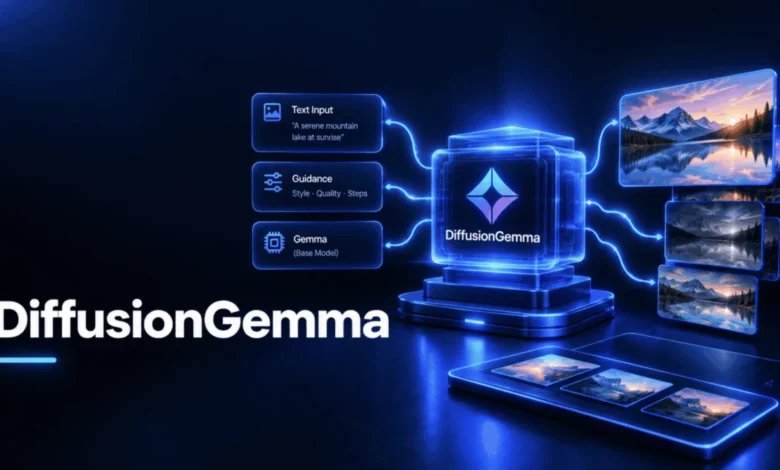
DiffusionGemma, built upon the architecture of the Gemma 4 26B model, replaces this linear process with a parallelized denoising loop. Instead of writing text word by word, the model begins with a 256-token "canvas" consisting of random noise. Through a process of iterative refinement, the model denoises this entire block simultaneously. Under Google’s "Uniform State Diffusion," tokens that achieve high confidence scores assist in the resolution of more ambiguous tokens. This transition effectively moves the system’s primary constraint from memory bandwidth to raw compute power, allowing the GPU to utilize its parallel processing capabilities fully.
Chronology and Development
The introduction of DiffusionGemma did not occur in a vacuum. The project is the result of years of research into non-autoregressive sequence modeling. The following timeline outlines the progression leading to its current release:
- 2023–2024: Research into block-level attention and diffusion-based text models intensifies, with academic papers exploring the possibility of bidirectional attention for language.
- Early 2025: Initial proofs-of-concept emerge, demonstrating that "block-autoregressive denoising" can provide a stable mechanism for long-form generation.
- March 2025: Key findings regarding block-level attention and self-correction are published in technical literature (e.g., arXiv:2503.09573), laying the groundwork for a scalable model.
- June 10, 2026: Google DeepMind officially releases the DiffusionGemma 26B-A4B-it model under an Apache 2.0 license, providing a pathway for researchers and developers to experiment with the technology.
Technical Architecture and Hardware Considerations
DiffusionGemma operates on a Mixture-of-Experts (MoE) design. While the model contains 26 billion total parameters, it only engages 3.8 billion active parameters per token, denoted by the "A4B" suffix. This design choice optimizes for performance, ensuring that the model remains responsive despite its sophisticated internal mechanics.
For deployment, the hardware requirements vary significantly based on the model’s quantization. While the full, unquantized model necessitates a high-performance environment—such as an A100 or H100 with at least 60GB of VRAM—the quantized version is designed for consumer-grade hardware. An 18GB VRAM footprint allows the model to run on high-end consumer GPUs, such as the NVIDIA RTX 4090 or the newer 5090 series.
To run the model, developers must utilize the Hugging Face transformers library, specifically version 5.11.0 or later, which includes the necessary DiffusionGemmaForBlockDiffusion classes. Unlike standard models, the setup requires an AutoProcessor to manage multimodal inputs, including images and video, which the model can process alongside text.
The Advantage of Self-Correction
One of the most compelling features of the diffusion approach is the capacity for self-correction. In an autoregressive model, once a token is committed to the sequence, it is immutable. If the model makes a logical error early in a sentence, it has no mechanism to backtrack or refine that choice.
DiffusionGemma changes this by employing bidirectional attention within its active canvas. Because tokens can "see" each other during the denoising process, the sampler can re-noise a token if its confidence level drops during iteration. This allows the model to "change its mind" before finalizing a block, leading to more coherent and structurally sound outputs. This process is further enhanced by the "thinking mode," which enables the model to perform multi-step reasoning in a separate channel before finalizing the user-facing response.
Industry Implications and Production Serving
While DiffusionGemma represents a breakthrough for local and low-concurrency environments, industry analysts remain cautious regarding its immediate application in large-scale cloud services. For providers serving thousands of concurrent requests, the mature, highly optimized batching systems of traditional autoregressive models remain the industry standard.
However, Google’s collaboration with the vLLM team demonstrates a clear intent to bring this technology into production. By integrating the denoising loop into the vLLM serving engine, developers can now deploy DiffusionGemma via an OpenAI-compatible API. This inclusion of diffusion-config parameters—such as canvas_length and entropy_bound—into the standard vLLM toolkit allows enterprise users to fine-tune the balance between generation speed and output quality.
Comparative Data: Sampling and Performance
The effectiveness of the diffusion process is largely dictated by the sampling configuration. Unlike the simple temperature settings of standard LLMs, DiffusionGemma requires a more nuanced approach.
| Parameter | Recommended Setting | Purpose |
|---|---|---|
| Max Denoising Steps | 48 | Provides an upper bound for convergence. |
| Temperature Schedule | Linear 0.8 to 0.4 | Promotes exploration early; locks in certainty late. |
| Adaptive Stopping | Entropy Threshold: 0.005 | Improves efficiency by halting steps early. |
| Token Selection | Entropy Bound: 0.1 | Enables the self-correction mechanism. |
The use of an entropy-bound token selection is perhaps the most significant differentiator. By only committing tokens with the lowest entropy—the highest confidence—the model avoids premature "locking" of incorrect information.
Looking Ahead
DiffusionGemma serves as a critical proof-of-concept for the next generation of language processing. By demonstrating that the efficiency gains of diffusion are not limited to image synthesis, Google has challenged the assumption that text generation must always be a sequential, autoregressive process.
As the research community continues to test the boundaries of block-autoregressive denoising, the implications for local AI development are substantial. By shifting the bottleneck from memory to compute, models like DiffusionGemma offer a path toward more capable, self-correcting AI that can operate effectively on personal hardware, potentially democratizing access to high-level reasoning capabilities without the need for massive, centralized data centers. While it remains an experimental preview, the architectural foundation laid by DiffusionGemma is likely to influence the next wave of LLM development, bridging the gap between current probabilistic text generation and more iterative, deliberate reasoning systems.