Apple’s iPhone 18 Pro Lineup Introduces Industry-Shaking Hardware Upgrades and Mechanical Aperture Controls

Apple’s September product showcase in 2026 delivered monumental announcements for the technology giant, headlined by the much-anticipated debut of the iPhone Duo. However, the technological centerpiece for mobile photography enthusiasts was undoubtedly the comprehensive overhaul of the iPhone 18 Pro and Pro Max camera systems. Marking a radical shift in smartphone imaging philosophy, Apple has integrated a genuine physical variable aperture alongside sophisticated manual controls, professional video suites, and cryptographic authenticity tools. This strategic evolution effectively blurs the line between high-end digital single-lens reflex (DSLR) cameras and pocket-sized communication devices, setting a new benchmark for the mobile industry while introducing complex mechanical challenges.
The integration of these advanced capabilities represents a profound redirection in how Apple envisions the core utility of its flagship smartphones. By opening the September event with cinematic sequences shot entirely on the iPhone 18 Pro, the company emphasized its commitment to serving professional videographers and independent creators. With features including adjustable mechanical shutter speeds, precise manual focus adjustments, and a real-time live histogram, the device functions less like a conventional phone camera and more like a professional production tool.
The Mechanics and Implementation of Variable Aperture
At the heart of the iPhone 18 Pro and Pro Max camera system is a redesigned 48-megapixel main sensor engineered around a physically adjustable aperture. In traditional optics, an aperture functions as the iris of a lens, controlling the volume of light that reaches the image sensor. A wider aperture permits more light into the system, which is ideal for low-light environments while simultaneously producing a shallow depth of field that gracefully blurs background elements. Conversely, a narrower aperture restricts light intake, bringing expansive landscapes or complex group portraits into sharp, unified focus.
Historically, the vast majority of smartphones have relied on fixed apertures—such as the static ƒ/1.78 configuration found on the preceding iPhone 17 Pro—forcing software algorithms to artificially simulate depth-of-field manipulation and low-light exposure. To overcome this limitation, Apple engineered an aperture mechanism utilizing six microscopic, laser-cut metallic blades. These mechanical components physically shift across four distinct settings, dynamically widening or narrowing in real time depending on ambient lighting conditions and the user’s specific framing requirements.
This hardware-level adjustment yields tangible improvements in real-world photography. Low-light images retain natural fidelity and dynamic range without relying entirely on aggressive computational noise reduction, while multi-subject group shots maintain exceptional sharpness across every plane. Nevertheless, the inclusion of moving mechanical parts within a consumer smartphone introduces significant engineering hurdles.
Historical Precedents and Industry Skepticism
The deployment of a variable aperture in mobile hardware is not entirely unprecedented, though previous attempts by competitors met with limited commercial longevity. Samsung previously introduced physical variable apertures in the Galaxy S9 and Galaxy S10 series, allowing users to toggle between ƒ/1.5 and ƒ/2.4 settings. However, the company quietly abandoned the feature in subsequent generations, citing the mechanical complexity, space constraints, and minimal consumer demand relative to manufacturing costs.

More recently, industry insiders heavily rumored that Samsung intended to reintroduce variable aperture technology for the Galaxy S27 series. Reports surfaced indicating that Samsung ultimately scrapped these blueprints due to concerns over structural bulk and the escalating costs associated with mechanical integration for marginal gains in everyday image quality.
Consequently, industry analysts remain divided on whether Apple’s engineering team can achieve long-term durability where others have faltered. Smartphones are subjected to rigorous physical stress, including accidental drops, extreme temperature fluctuations, and continuous vibration. Integrating delicate, moving laser-cut blades into a heavily miniaturized chassis creates an unprecedented point of structural failure. Whether the variable aperture becomes a permanent staple of Apple’s pro lineup or quietly phases out over future product cycles remains a critical question for device longevity.
Advanced Manual Controls and Pro-Level Workflows
Complementing the physical hardware changes, Apple has introduced a dedicated "Pro controls" interface natively integrated into the iOS Camera app. This suite addresses long-standing complaints from professional photographers and advanced amateurs who prefer granular manual intervention over automated computational photography.
The new interface surfaces direct controls for aperture manipulation, shutter speed selection—allowing users to freeze fast-moving action or introduce creative motion blur—and white balance correction to neutralize unwanted color casts under complex artificial or natural lighting. Furthermore, Apple has incorporated a live histogram directly into the viewfinder. This graphical overlay maps pixel exposure distribution in real time, enabling photographers to instantly identify underexposed shadows or overexposed, blown-out highlights before capturing an image.
Alongside these physical and manual adjustments, Apple refined its computational imaging pipeline. Rather than relying solely on aggressive algorithmic flattening and excessive sharpening, the underlying image processing has been recalibrated to preserve natural textures and subtle gradients. Additionally, the software tool known as Photographic Styles now includes fine-tuned controls for image texture and grain, granting creators greater autonomy over the aesthetic mood of their photographs.
Cinematic Video Capabilities and AI Tracking
Video production on the iPhone 18 Pro lineup received an equally robust upgrade path, bridging the gap between mobile capture and professional broadcast standards. Cinematic mode effects can now be adjusted, applied, and rendered in post-production at frame rates up to 60 frames per second, offering unprecedented flexibility for editors. Furthermore, time-lapse recording has been expanded to support full 4K resolution paired with Dolby Vision HDR.
Audio performance has also advanced through improvements to Apple’s Audio Mix algorithms. The upgraded software isolates human voices with greater clarity while more effectively suppressing ambient noise and isolating background music tracks. To assist solo creators, Apple integrated an advanced, artificial intelligence-powered smart focus system. This tool reliably locks onto and tracks erratic moving subjects—such as children, pets, or athletes—ensuring critical focus is maintained throughout dynamic sequences.

Apple Reference Image and the Fight Against Synthetic Media
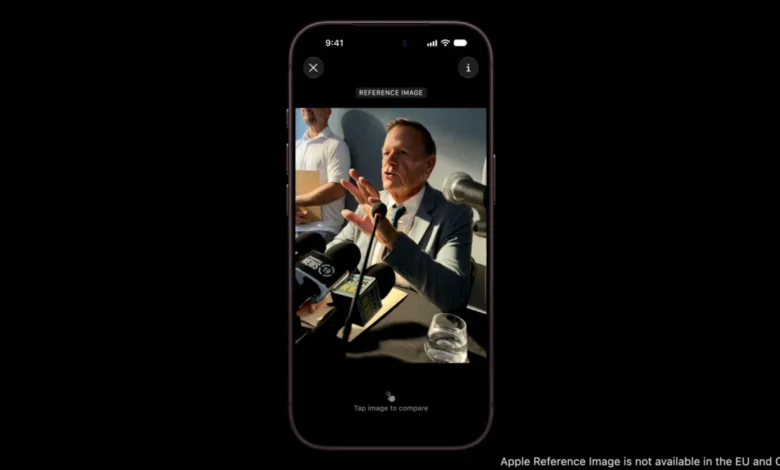
Perhaps the most culturally significant addition to the iPhone 18 Pro series is Apple Reference Image, a pioneering security and authenticity feature designed to combat the proliferation of deepfakes and artificial intelligence-generated media. As generative AI tools become virtually indistinguishable from genuine photography, verifying the authenticity of visual media has emerged as a critical global challenge for journalism, law enforcement, and public discourse.
When a user initiates the "Reference" capture mode, the newly redesigned sensor captures raw optical data that is immediately encrypted and processed via Apple’s Private Cloud Compute infrastructure. This process generates an immutable digital negative known as an Apple Reference Image. Stored securely alongside the final edited photograph within the native Photos app, this reference file allows auditors, publishers, and consumers to verify whether an image has been manipulated, altered, or synthetically fabricated.
This cryptographic signing infrastructure operates in tandem with comprehensive image metadata and upcoming native compatibility with the SynthID watermarking standard. By proactively addressing the authenticity crisis, Apple is positioning the iPhone 18 Pro not merely as a high-end consumer camera, but as a trusted verification tool for photojournalists and documentary creators operating in an era of rampant visual misinformation.
Market Implications and Future Outlook
The launch of the iPhone 18 Pro and Pro Max signifies a pivotal moment for the smartphone industry. By successfully miniaturizing mechanical aperture technology and coupling it with sophisticated manual controls, professional-grade video tools, and robust cryptographic verification systems, Apple has redefined the ceiling of mobile imaging capabilities.
While questions regarding the long-term durability of mechanical optical components will persist until these devices undergo extensive real-world usage, the immediate market response underscores a strong demand for professional-grade creative tools housed within everyday consumer electronics. As competitors evaluate Apple’s engineering achievements, the mobile landscape may experience a renewed wave of hardware innovation aimed at bridging the traditional divide between computational photography and classical optical mechanics.