AWS Announces Enhanced Custom Event Bus in Amazon EventBridge to Eliminate Multi-Account Complexity and Streamline Serverless Architecture

Cloud computing paradigms have fundamentally shifted how modern enterprises construct, scale, and maintain mission-critical software. At the forefront of this evolution are event-driven architectures, which allow loosely coupled microservices to communicate asynchronously by producing and reacting to discrete changes in state. Amazon Web Services has long been a dominant force in this domain through Amazon EventBridge, a serverless event bus that connects applications using data from your own applications, integrated software-as-a-service systems, and AWS services. However, as enterprise adoption scales across complex organizational structures, foundational architectural patterns encounter friction. To resolve long-standing operational bottlenecks inherent in multi-account cloud environments, Amazon Web Services has officially announced the launch of an enhanced custom event bus in Amazon EventBridge, purpose-built to revolutionize how large enterprises handle distributed event routing.
The Structural Evolution of Multi-Account Serverless Environments
To understand the engineering breakthrough represented by the enhanced custom event bus, one must examine the trajectory of enterprise cloud migrations. Historically, organizations constructing event-driven applications on Amazon EventBridge begin their journey with a solitary custom event bus residing within a single AWS account. This streamlined configuration operates efficiently when a unified development team retains total ownership of the underlying architecture. Yet, as digital transformation initiatives mature, organizational scaling demands governance models that isolate workloads for security, billing, and compliance purposes.
Industry best practices established by AWS strongly advocate for a multi-account cloud strategy, wherein distinct business units, engineering squads, or product lines operate within their own isolated AWS accounts. While this segregation successfully enforces security boundaries and administrative autonomy, it introduces severe architectural friction regarding event distribution.
To bridge the gap between isolated accounts, developers historically relied on a web of multiple event buses interconnected via complex cross-account rules and brittle bus-to-bus configurations. This tactical workaround inadvertently reintroduced the very operational complexity that serverless computing was originally designed to eliminate. Platform engineering teams rapidly lost operational visibility into who was subscribing to specific enterprise events. Furthermore, the compounding financial costs of cross-account and bus-to-bus routing strained corporate budgets, while engineering groups requiring advanced capabilities—such as strict event ordering—were left with no choice but to construct convoluted workarounds or abandon serverless paradigms altogether for specific workloads.
Core Innovations of the Enhanced Custom Event Bus
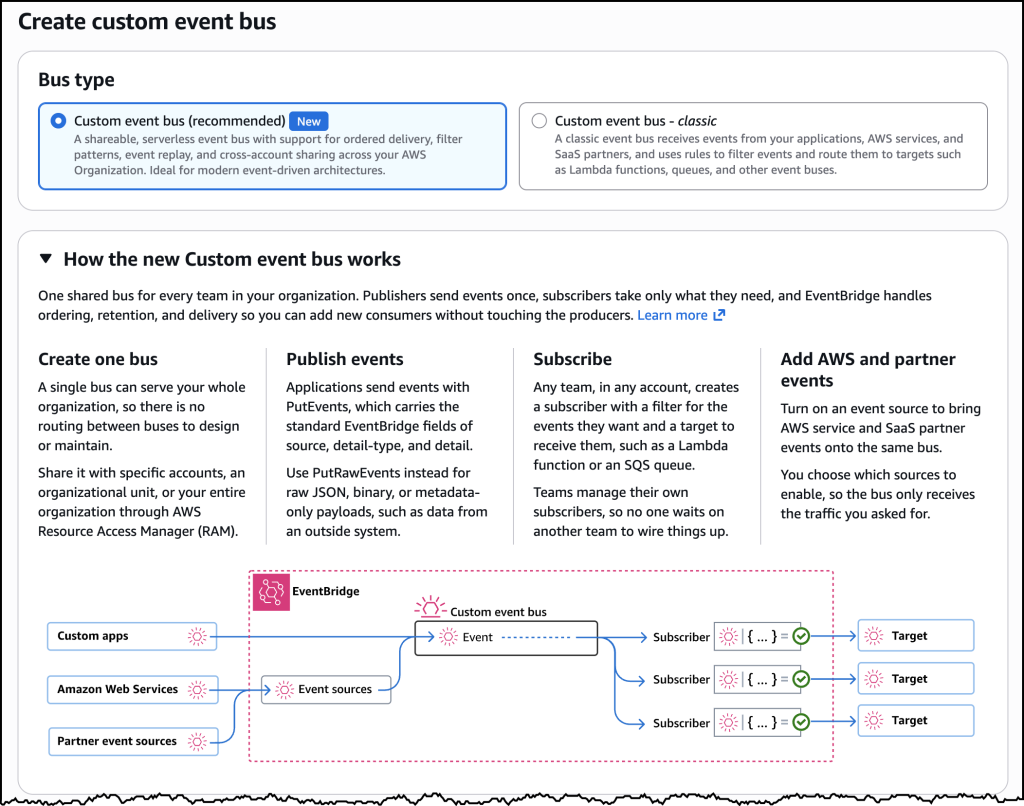
Designed specifically to eradicate these multi-account hurdles, the newly unveiled enhanced custom event bus introduces a paradigm shift: a single, centralized event bus shared transparently across all AWS accounts within an entire corporate organization. By deploying this unified infrastructure backbone, platform teams can finally establish enterprise-wide event streaming without sacrificing granular administrative oversight.

At the core of this release are four transformative technical capabilities: native organization-wide sharing, integrated event ordering with synchronous target invocation, consolidated subscriber resource management, and advanced event evaluation mechanisms including content-based deduplication and JSONata transformation.
Organization-Wide Sharing via AWS Resource Access Manager
The logistical headache of managing cross-account permissions has historically been a major pain point for platform architects. The enhanced custom event bus eliminates this administrative overhead by integrating directly with AWS Resource Access Manager. Platform administrators can now provision a single event bus and authorize resource sharing across an entire AWS organization, specific organizational units, or designated AWS Identity and Access Management roles and users.
This architectural simplification means publishers can broadcast events globally across the corporate ecosystem without needing explicit knowledge of which downstream teams consume them. Concurrently, subscribers are empowered to independently establish their own event consumption pipelines. To prevent resource degradation and accommodate enterprise growth, the enhanced custom event bus launches with an expansive default quota of 10,000 active subscribers per bus—a threshold that can be further elevated upon request—thereby eliminating the artificial fragmentation previously forced by strict subscriber limits.
Reconciling Asynchronicity with Strict Event Ordering
While event-driven architectures thrive on asynchronous decoupling where message sequence is theoretically irrelevant, real-world enterprise applications frequently encounter operational domains where chronology is paramount. For instance, in sophisticated logistics and supply chain management platforms, real-time driver location telemetry must be processed in exact chronological sequence. Out-of-sequence ingestion inevitably causes automated routing algorithms to compute operational decisions based on stale geospatial data, resulting in systemic failures.
The newly introduced enhanced custom event bus successfully bridges this divide by supporting both asynchronous unordered patterns and strict ordered delivery natively on the same bus infrastructure. Publishers can embed an EventGroupId parameter within outgoing event payloads. EventBridge intelligently guarantees that events carrying identical identifiers are delivered in strict sequential order exclusively to subscribers configured for ordered processing, while concurrently routing identical data streams to asynchronous consumers without performance degradation.
To ensure absolute reliability during ordered message consumption, the enhanced architecture introduces native synchronous invocation for high-performance targets such as AWS Lambda. This synchronous execution model confirms successful downstream processing before acknowledging event completion, effectively removing the historical necessity of deploying Amazon Simple Queue Service queues as intermediary buffers between event buses and serverless compute functions.

Consolidated Subscriber Resource Management
Managing event subscriptions in legacy EventBridge implementations required a tedious orchestration of discrete rules, distinct targets, and fragmented retry policies dispersed across numerous cloud resources. The enhanced custom event bus streamlines this administrative lifecycle by introducing the unified Subscriber resource.
This single, manageable construct encapsulates event filtering criteria, target configurations, custom retry policies, and dead-letter queue destinations into a cohesive operational unit. Additionally, the inclusion of variable start time options within the Subscriber resource drastically simplifies the onboarding of nascent consumer applications and streamlines event replay procedures required for disaster recovery and application state hydration.
Advanced Event Evaluation and Data Transformation
Data hygiene and payload transformation represent critical friction points when integrating disparate microservices. The enhanced custom event bus addresses these challenges directly through advanced payload evaluation primitives.
Publishers can now enable content-based deduplication directly at the bus level. When network timeouts or partial transmission failures trigger duplicate message transmissions, EventBridge algorithmically hashes the core attributes of the event payload and collapses identical matches arriving within a strict five-minute sliding window. This mechanism grants those specific retry operations true exactly-once delivery semantics, supplementing the standard at-least-once model without requiring publishers to generate and track custom idempotency tokens.
Furthermore, subscribers gain the ability to leverage native JSONata expressions to reshape incoming event payloads dynamically before they reach downstream targets. Whether a consumer requires field extraction, attribute renaming, or mathematical value computation due to legacy API schemas, JSONata handles the transformation natively. Additionally, for enterprises producing data streams encoded in Apache Avro or Protocol Buffers, EventBridge can now seamlessly deserialize these binary payloads into standard JSON. This enables subscribers to execute fine-grained filtering and routing operations across the complete event payload without necessitating custom ingestion and deserialization microservices.
A Scalable Economics and Pricing Model
Financial predictability is a paramount concern for enterprise platform engineering teams scaling serverless infrastructure. To align costs with actual architectural utilization, AWS has introduced a modernized ingress and egress throughput pricing model specifically for the enhanced custom event bus.
Under this new framework, event publishers incur charges exclusively for data ingested into the bus, while subscribers pay for events successfully delivered to their respective targets. This economic structure directly replaces the legacy per-event pricing model, neutralizing the compounding financial penalties associated with complex cross-account and bus-to-bus routing topologies.
Importantly, AWS has confirmed that existing EventBridge custom event buses will remain fully operational without requiring immediate migration. These legacy architectures will seamlessly transition to a designation labeled Custom event bus — classic, ensuring complete continuity for ongoing production workloads while enterprises adopt the enhanced custom event bus at their own operational pace.
Availability and Global Infrastructure Deployment
The rollout of the enhanced custom event bus represents a major engineering milestone for Amazon Web Services, reflecting the company’s ongoing commitment to refining serverless application patterns for hyper-scale enterprises.
As of today, the enhanced custom event bus is generally available across a robust global footprint spanning numerous strategic AWS Regions, including US East (N. Virginia), US East (Ohio), US West (Oregon), Europe (Ireland), Europe (Frankfurt), Europe (Stockholm), Europe (Spain), Asia Pacific (Hong Kong), Asia Pacific (Malaysia), Asia Pacific (Mumbai), Asia Pacific (Singapore), Asia Pacific (Sydney), Asia Pacific (Thailand), and Asia Pacific (Tokyo).
Cloud architects, platform engineers, and developers can immediately provision their inaugural enhanced custom event bus through the AWS Management Console, the AWS Command Line Interface, or programmatic calls via the official EventBridge APIs. Comprehensive documentation and architectural guides are currently accessible via the official Amazon Web Services documentation portal, marking a new chapter in the evolution of enterprise event-driven computing.
Related posts: