Building Anagram Architect: How Rust and WebAssembly Revolutionized Client-Side Word Puzzle Generation

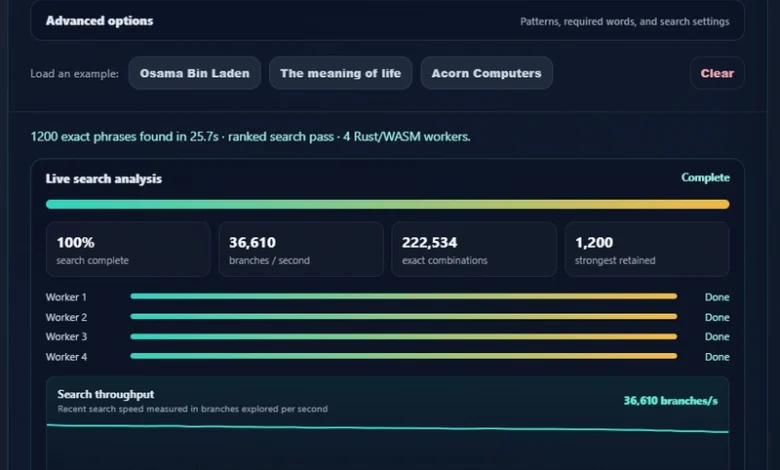
The intersection of high-performance systems programming and natural language processing has yielded an innovative web utility known as Anagram Architect. Developed to solve the notoriously complex problem of multi-word anagram generation entirely within the browser, the platform blends low-level computational efficiency with algorithmic linguistics. When queried with the philosophical prompt "The meaning of life," the browser-based engine evaluated over 222,000 exact combinations in roughly 25.7 seconds, ultimately returning the precise anagram "The fine game of nil." This achievement highlights a broader technological shift: leveraging WebAssembly (WASM) and Rust to execute heavy, compute-intensive combinatorial searches directly on user hardware without relying on remote server architectures or dedicated APIs.
Background Context and the Computational Challenge of Anagrams
For centuries, anagrams have served as a literary pastime, a cryptographic device, and a linguistic puzzle. While checking whether two completed phrases are exact anagrams is computationally trivial—requiring only the normalization of strings into lowercase characters, frequency counting, and table comparisons—generating multi-word anagrams from scratch presents an exponential computational barrier. As string lengths increase, the number of potential word combinations explodes combinatorially.
Traditional web applications offload such heavy processing to centralized servers, utilizing cloud databases and backend microservices to compute results before returning them to the client. However, this centralized model introduces latency, incurs server costs, and raises potential privacy concerns regarding the user queries being processed. The developer of Anagram Architect sought to bypass these limitations by shifting the entire computational burden to the client-side browser environment. Achieving this required a technology stack capable of near-native execution speeds within standard web browsers: Rust for the core search logic, compiled down to WebAssembly, paired with JavaScript and Web Workers to manage user interface responsiveness.
Chronology of the System Architecture and Development
The engineering journey behind Anagram Architect required a methodical, multi-phase approach to optimize performance and usability.
In the initial architectural phase, the developer established the core data structures. Both source phrases and dictionary entries are transformed into compact 26-letter frequency signatures. This allows the engine to perform rapid mathematical operations—subtracting chosen word letter counts from the remaining letter pool—to prune invalid branches before deep recursive exploration begins. If any letter count drops below zero, the branch is immediately terminated.
During the optimization phase, the challenge shifted from mere exactness to semantic relevance. Because a dictionary can confirm word existence but cannot measure contextual appropriateness, the system integrated a ranking layer. This layer evaluates phrases based on linguistic signals, prioritizing combinations that sound natural and memorable over fragmented, nonsensical word salads. To prevent updates from degrading overall output quality, the developer established a rigorous benchmark set of classic anagrams, ensuring that algorithmic adjustments to one phrase do not negatively impact others.
In the final deployment and feature-expansion phase, advanced user controls were introduced. Recognizing that automated engines occasionally require human guidance, the architecture was updated to allow users to enforce constraints such as mandatory or excluded words, letter patterns, and grammatical templates like [Noun] of [Noun] or [Verb] the [Noun]. Furthermore, a "Pick List" feature was implemented to serve as an interactive workspace, enabling users to reorder results, lock specific words, substitute equivalents, and apply capitalization or punctuation.

Technical Deep Dive: Rust, WebAssembly, and Web Workers
The technological backbone of Anagram Architect relies heavily on Rust’s memory safety guarantees and fearless concurrency. The search core utilizes small fixed arrays, explicit integer fields, and compact indexes, facilitating high-speed predictable mutations within the hot execution path. Compiling this Rust codebase into WebAssembly enables execution within the browser sandbox at speeds approaching native machine code.
To prevent deep recursive searches from freezing the browser tab and rendering the user interface unresponsive, the system implements a multithreading model using Web Workers. The candidate search space is systematically divided into distinct shards and distributed across multiple background workers. Each worker independently loads the WASM engine, explores its assigned shard, and periodically reports progress metrics back to the main thread.
The main JavaScript thread aggregates these incoming candidates into a single, stable ranking while continuously updating interface indicators—such as search throughput measured in branches per second—and remaining fully responsive to user cancellations or modifications. During a typical execution run, four concurrent workers explore approximately 36,000 branches per second entirely within the local browser environment.
Data, Performance Metrics, and Privacy Implications
Performance benchmarks for Anagram Architect demonstrate the viability of client-side combinatorial computation. In benchmark evaluations involving the 25.7-second processing window for "The meaning of life," the engine evaluated 222,534 exact combinations, filtered them down to the top 1,200 strongest phrases, and ranked "The fine game of nil" at the summit. However, execution times fluctuate depending on the length and complexity of the source phrase, user-defined constraints, browser performance, and host hardware specifications.
Beyond raw performance, the architecture addresses modern data privacy considerations. Because the dictionaries, language data, JavaScript bundles, and WASM modules are downloaded as static assets upon initial page load, no external search API or backend database receives the user’s input text. Names, unpublished literary titles, private jokes, and sensitive phrases remain entirely isolated within the user’s local browser memory. While local processing still requires network asset retrieval, the absence of telemetry or query logging establishes a zero-knowledge interaction model for sensitive linguistic exploration.
Broader Impact and Industry Implications
The deployment of tools like Anagram Architect signals a broader industry trend toward edge computing and sophisticated client-side execution. As WebAssembly matures, developers are increasingly moving complex computational workloads—traditionally reserved for heavy server infrastructure—directly into consumer web browsers. This paradigm shift reduces cloud infrastructure expenditures for developers while offering users instantaneous, private, and highly responsive applications.
In the realm of natural language processing and computational creativity, the project demonstrates the symbiotic potential of combining brute-force algorithmic correctness with human-guided heuristics. While automated engines excel at mathematical validation and combinatorial exploration, language remains an inherently cultural and semantic domain. By empowering users with granular constraints, template matching, and interactive editing workshops, Anagram Architect bridges the gap between raw computational output and meaningful human expression. As developers continue to explore the boundaries of Rust and WebAssembly in browser environments, applications ranging from cryptography and puzzle generation to client-side machine learning stand to benefit from these performance gains.