Global E-Learning Platform 365 Data Science Announces Free Access Initiative for AI and Data Training Program Ahead of November 2026

The global landscape of artificial intelligence and data science education is undergoing a profound transformation, driven by the urgent need for accessible, high-caliber technical training. In response to this accelerating demand, 365 Data Science has officially announced its sixth annual Free Access Initiative, opening its comprehensive learning platform at no cost to users worldwide. Scheduled to run from November 5 to November 20, 2026, ending precisely at 15:00 UTC, the limited-time program aims to democratize technical education. It offers aspiring AI professionals, career switchers, and data enthusiasts an unrestricted opportunity to acquire in-demand competencies without financial barriers.
As emerging technologies continue to reshape global industries, the imperative for workforce upskilling has never been more pronounced. This initiative is designed to address the widening skills gap in advanced computing fields, specifically targeting foundational data literacy, machine learning, and the rapidly expanding domain of AI engineering. By removing paywalls for a designated two-week window, the organization provides a practical pathway for individuals globally to engage with industry-standard curricula, earn verifiable credentials, and position themselves competitively within the modern digital economy.
Background Context and Evolution of the Free Access Initiative
The origins of the Free Access Initiative trace back to a critical juncture in modern educational history. Launched initially in 2020 at the onset of the global COVID-19 pandemic, the program was conceived as a philanthropic response to widespread economic disruption and sudden shifts toward remote work and digital learning. What began as a temporary measure to support stranded students and displaced professionals has since evolved into an anticipated annual tradition, marking its sixth consecutive year in 2026.
Over the years, the scope of the curriculum has expanded significantly to mirror the rapid evolution of the technology sector. While initial iterations focused primarily on foundational data analytics, SQL, and introductory Python programming, the contemporary curriculum reflects the paradigm shift toward generative artificial intelligence and autonomous systems. Today, the platform incorporates advanced modules on AI engineering, intelligent agents, large language model deployment, and complex machine learning workflows. This evolution underscores the platform’s responsiveness to market demands, ensuring that learners are not merely acquiring legacy skills, but are being trained in the exact disciplines currently driving corporate technological adoption.
Chronology and Program Timeline
The structured timeline of the 2026 initiative is designed to maximize engagement and provide a focused, intensive learning experience for all participants.
- Preparation Phase (October 2026): Prospective learners are encouraged to explore preliminary course outlines, set up user profiles, and identify targeted learning paths based on their current skill levels and career objectives.
- Launch Date (November 5, 2026): The platform officially lifts all subscription barriers, granting immediate, unlimited access to all 134 specialized courses, interactive exercises, and project environments.
- Active Learning Window (November 5 – November 20, 2026): Participants engage with self-paced video lectures, complete hands-on coding challenges, and participate in simulated real-world projects designed to replicate professional environments.
- Deadline and Evaluation (November 20, 2026, at 15:00 UTC): The free access period concludes precisely at the designated hour. Users who have completed course requirements within this window are eligible to secure industry-recognized certificates.
- Post-Initiative Phase (Late November 2026 onward): Graduates integrate their newly earned credentials into professional portfolios and resumes, translating their educational milestones into career advancement opportunities.
Quantitative Impact and Supporting Data
The scale and reach of the initiative have expanded exponentially since its inception, cementing its status as a major global event in digital education. Official metrics from the preceding 2025 edition illustrate the immense public appetite for accessible technical training, establishing records that the 2026 program aims to build upon.
During the 2025 edition, the platform recorded its most successful deployment to date. More than 220,000 unique users hailing from 216 countries and territories participated in the global learning event. Geographic participation spanned diverse economic landscapes, reflecting a universal demand for AI and data proficiency. Collectively, these participants invested over 7.2 million minutes into active learning, completing complex modules across various data science disciplines. Furthermore, the initiative resulted in the issuance of more than 36,000 verified certificates of completion, validating the practical competencies of participants and offering them tangible proof of skill acquisition for prospective employers.
Statistical analyses of workforce trends consistently highlight the value of such interventions. According to labor market reports from various economic agencies, job postings requiring artificial intelligence and advanced data processing skills have outpaced general job growth significantly over the past five years. Programs that provide barrier-free entry to these educational resources play a vital macroeconomic role in narrowing the digital divide between industrialized technology hubs and emerging markets.
Official Perspectives and Leadership Commentary
Corporate leadership at 365 Data Science has emphasized the strategic importance of the initiative in the context of broader technological shifts. Ned Krastev, Chief Executive Officer of 365 Data Science, has been a vocal advocate for proactive workforce education, noting that the speed of technological innovation demands unconventional educational models.
"The AI and data landscape is evolving faster than ever, creating extraordinary opportunities for career advancement for people ready to embrace new technologies," Krastev stated in recent platform briefings. Addressing the core philosophy driving the free access period, he added, "Artificial intelligence is transforming industries at an unprecedented pace. Understanding how AI systems work and how to build, deploy, and integrate them has become essential for anyone pursuing a data-driven career. At 365 Data Science, we aim to bridge that gap by empowering learners to gain not only data literacy but also practical expertise in AI engineering and intelligent agents: the skills defining the next generation of tech professionals."
Industry analysts and educational observers have largely commended these observations, noting that traditional academic institutions often struggle to update curricula at the speed demanded by the tech sector. Initiatives managed by specialized platforms help bridge this lag, providing agile, market-aligned training that addresses immediate corporate deficits in technical talent.

Curriculum Architecture and Practical Learning Methodology
The comprehensive curriculum made available during the November 2026 event is structured to accommodate learners at every stage of their professional journey, from absolute beginners to experienced software developers looking to pivot into specialized fields.
The platform’s course catalog comprises 134 expert-led modules. These are systematically organized into distinct career paths, providing clear, step-by-step roadmaps. Rather than requiring learners to navigate an unstructured library of content, these paths guide participants logically through prerequisite knowledge—such as mathematics, statistics, and foundational programming—before advancing to sophisticated topics like neural networks, predictive modeling, and natural language processing.
A central pillar of the educational philosophy is the emphasis on practical, hands-on experience. Theoretical knowledge alone is frequently insufficient to secure technical employment; consequently, the platform incorporates real-world projects that simulate actual workplace scenarios. Participants are tasked with solving complex business problems, cleaning disordered datasets, building predictive models, and deploying intelligent software agents.
To reinforce these practical applications, the platform features newly enhanced interactive exercises and guided challenges. These tools provide immediate feedback, allowing learners to test their code, debug errors, and refine their problem-solving methodologies in a controlled, risk-free environment.
The Value of Industry-Recognized Certifications
In the contemporary hiring environment, where remote work and global talent pools intensify competition for technical roles, professional credentials serve as critical signals of competence to hiring managers and human resources algorithms.
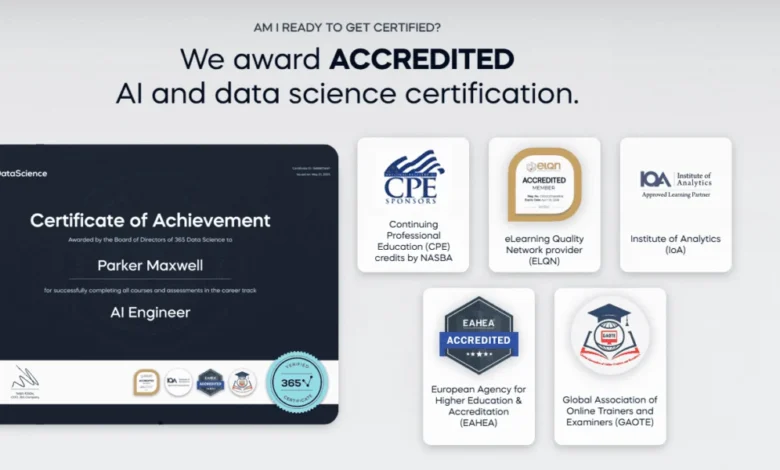
A significant incentive for participants during the 365 Data Science Free Access Initiative is the opportunity to earn verifiable, industry-recognized certificates at no cost. These credentials validate proficiency in specific domains, including data analytics, machine learning engineering, business intelligence, and artificial intelligence deployment.
Unlike informal completion badges, these certificates are structured to meet professional standards, demonstrating to prospective employers that the holder has successfully navigated rigorous coursework and demonstrated practical competence. By removing the financial barrier typically associated with accredited professional certifications, the initiative democratizes career advancement, enabling talented individuals from economically disadvantaged backgrounds to build competitive, verified portfolios that enhance their global employability.
Broader Economic and Societal Implications
The broader implications of widespread AI and data literacy training extend far beyond individual career advancement. As generative models, automated decision-making frameworks, and data-driven logistics become standard operating procedures across finance, healthcare, manufacturing, and retail, the composition of the global workforce must adapt accordingly.
Economists frequently warn of a potential displacement effect associated with automation, wherein routine administrative and technical tasks are absorbed by machine learning systems. However, industry consensus suggests that this transition simultaneously generates a massive creation effect, spawning new professional categories centered on the oversight, maintenance, training, and ethical governance of AI systems.
Initiatives that facilitate mass upskilling act as a stabilizing mechanism during this transitional phase. By enabling hundreds of thousands of individuals to transition from passive consumers of technology to active creators and managers of intelligent systems, programs like the 365 Data Science Free Access Initiative contribute to macroeconomic resilience. They ensure that the benefits of technological progress are distributed more broadly across the global workforce, rather than being concentrated exclusively within specialized technology conglomerates.
Conclusion and Participation Guidelines
As the technology sector looks toward the close of 2026, the imperative for continuous learning and professional reinvention remains paramount. Whether participants are recent university graduates seeking entry-level positions, mid-career professionals executing strategic career pivots, or seasoned specialists looking to update their technical toolkit, the upcoming open-access window offers a timely, risk-free investment in personal and professional development.
The three-week open-access period offers a rare opportunity to acquire high-value competencies without financial constraints. Interested individuals can prepare for the event by visiting the official 365 Data Science platform prior to November 5, 2026, to review available learning paths and map out their educational objectives for the duration of the initiative. Through rigorous training, practical project execution, and verifiable certification, participants can position themselves effectively for the demands of the modern, data-driven economy.