Azure Kubernetes Fleet Manager Unveils Public Preview of Cross-Cluster Networking, Revolutionizing Multi-Cloud Kubernetes Management

Microsoft has officially launched the public preview of cross-cluster networking for Azure Kubernetes Fleet Manager, a significant advancement aimed at simplifying and enhancing the management of distributed Kubernetes environments. This new capability promises to deliver a unified, high-performance network that can span an organization’s entire fleet of Azure Kubernetes Service (AKS) clusters, regardless of their geographic location or cloud provider. The introduction marks a pivotal moment in the evolution of multi-cluster Kubernetes management, addressing long-standing challenges related to connectivity, operational complexity, and resilience.
The shift towards modern application architectures, characterized by microservices and containerization, has fundamentally reshaped infrastructure demands. The focus has moved beyond simply scaling individual Kubernetes clusters to orchestrating and managing applications and their underlying networks across multiple clusters, regions, and even clouds. This evolving landscape presents a complex set of challenges for IT operations and platform engineering teams.
Historically, establishing reliable and performant network connectivity between separate Kubernetes clusters has been a significant hurdle. Organizations often resort to intricate configurations involving Virtual Private Networks (VPNs), dedicated gateways, and manual service discovery mechanisms. These traditional approaches not only introduce substantial operational overhead but also contribute to increased latency and potential points of failure, creating what is often referred to as a "networking tax." This tax impacts performance, complicates deployments, and hinders the seamless operation of distributed applications, especially for large-scale deployments or those requiring high availability and disaster recovery.
Azure Kubernetes Fleet Manager, introduced by Microsoft to streamline multi-cluster Kubernetes management, has already made strides in simplifying workload propagation and orchestrating cluster updates. However, the network layer remained a critical area requiring further innovation. The new cross-cluster networking feature directly addresses this gap by leveraging Advanced Container Networking Services and a Cilium-based data plane. This integration aims to provide transparent East-West (E-W) multi-cluster networking, enabling services and workloads to communicate across cluster boundaries as if they were local, while maintaining essential cluster-level isolation and governance.
The underlying technology powering this new capability draws from robust, open-source projects within the Cloud Native Computing Foundation (CNCF). Cilium, a widely adopted open-source project for networking, security, and observability, serves as the data plane, enabling efficient packet processing and policy enforcement. For fleet-level orchestration, the Kubefleet project provides the necessary framework. This reliance on established CNCF projects underscores Microsoft’s commitment to transparency, portability, and leveraging the broader Kubernetes ecosystem’s continuous innovation.
The Persistent Challenge of Multi-Cluster Networking
The proliferation of multiple AKS clusters is a common strategy for organizations, driven by various factors. Regulatory compliance often necessitates data localization, leading to the deployment of clusters in specific geographic regions. Disaster recovery and business continuity planning mandate redundant infrastructure, typically achieved through geographically distributed clusters. Furthermore, isolating blast domains – limiting the impact of potential failures or security breaches to specific segments of an application or infrastructure – is a crucial security practice that often involves segmenting workloads across multiple clusters.
Even for organizations operating a modest number of clusters, maintaining consistent and reliable inter-cluster connectivity is paramount. This is essential for scenarios such as seamless failover mechanisms, where workloads can be automatically shifted to a healthy cluster in the event of an outage. It also underpins shared services architectures, where common components like databases, authentication services, or logging platforms are accessed by applications deployed across numerous clusters. The ability to effortlessly shift workloads across regions to optimize for capacity or minimize latency for end-users further highlights the need for robust cross-cluster networking.
From a platform engineering perspective, the goal is to abstract away the underlying infrastructure complexities from application developers. This allows developers to focus on building and deploying applications without needing to manage intricate network configurations between clusters. The introduction of cross-cluster networking aims to achieve this abstraction, enabling platform teams to manage the network as a unified entity, simplifying cluster-level changes and updates without disrupting ongoing application operations.
Microsoft’s Vision: Unified Multi-Cluster Management with Seamless Networking
Microsoft’s Azure Kubernetes Fleet Manager was conceived to address the growing complexity of managing distributed Kubernetes deployments. While it has successfully simplified workload distribution and update orchestration, the network has remained a significant operational challenge. The integration of Cilium-based cross-cluster networking represents a crucial step towards realizing the vision of truly unified multi-cluster management.
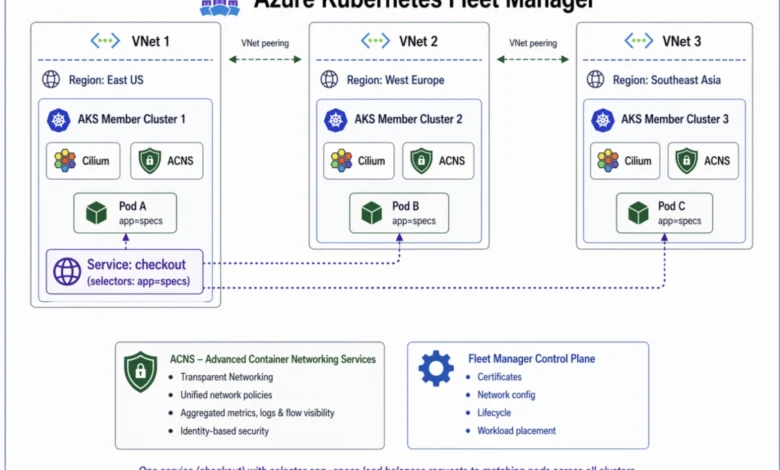
This new feature extends the familiar Kubernetes networking model beyond the confines of a single cluster, creating a cohesive network fabric for the entire fleet. This allows services and pods in one cluster to communicate with services and pods in another cluster seamlessly, as if they resided within the same network segment. This capability is underpinned by the efficient routing, policy enforcement, and observability capabilities enabled by eBPF (extended Berkeley Packet Filter) technology, a core component of Cilium’s performance advantages.
The architectural diagram illustrating this new capability depicts a fleet of AKS clusters interconnected through a managed network. This unified approach facilitates straightforward service discovery across cluster boundaries, enabling applications to locate and communicate with their dependencies regardless of their physical location within the fleet. Crucially, it also allows for consistent policy enforcement across the entire distributed environment, ensuring security and compliance are maintained uniformly.

Key capabilities highlighted by this release include:
- Transparent Pod-to-Pod Connectivity: Enables direct communication between pods across different AKS clusters without the need for explicit NAT gateways or complex overlay networks. This significantly reduces latency and simplifies network architecture.
- Unified Service Discovery: Services exposed in one cluster can be seamlessly discovered and accessed by applications in other clusters within the fleet, simplifying application deployment and inter-service communication.
- Centralized Policy Enforcement: Allows for the definition and enforcement of network policies across the entire fleet, ensuring consistent security posture and compliance.
- High Performance: Leverages eBPF and Cilium’s advanced networking capabilities to deliver high-throughput, low-latency communication suitable for demanding enterprise workloads.
- Managed Service: Microsoft handles the deployment, configuration, and ongoing management of the underlying networking components, reducing operational burden on IT teams.
Strategic Resilience and Business Agility
In today’s digital-first economy, resilience is not merely a technical consideration but a critical competitive advantage. The ability of an organization to withstand and recover from disruptions is paramount to maintaining customer trust and business continuity. Cross-cluster networking directly contributes to building inherently resilient architectures that can gracefully handle single-cluster or even single-region failures.
For organizations running "Shared Services" clusters that cater to hundreds or thousands of tenants, the ability to reroute traffic or provide services from an alternate cluster in the event of an outage is essential for maintaining service availability. Similarly, for "Global Services" that need to serve users from the nearest or healthiest available endpoint, cross-cluster networking provides the foundational connectivity required for intelligent traffic routing and load balancing.
Azure Kubernetes Fleet Manager’s cross-cluster networking capability empowers businesses to design and deploy infrastructure that is as agile and responsive as their evolving business needs. It moves beyond the limitations of siloed clusters, creating a more interconnected and adaptable environment. Microsoft’s commitment to providing a robust, secure, and performant platform for multi-cluster environments is evident in this release, signaling a future where the physical boundaries of individual clusters no longer impede innovation and operational flexibility.
Getting Started with Cross-Cluster Networking
Microsoft has designed the setup process for cross-cluster networking to minimize operational complexity and accelerate adoption. The prerequisites for enabling this feature on AKS clusters typically involve ensuring they meet certain version requirements and have the necessary network configurations in place.
The setup process involves a series of straightforward steps within the Azure portal or via Azure CLI commands. Once the cross-cluster networking is configured for a fleet, Azure Kubernetes Fleet Manager automatically deploys and manages the essential components required for inter-cluster communication. This managed approach eliminates the manual effort typically associated with setting up and maintaining complex multi-cluster networking solutions, allowing platform teams to concentrate on higher-value tasks related to application delivery and innovation rather than infrastructure plumbing.
A demonstration video guide is available to walk users through the process and showcase the capabilities in action, providing a visual and practical understanding of how to leverage this new feature.
Documentation and Resources
Comprehensive documentation and supporting resources are available to assist users in adopting and utilizing the cross-cluster networking capabilities. These resources typically include:
- Official Documentation: Detailed guides on configuration, best practices, and troubleshooting.
- Tutorials and Quickstarts: Step-by-step instructions for common use cases.
- Community Forums and Support Channels: Platforms for users to ask questions, share experiences, and receive assistance.
Microsoft encourages users to provide feedback on this new public preview feature. This feedback is crucial for ongoing development and refinement, ensuring that the solution meets the evolving needs of the Azure Kubernetes community. Organizations can reach out to their Microsoft account teams or engage through the Azure Kubernetes Service community channels to share their insights and experiences.
The introduction of cross-cluster networking for Azure Kubernetes Fleet Manager represents a significant leap forward in managing distributed Kubernetes workloads. By abstracting network complexity and providing a unified, high-performance connectivity layer across an entire fleet, Microsoft is empowering organizations to build more resilient, scalable, and agile cloud-native applications. This development is set to redefine the landscape of multi-cloud Kubernetes management, paving the way for greater operational efficiency and accelerated innovation.
Related posts: