COMPRION Works with STMicroelectronics to Provide Reference Environment for SGP.32 IPAd Testing

The landscape of cellular Internet of Things (IoT) connectivity is undergoing a monumental shift with the widespread adoption of the GSMA SGP.32 specification. As industries increasingly rely on massive deployments of remote sensors, automated machinery, and smart infrastructure, the need for scalable, secure, and flexible profile management has never been more critical. At the center of this evolution is the IoT Profile Assistant (IPA), a cornerstone component designed to handle eSIM profile management on devices that often lack user interfaces or displays. However, implementing and validating device-side IPA (IPAd) software introduces complex integration challenges for hardware manufacturers, module makers, and system integrators.
To bridge this gap and streamline development cycles across the globe, testing and measurement leader COMPRION and semiconductor giant STMicroelectronics have announced a jointly validated end-to-end test environment. By combining ST’s advanced ST4SIM-300 embedded Universal Integrated Circuit Card (eUICC) technology with COMPRION’s specialized test tools, the two companies are offering a robust reference architecture. This collaborative solution aims to simplify interoperability testing, mitigate integration risks, and accelerate the time-to-market for next-generation cellular IoT solutions spanning automotive, smart metering, industrial automation, and financial payment sectors.
Understanding the GSMA SGP.32 Specification and the Role of the IPAd
For decades, consumer electronics and traditional M2M (Machine-to-Machine) deployments relied on distinct eSIM architectures under the SGP.22 and SGP.02 specifications. While these standards successfully revolutionized how devices connect to cellular networks, they fell short of meeting the unique operational requirements of modern IoT ecosystems. Consumer solutions typically depend on user interfaces—such as a smartphone screen or companion app—to scan QR codes and authorize profile downloads. Traditional M2M solutions, conversely, were built for heavy-duty industrial environments but lacked the operational flexibility required for lightweight, headless IoT devices that populate modern smart cities and industrial complexes.
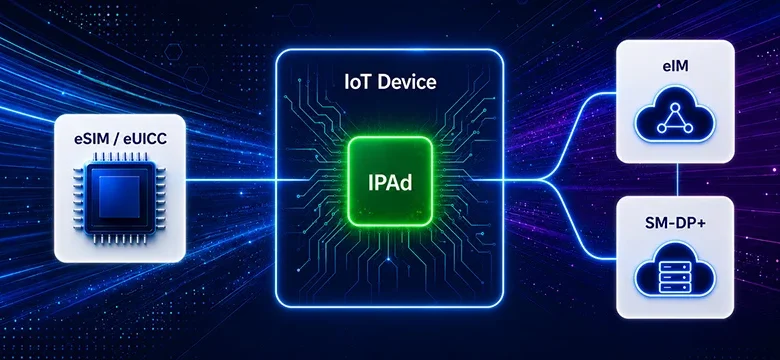
To address these limitations, the GSMA introduced the SGP.32 specification, specifically tailored for the IoT market. Within this architecture, the IoT Profile Assistant (IPA) serves as the indispensable orchestrator for remote SIM provisioning. Operating in tandem with the eSIM IoT Remote Manager (eIM), the IPA facilitates the remote downloading, activation, deactivation, and switching of cellular profiles over-the-air.
Crucially, the SGP.32 specification outlines two distinct deployment paradigms for the IPA:
- IPAe (IPA on eUICC): The assistant logic resides securely within the secure element itself.
- IPAd (IPA on Device): The assistant logic is integrated into the host IoT device’s operating system or application processor.
While the IPAd approach grants developers greater architectural flexibility and control over device resources, it introduces significant verification hurdles. Because the IPAd must communicate flawlessly with multiple external and internal entities—including the eUICC, the eIM, and the Subscription Manager Data Preparation Plus (SM-DP+) server—ensuring seamless end-to-end interoperability is a formidable engineering challenge.
The Engineering Complexities of IPAd Testing
Developing a reliable device-side IoT Profile Assistant is rarely a matter of writing isolated code. The inherent complexity of the SGP.32 ecosystem means that an IPAd implementation must correctly interpret and execute complex protocol sequences across disparate network nodes and hardware boundaries.
Manufacturers of IoT modules, gateways, and embedded software components frequently encounter difficulties when attempting to validate these interactions in-house. A typical provisioning workflow requires the eIM to dispatch a download trigger to the device. Upon receiving this trigger, the IPAd must securely establish a session, communicate with the SM-DP+, pull the correct encrypted profile, and securely hand it over to the eUICC for installation and storage. If any single component along this chain fails to synchronize or misinterprets a command, the profile download fails, leaving the IoT device stranded without connectivity.
Dr. Marcus Dormanns, Director of Product Management and Business Development at COMPRION, highlighted the core engineering bottleneck facing the industry. Many organizations are currently engineering components for the SGP.32 ecosystem for the very first time. According to Dr. Dormanns, the primary obstacle rarely stems from programming individual functions; rather, the true difficulty lies in validating the complex, multi-party interactions between the IPAd, the eUICC, and backend operational systems. This exact friction point forms the foundational justification for the joint testing framework.
Anatomy of the Jointly Validated SGP.32 Test Environment
To alleviate the integration burdens faced by developers, COMPRION and STMicroelectronics have synthesized their respective market-leading technologies into a cohesive, pre-validated testbed. The solution merges COMPRION’s specialized software testing suite—featuring the COMPRION eUICC Profile Manager with Loader IoT and the COMPRION Network Bridge—with GSMA-compliant SGP.32 eUICCs from STMicroelectronics, specifically anchored by the ST4SIM-300 product line.
This comprehensive environment provides a holistic framework for validating third-party IPAd implementations, regardless of whether a developer chooses to build their software stack completely from scratch or leverage existing reference designs. The architecture integrates physical ST4SIM-300 hardware with fully simulated eIM and SM-DP+ functionalities provided by COMPRION. Furthermore, the test suite incorporates advanced analysis and monitoring tools, granting engineers deep visibility into every protocol exchange occurring between the device operating system, the secure element, and remote cloud infrastructure.
By supplying a standardized, highly predictable reference environment, the collaboration ensures that developers can test edge cases, stress-test protocol handling, and verify compliance well before physical hardware reaches mass production.
Accelerating Deployment and Reducing Integration Risk
The overarching economic and operational implication of this partnership centers on risk mitigation and accelerated commercialization. In the fast-paced IoT marketplace, delays in securing network certification or resolving interoperability bugs can cost companies their competitive edge.
Agostino Vanore, Secure Edge and IoT eSIM Business Unit Manager at STMicroelectronics, emphasized the tangible benefits delivered to the wider engineering community. By establishing a robust, pre-tested verification framework, developers can meticulously verify the operational harmony between the IPAd and the eUICC under highly realistic network conditions. This capability allows engineering teams to unearth potential defects early in the design cycle, effectively eliminating integration roadblocks prior to wide-scale field deployment. Consequently, connectivity providers and IoT device manufacturers can introduce their solutions to the market with greater speed and reduced financial exposure.
To further lower the barrier to entry, STMicroelectronics provides a functional IPAd sample implementation. This sample code serves as a reliable baseline or template, enabling developers to bootstrap their custom software development efforts without needing to architect every foundational protocol handler from zero.
Target Industries and Broader Market Implications
The advent of streamlined SGP.32 testing tools arrives at a critical juncture for several high-growth vertical markets where reliable cellular connectivity is non-negotiable.
Automotive Applications: Modern connected vehicles rely on embedded cellular links for telematics, over-the-air firmware updates, infotainment, and emergency eCall services. As vehicles cross international borders, the ability to dynamically switch carrier profiles securely via SGP.32 without physical SIM card swaps is vital. The COMPRION and ST test environment ensures that vehicle telematics control units (TCUs) can execute these profile updates flawlessly.
Smart Metering and Utilities: Utility providers deploy millions of smart gas, water, and electricity meters in remote or subterranean locations where manual maintenance is cost-prohibitive. These devices must operate autonomously for over a decade. A failure in remote profile management due to a faulty IPAd could result in catastrophic data collection blackouts. Pre-validated test environments help guarantee field reliability.
Industrial IoT (IIoT) and Smart Manufacturing: Industrial machinery, robotics, and asset tracking tags require resilient, continuous communication channels. The ability to provision and manage these devices remotely across diverse global cellular networks underpins the entire promise of Industry 4.0.
Payment Systems and Point-of-Sale (POS) Terminals: Financial transactions demand uncompromising security and uptime. Implementing SGP.32 compliant profile switching in headless financial terminals requires stringent verification to protect sensitive encryption keys and user data against sophisticated cyber threats.
Conclusion: A Foundation for Scalable Cellular IoT
As the telecommunications and embedded systems industries transition fully into the SGP.32 era, the availability of dependable, standardized testing infrastructure will dictate which products succeed in a crowded global marketplace. The strategic alignment between COMPRION and STMicroelectronics delivers an essential toolkit that demystifies the complexities of device-side IoT Profile Assistant development.
By uniting advanced hardware secure elements with sophisticated protocol simulation and analysis software, the collaboration provides a clear, reliable pathway for developers, system integrators, and device manufacturers. As these industries continue to scale toward billions of connected endpoints, solutions of this caliber will remain foundational to ensuring secure, seamless, and resilient remote device management worldwide.