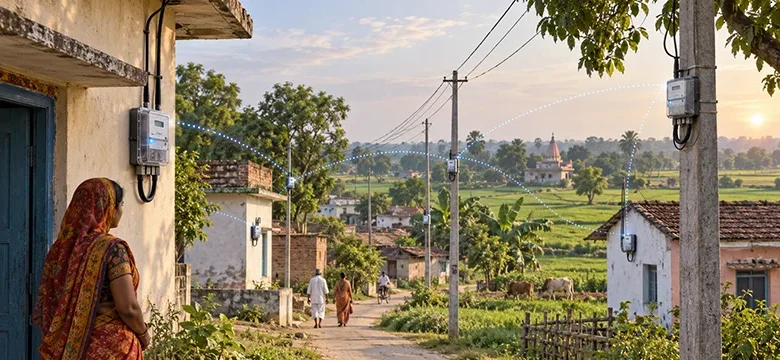
The landscape of modern utility management is undergoing a profound digital transformation, particularly within emerging markets where legacy infrastructure struggles to keep pace with rapid urbanization and rural development. In the northern Indian state of Uttar Pradesh, a major milestone in advanced metering infrastructure has been achieved through the successful deployment of nearly one million Polaris smart meters powered by Wirepas RF mesh connectivity. This large-scale initiative bypasses traditional connectivity hurdles by transforming the meters themselves into decentralized communication nodes, significantly reducing dependence on widespread cellular coverage and costly dedicated gateway hardware. Spearheaded as part of India’s ambitious national smart metering modernization agenda, this deployment offers a compelling blueprint for addressing the unique logistical challenges of extending digital utilities across vast, geographically dispersed populations.
The Rural Connectivity Challenge in India’s Most Populous State
Uttar Pradesh presents an exceptionally demanding environment for large-scale Internet of Things deployments. With a population exceeding 200 million residents, the state is characterized by a stark demographic distribution: approximately 78 percent of its inhabitants reside in rural villages rather than dense urban centers. Deploying conventional advanced metering infrastructure (AMI) in such regions has historically triggered significant engineering and financial roadblocks.
In densely populated metropolitan areas, cellular networks can easily handle millions of connected endpoints. However, stretching standard cellular coverage into remote, rural villages often exposes coverage gaps, inconsistent signal strength, and high maintenance overheads. Furthermore, relying entirely on dedicated communications infrastructure—such as installing numerous standalone gateway base stations across isolated rural clusters—introduces prohibitive capital expenditures and ongoing operational complexities. For utility providers tasked with upgrading millions of endpoints under strict budgetary and timelines constraints, these traditional models can quickly become economically unsustainable.
Decentralizing Infrastructure: How RF Mesh Changes the Economic Equation
To overcome these structural barriers, the recent deployment by Polaris Smart Metering leverages Wirepas RF mesh technology. Rather than forcing every individual smart meter to maintain an independent, direct cellular link to a remote cloud or utility server, the mesh architecture enables meters to communicate locally with one another. These devices dynamically route, relay, and aggregate consumption data across a self-forming, self-healing wireless network.
In this topology, select dual-communication meters serve as strategic conduits, utilizing cellular backhaul only where necessary to connect the local mesh clusters back to the utility’s Head End Systems (HES). This fundamental shift alters the underlying economics of AMI deployment. Adding a new meter to the grid in a remote village no longer automatically triggers the purchase of a new cellular subscription or the installation of nearby gateway hardware. Instead, every newly installed meter acts as an additional node, effectively strengthening the local mesh network and expanding overall coverage organically.
This decentralized approach addresses the core logistical friction points of rural rollouts. By distributing the communication workload across the device population itself, project stakeholders can achieve high reliability without requiring exhaustive, capital-intensive macro-cellular upgrades in every single settlement.
Policy Framework and National Integration
The Uttar Pradesh deployment does not occur in a vacuum; it forms a critical component of India’s wider national strategy to overhaul its power distribution sector. The Government of India has aggressively pursued utility modernization through initiatives such as the Revamped Distribution Sector Scheme (RDSS). The primary objective of the RDSS is to improve the operational efficiencies and financial sustainability of state-owned power distribution companies (DISCOMs) by reducing aggregate technical and commercial losses, improving billing accuracy, and enabling real-time grid monitoring.
Across the broader Indian market, Wirepas reports that its RF mesh platform has already been integrated into more than 11 million smart meters deployed under various RDSS-backed state projects. This widespread adoption underscores the technology’s scalability and its compliance with rigorous regulatory benchmarks. Specifically, the platform aligns with the DLMS (Device Language Message Specification) protocol and the Indian standard IS15959, ensuring seamless interoperability with existing utility software architectures and standardized Application Programming Interfaces (APIs).
By meeting these strict national and international compliance standards, technology providers and meter manufacturers can integrate mesh capabilities directly into mass-production pipelines, giving utilities the confidence that decentralized networks will interface smoothly with legacy billing, customer information, and distribution management systems.
Industry Implications for Massive IoT and Smart Grids
The success of the Uttar Pradesh rollout provides valuable insights for the broader massive IoT ecosystem, illustrating that wide-area network design does not have to be a binary choice between private infrastructure and ubiquitous cellular connectivity.
For utility providers and system integrators, the combination of a local self-forming mesh network with selective wide-area backhaul offers a resilient hybrid model. Localized data traffic remains within the secure boundaries of the device-to-device network, reducing exposure to public network congestion or carrier outages, while long-haul data transport is optimized and concentrated at strategic aggregation points.
For meter original equipment manufacturers (OEMs), this architectural shift alleviates the pressure to embed expensive, power-hungry cellular modems into every single manufactured endpoint. This reduction in bill-of-materials cost can translate to more competitive pricing for utilities, accelerating the pace of national smart grid deployments.
Meanwhile, cellular network operators and connectivity providers must adapt to a shifting role. Rather than provisioning high-density connections for every individual utility meter, operators can focus on providing high-capacity, reliable backhaul links at designated aggregation nodes. This optimizes network resource allocation, ensuring that cellular infrastructure is utilized where it provides the highest operational value.
Broader Impact and Future Outlook
As the deployment in Uttar Pradesh continues to scale toward its target milestones, industry observers are closely monitoring its long-term performance metrics, particularly regarding network latency, battery longevity in remote endpoints, and maintenance overhead during extreme weather seasons.
The lessons learned from connecting nearly one million rural meters via RF mesh will likely influence future smart infrastructure projects across other developing nations facing similar demographic and geographic challenges. Large-scale deployments in regions with sprawling rural populations demonstrate that the most efficient network architecture for massive IoT is not always one where every device connects independently to external infrastructure. Instead, when deployed in sufficient density, fixed endpoints can successfully organize themselves into a robust, self-sustaining digital fabric capable of powering the modern grid of the future.