The Evolution of RAG and the Chunking Bottleneck
The integration of RAG into enterprise workflows has grown rapidly since the introduction of transformer-based architectures. In early 2023, industry benchmarks began revealing a consistent failure pattern: systems were retrieving "technically relevant" chunks that lacked the surrounding semantic context required to answer complex user queries. This phenomenon, often termed "context fragmentation," occurs when arbitrary splitting methods—such as strictly character-based or word-count-based slicing—sever critical relationships between sentences, clauses, or logical sections.
By mid-2024, the industry moved away from "one-size-fits-all" preprocessing. Engineers began to realize that a legal contract, a Python code repository, and a casual FAQ page require fundamentally different ingestion logic. The shift toward specialized chunking strategies reflects a broader trend: optimizing the "signal-to-noise" ratio in vector search to reduce hallucinations and improve precision in automated customer support and internal knowledge management tools.
A Chronology of Retrieval Optimization
The development of chunking strategies has followed a distinct timeline:
- The Era of Fixed Constraints (Pre-2023): Developers relied almost exclusively on character-count limits. This period was characterized by high retrieval failure rates, as context was frequently lost at the arbitrary cutoff points.
- The Structural Shift (2023): The adoption of document-aware parsing (Markdown, HTML, and code-based splitting) allowed systems to respect the hierarchy of the source files.
- The Semantic & Intelligent Turn (2024-Present): The emergence of semantic chunking, late chunking, and agentic analysis marks the current state-of-the-art, where models actively participate in determining the most logical boundaries for information storage.
The Decision-Tree Framework
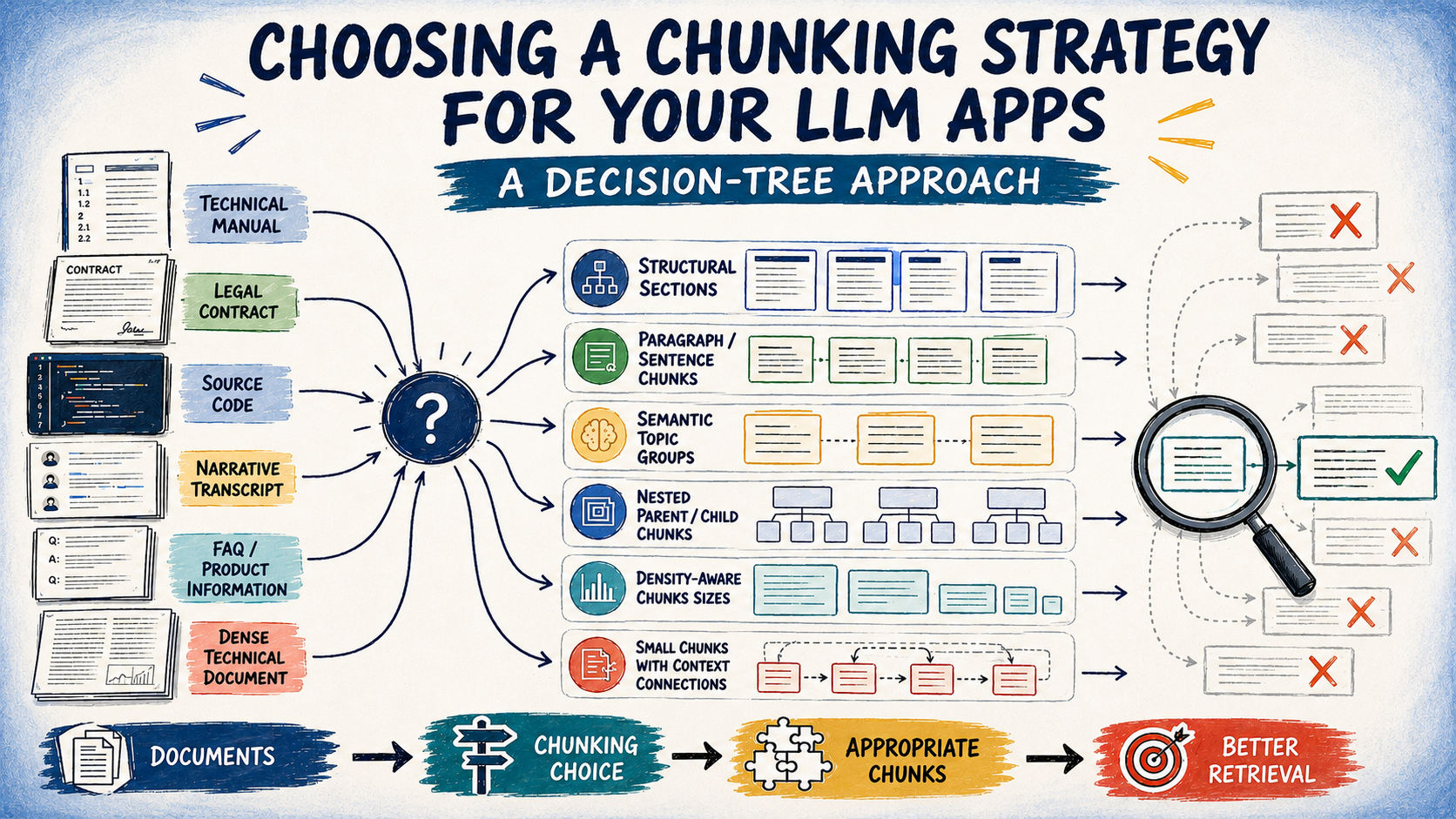
Selecting an appropriate strategy requires a systematic evaluation of document topology. Following a six-step decision tree ensures that resources are allocated based on data complexity rather than convenience.
1. Assessing Granularity and Scope
The initial audit asks: Is chunking necessary? For concise assets like product descriptions or single-topic FAQs, the overhead of segmenting the data often outweighs the benefits. Embedding the entire document preserves the integrity of the information. If the document exceeds the context window or contains multiple distinct topics, the system must proceed to structural analysis.
2. Evaluating Internal Document Architecture
Where document structure is robust, "document-based chunking" is the industry standard. By utilizing native markers—such as header tags, section breaks, or function definitions in source code—developers can ensure that logically grouped information remains together. When structure is inconsistent or absent, however, the system must shift to more algorithmic approaches.
3. Identifying Cross-Document Dependencies
A persistent challenge in RAG is the "referenced context" problem. In legal or technical documentation, a term defined in the introduction may be used throughout the text. If a model only sees a isolated chunk from the middle of the document, the lack of definitions leads to retrieval failure. "Late chunking" addresses this by embedding the entire document using a long-context model, then deriving smaller chunks from the resulting high-dimensional representation. This preserves the global context even at the local chunk level.
4. Managing Information Density and Variable Granularity
Information density is rarely uniform. Technical manuals often contain dense, high-value data alongside sparse, decorative, or introductory text. Adaptive chunking adjusts the size of the segments based on the density of the content, ensuring that no single chunk is overwhelmed by noise or lacks sufficient detail.
5. Balancing Retrieval Quality Against Operational Cost
The choice between LLM-based chunking and semantic chunking is a classic trade-off between performance and compute budget. LLM-based chunking, which uses a model to identify logical breakpoints, yields the highest precision but incurs significant API costs. For organizations with massive, heterogeneous datasets, this may be prohibitively expensive. In such cases, semantic chunking—which measures the embedding distance between sentences—provides a cost-effective middle ground by identifying shifts in topic without the need for a full LLM pass.
6. The Heterogeneous Challenge
In complex environments where the repository contains a mixture of disparate file types, "agentic chunking" is the most robust solution. An autonomous agent inspects each document to determine the most effective parsing strategy. For more uniform collections, recursive chunking remains the most reliable baseline, systematically reducing content until it fits target parameters while attempting to preserve paragraph and sentence cohesion.
Supporting Data and Implementation Trade-offs
Industry research suggests that the cost of poor chunking is not merely a decrease in retrieval accuracy, but an increase in total cost of ownership (TCO) for AI infrastructure. Over-segmenting leads to "retrieval bloat," where too many chunks are returned, confusing the final generation step. Conversely, under-segmenting leads to "context dilution," where the LLM cannot find the specific answer within a massive, generic chunk.
| Strategy | Ideal Use Case | Primary Risk |
|---|---|---|
| Recursive | Uniform, large-scale corpora | Semantic loss at boundaries |
| Semantic | Unpredictable topic shifts | Threshold calibration errors |
| LLM-Based | High-stakes legal/technical data | Significant compute latency |
| Late Chunking | Highly cross-referenced data | Requires long-context hardware |
Broader Implications and Future Outlook
The shift toward intelligent, document-aware chunking signifies that the "data prep" phase of AI development is becoming as important as the model architecture itself. As retrieval systems mature, we can expect the emergence of "dynamic chunking," where the segmentation strategy itself is updated in real-time based on the incoming user query.
Organizations currently struggling with RAG performance should audit their preprocessing pipelines. The most common pitfall observed in enterprise deployments is the application of a "fixed-size" default to complex, highly structured documents. By moving toward a logic-based, hierarchical approach, companies can significantly reduce hallucination rates and improve the reliability of their AI assistants.
Ultimately, the goal is to align the digital architecture of the document with the human logic of the query. When these two align, the system moves beyond simple keyword matching and into the realm of true semantic retrieval, providing the high-fidelity answers that modern enterprise applications demand. As the ecosystem continues to evolve, the ability to select and implement these strategies will remain a core competency for developers in the generative AI space.