How SerpApi Markdown Output Drastically Reduces AI Token Consumption and Operational Costs

In the rapidly evolving landscape of artificial intelligence, the efficiency of Large Language Models (LLMs) is no longer determined solely by the sophistication of the underlying architecture, but by the economy of the data fed into them. As AI agents become more autonomous—tasked with recursive web searches, complex file retrieval, and multi-step reasoning—the cost of "token bloat" has emerged as a significant barrier to scalability. A single, seemingly benign search query can trigger a cascade of nested JSON objects, metadata, and tracking strings that serve no purpose for the model’s reasoning process but consume thousands of expensive tokens. SerpApi, a leader in search engine data extraction, has recently introduced a Markdown output feature specifically designed to trim this fat, offering a potential 74% reduction in token consumption.
The Problem of Token Bloat in Agentic Systems
Modern AI agents often operate in loops. When an agent is prompted to research a topic, it may perform an initial search, parse the results, encounter an ambiguity, and execute a second, deeper search. If the initial payload from a search API includes extraneous data—such as tracking links, server-side metadata, and redundant JSON boilerplate—the agent’s context window fills rapidly.
Every token represents a cost in both compute and capital. For developers building on top of premium models like GPT-4o or Claude 3.5 Sonnet, the context window is a finite resource. When an agent pulls in full-length files or bloated logs, it inadvertently forces the model to ignore relevant information to make room for unnecessary data. Historically, developers have relied on JavaScript Object Notation (JSON) for data exchange because it is machine-readable and highly structured. However, JSON requires significant syntax overhead—brackets, quotes, and key-value pairs—that the model must process, consuming tokens without adding informational value.
Chronology of Data Retrieval Efficiency
The shift toward model-optimized data formats has gained momentum over the last 18 months as enterprises moved from simple RAG (Retrieval-Augmented Generation) setups to complex agentic workflows.
- Q1 2023: The industry standard for search APIs remained strictly JSON-based. Developers began experimenting with custom post-processing scripts to strip out unused keys, a process that increased latency and server-side complexity.
- Q4 2023: As context windows expanded, the "lost in the middle" phenomenon—where models struggle to recall information buried in the middle of long, unstructured inputs—led developers to prioritize data density.
- Mid-2024: SerpApi identified that the structural requirements of web browsers and UIs were fundamentally misaligned with the cognitive needs of LLMs. This realization led to the development of a native Markdown conversion layer.
- Present: The rollout of Markdown output across all 100+ SerpApi endpoints represents a fundamental shift: data is now being formatted specifically for "machine reading" rather than "browser rendering."
Quantitative Analysis: The Efficiency Delta
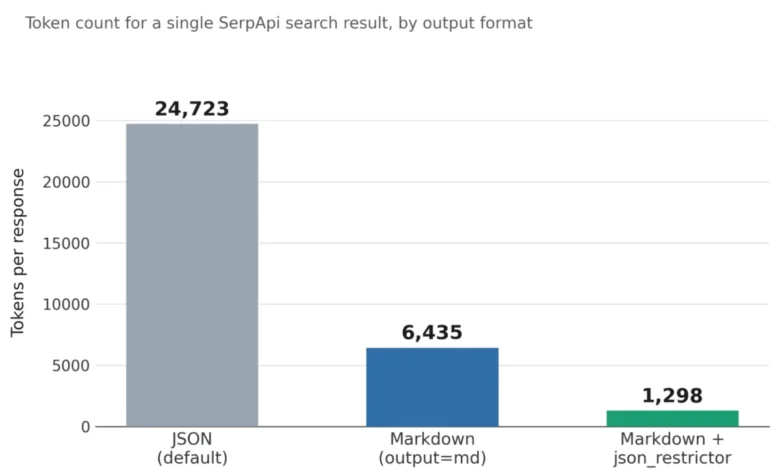
The impact of shifting from JSON to Markdown is not merely marginal; it is transformative for cost-sensitive applications. Internal benchmarks conducted using SerpApi’s infrastructure provide a clear look at the efficiency gains. A standard search query for "coffee" in JSON format required 24,723 tokens to process. By migrating the same request to a structured Markdown output, the requirement plummeted to 6,435 tokens.
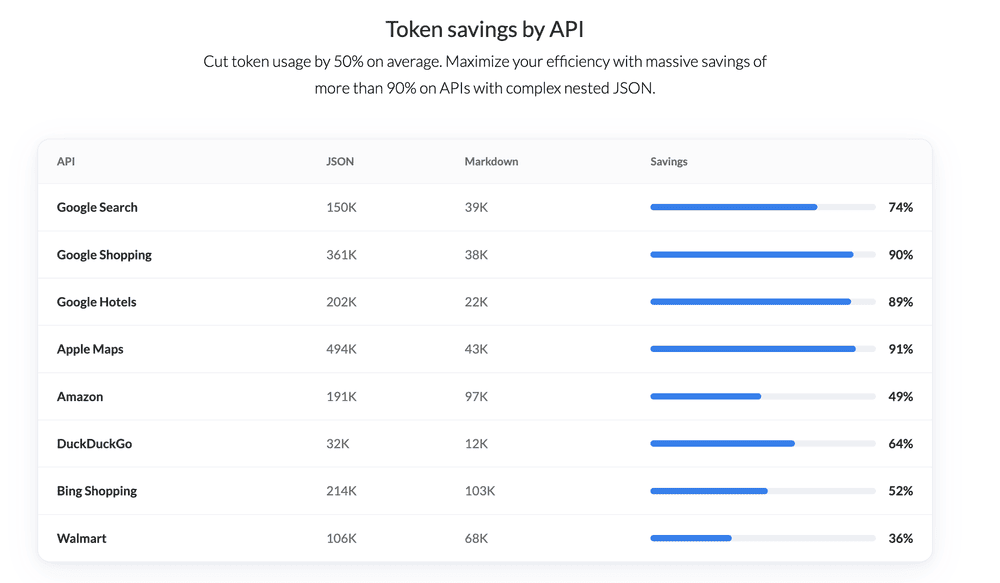
This represents a 74% reduction in token consumption. For a high-frequency trading bot or a research agent running thousands of queries per day, this reduction effectively lowers the operational cost of the API-to-LLM pipeline by nearly three-quarters. Furthermore, when implementing additional field restrictions—selecting only the necessary metadata—that same search can be reduced to just 1,298 tokens. This granular control allows developers to optimize the input based on the specific intent of the agent.
Technical Mechanisms: Why Markdown Wins for LLMs
Markdown is inherently more concise than JSON because it replaces structural syntax with formatting conventions. In JSON, every object, array, and key-value pair is enclosed in braces and quotes. Markdown, by contrast, uses headers, tables, and lists—structures that LLMs are trained to parse with high proficiency.
When SerpApi processes a request for Markdown, it performs several key transformations:
- Metadata Stripping: Internal server identifiers and tracking parameters—essential for ad-tech but useless for AI reasoning—are excised.
- Schema Normalization: Complex, nested JSON trees are flattened into markdown tables, which are easier for models to navigate.
- Link Consolidation: Instead of verbose URLs with extensive query parameters, links are simplified or converted to descriptive text, reducing the character count significantly.
- YAML Frontmatter: For developers who still require structured context, the header provides essential data in a compact, readable format that occupies minimal space compared to a full JSON tree.
Strategic Considerations for Developers
While the advantages of Markdown are clear, industry experts warn that it is not a universal replacement for JSON. The choice between formats should be dictated by the downstream application’s requirements.
If a system requires high-precision data—such as financial platforms needing exact floats for prices, or logistics software requiring specific coordinate integers—JSON remains the industry standard. JSON’s rigidity ensures that data types are preserved throughout the pipeline, preventing errors that could arise from the more ambiguous nature of text-based Markdown. However, for summarization tasks, content extraction, and general research agents, Markdown is objectively superior. The table rows and clear hierarchies in Markdown allow the model to focus its "attention" (in the Transformer sense) on the actual information rather than the syntax of the data structure.
Broader Implications for the AI Economy
The integration of Markdown output signifies a broader maturation of the AI supply chain. As the industry moves past the "hype phase" and into the "deployment phase," efficiency has become the primary metric of success. Companies are realizing that the cost of an AI application is not just the model provider’s fees, but the entire "data pipeline" cost.
By pushing this optimization to the API layer, providers like SerpApi are essentially offering a "pre-processing" service that happens before the data even reaches the LLM. This saves not only money but also time, as smaller payloads require less bandwidth and lower latency for processing. This development is expected to trigger a wave of similar optimizations across other data providers. As AI agents take on more, the ability to "prune" the data before it enters the context window will become a mandatory feature for any data-as-a-service provider.
How to Implement and Validate Gains
For organizations looking to integrate these optimizations, the barrier to entry is low. Most implementations require only a simple query parameter update—such as appending output=md to the API request.
To validate these savings, developers are encouraged to run a "before and after" audit. By tracking the usage or token_count metrics provided by the LLM provider (such as OpenAI or Anthropic), developers can compare the specific impact of Markdown against their legacy JSON workflows. This empirical evidence allows for a data-driven approach to cost reduction.
In conclusion, the move toward Markdown-optimized data is a vital step toward sustainable AI development. By stripping away the bloat and focusing on the information that actually contributes to model reasoning, developers can build more efficient, scalable, and cost-effective agents. The shift is not just about saving tokens; it is about refining the interface between the vast, chaotic web and the precise, logical systems of modern artificial intelligence. As the industry continues to scale, those who prioritize the efficiency of their data shape will undoubtedly have a competitive advantage in both performance and operational sustainability.