Beyond Prediction: The Convergence of Traditional Machine Learning and Agentic Reasoning in Modern Enterprise Architecture


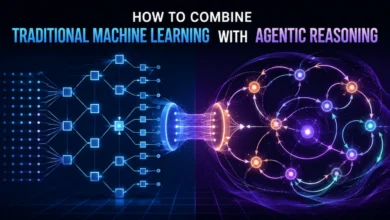
In the rapidly evolving landscape of artificial intelligence, a fundamental shift is occurring in how organizations design and deploy autonomous systems. For decades, the industry has relied heavily on traditional machine learning—mathematical models trained to map specific inputs to precise statistical outputs. While these systems have achieved remarkable accuracy in fields ranging from medical diagnostics to financial fraud detection, they remain constrained by their static nature. Today, a new paradigm known as agentic reasoning is emerging, offering a way to move beyond simple prediction toward active, multi-step problem solving. By integrating the high-precision pattern recognition of traditional models with the adaptive, goal-oriented orchestration of agentic systems, enterprises are creating a new class of "hybrid AI" that can navigate complex, real-world workflows without the brittleness of previous generations.
The Foundation: The Success and Limitations of Predictive Modeling
To understand the current shift, one must first appreciate the legacy of supervised machine learning. Since the early 2010s, deep learning and ensemble methods have dominated the technological horizon. These models function as high-performance function approximators; given a set of features—such as pixel values in an image or historical transaction logs—they compute a probability or a regression value.
The success of these models is predicated on the "closed-world assumption." A model trained to predict credit risk, for example, operates under the assumption that all necessary information is captured within the features provided at the moment of inference. According to industry reports from firms like Gartner and McKinsey, these models are currently deployed in over 70% of Fortune 500 companies to automate routine tasks. They are prized for their speed, scalability, and auditability. However, the limitation of this architecture is inherent: it is essentially a "black box" that lacks agency. If the input data is incomplete, or if the environment changes in a way that wasn’t accounted for during the training phase, the model cannot pause, investigate, or pivot. It simply produces an output based on its training, regardless of whether that output is contextually appropriate.
The Evolution of Agency: From Prediction to Orchestration
The concept of "agentic" AI represents a move toward systems that possess a degree of autonomy in navigating time and environmental complexity. Unlike a standard model, an agent acts as an orchestrator. It uses a large language model (LLM) or a similar reasoning engine as a "cognitive core" to maintain a state of awareness over a long-running process.
The timeline of this development is relatively recent. While researchers have discussed autonomous agents since the early days of AI, it was not until the widespread availability of robust transformer-based models that these systems became practical. In 2023 and 2024, the focus shifted from pure generation to "agentic workflows." These systems possess four critical capabilities that distinguish them from traditional models:
- Decomposition: The ability to break a vague goal, such as "research the viability of this supplier," into a sequence of sub-tasks.
- Dynamic Tool Use: The capability to call external APIs, query databases, or execute code based on intermediate findings.
- Adaptive Feedback Loops: The capacity to monitor the output of a tool and determine if it requires a different approach.
- Active Implementation: The ability to execute changes in the environment, such as writing to a ledger or initiating an automated email.
The Hybrid Architecture: A Strategic Synergy
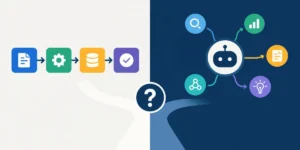
The most effective AI systems currently in development do not replace traditional models; they embed them. The industry is witnessing a transition toward a "hub-and-spoke" architecture. In this model, the agent acts as the hub, managing the workflow, while traditional machine learning models serve as the spokes—specialized tools called upon for specific, high-precision tasks.
Consider the architecture of a modern logistics optimization system. An agent is tasked with managing global supply chain disruptions. When a port strike occurs, the agent does not attempt to "reason" the statistical probability of a delay from scratch. Instead, it delegates that calculation to a specialized, pre-trained regression model that is optimized for port throughput metrics. The agent takes the output of that model, combines it with real-time news data gathered from web-search tools, and then uses its reasoning engine to formulate a mitigation plan—such as rerouting cargo via rail—before executing the API calls to update the logistics platform.
This division of labor is critical. Statistical models are superior at handling massive, high-dimensional datasets where patterns are subtle and require specialized training. Agents are superior at the "connective tissue" of business: the logic, sequence, and context that govern real-world operations.
Data and Implications for the Enterprise
Economic analysis suggests that the move toward hybrid AI could significantly increase the "ROI of inference." By enabling models to gather their own context, organizations reduce the burden on data engineering teams to clean and pre-package every possible scenario into a feature vector. Data from recent pilot programs in the financial services sector indicates that agentic workflows can reduce the time required for complex document review by as much as 60%, largely by reducing the need for human intervention in the "middle steps" of a process.
However, this transition introduces new challenges. The primary concern among security and compliance professionals is "agentic drift"—the risk that an autonomous system might deviate from established protocols when faced with novel edge cases. Consequently, the industry is seeing a rise in "Human-in-the-Loop" (HITL) frameworks, where agents are required to request human verification before taking high-stakes actions, such as finalizing a contract or moving significant financial assets.
Expert Perspectives and Future Outlook
Industry leaders and academic researchers generally agree that the integration of these two approaches is the next logical step in the maturity of AI. Dr. Sarah Chen, a lead architect in autonomous systems, notes: "For years, we’ve been trying to solve complex problems with simple models. Now, we are realizing that the model is only a component. The real intelligence lies in the orchestration layer that allows these models to interact with the world in a way that is coherent, auditable, and, most importantly, actionable."
As the technology matures, the definition of an "AI-ready" organization will change. It will no longer be enough to have high-quality datasets and well-tuned models. Companies will need to invest in the infrastructure that allows agents to interact safely with legacy systems. We can expect the next 18 to 24 months to be defined by the development of "agentic platforms"—environments that provide standardized hooks for models to interact with databases, tools, and human oversight mechanisms.
Conclusion
The convergence of traditional machine learning and agentic reasoning marks a transition from AI that merely observes to AI that participates. By separating the function of statistical prediction from the function of procedural planning, the industry is overcoming the static limitations that have historically hindered AI’s utility in complex, real-world scenarios.
This hybrid approach does not represent the obsolescence of predictive modeling. Rather, it represents the maturation of the AI stack. The predictive models of yesterday remain as essential as ever, but they are finally being liberated from the constraints of being "single-step" tools. As businesses continue to integrate these systems, the result will be a more resilient, responsive, and capable digital infrastructure—one where the model provides the insight, and the agent provides the action. The future of enterprise AI will be defined not by the sophistication of individual models, but by the intelligence of the systems that orchestrate them.