Automating Knowledge Graph Population: Extracting Entities and Triples from Unstructured Text with an LLM

The Evolution of Knowledge Retrieval
Traditional RAG systems have historically relied on vector-based similarity search. While effective at retrieving semantically relevant document chunks, vector search is fundamentally probabilistic. It lacks the ability to verify ground-truth facts, often leading to models that retrieve semantically related but factually incorrect information. The transition toward a 3-tiered Graph-RAG architecture addresses this by introducing a deterministic layer. In this framework, facts are stored as "quads"—Subject, Predicate, Object, and Context (SPOC)—allowing systems to trace every piece of information back to its source, providing a verifiable audit trail for every answer generated.
The fundamental challenge in this approach has long been the "cold start" problem: how to populate these graphs efficiently. Manual curation is unscalable for modern data volumes. Consequently, automated extraction pipelines are becoming the industry standard, utilizing the reasoning capabilities of LLMs to parse text into structured schemas.
Setting the Foundation: The Technical Infrastructure
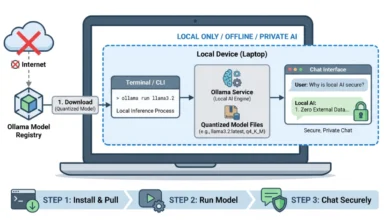
To implement this automated pipeline, developers must establish a local environment capable of high-fidelity data extraction. The integration of the Ollama server allows for the deployment of models like Llama 3.2, which, when configured with strict JSON output constraints, act as reliable parsing engines.
The process begins with the establishment of the infrastructure. For those working in local development environments or cloud-based research kernels such as Google Colab, the prerequisites are minimal: a functional Python environment, the requests library for communication with the LLM API, and the wikipedia library to serve as a source of unstructured data.
To ensure the system is reproducible, the following command-line instructions provide the necessary environment configuration:
apt-get update -qq && apt-get install -y -qq zstd: This ensures the system architecture supports the necessary data compression formats.curl -fsSL https://ollama.com/install.sh | sh: This deploys the Ollama runtime, which serves as the host for our local model.pip install wikipedia requests: These libraries enable the ingestion of real-world knowledge from the public domain.
Architecting the Quadstore Engine
At the heart of the knowledge graph lies the QuadStore. Unlike standard databases, a QuadStore must manage the four-dimensional nature of the data. By including a "Context" field, the database allows developers to distinguish between conflicting facts from different sources. For instance, if one source identifies an entity under a specific historical context and another source identifies it differently, the QuadStore can maintain both, allowing the retrieval layer to make informed decisions based on the provenance of the data.
The Python implementation of this engine is lightweight, typically utilizing a memory-mapped list structure. The core logic involves a query method that allows for flexible retrieval—filtering by subject, predicate, object, or context—thereby allowing the Graph-RAG system to perform highly specific lookups.
The Mechanics of Semantic Extraction
The extraction process involves prompting the LLM to act as a structured data architect. By setting the temperature parameter to 0.0, developers minimize creative variance, forcing the model to adhere strictly to the logic of the source text.
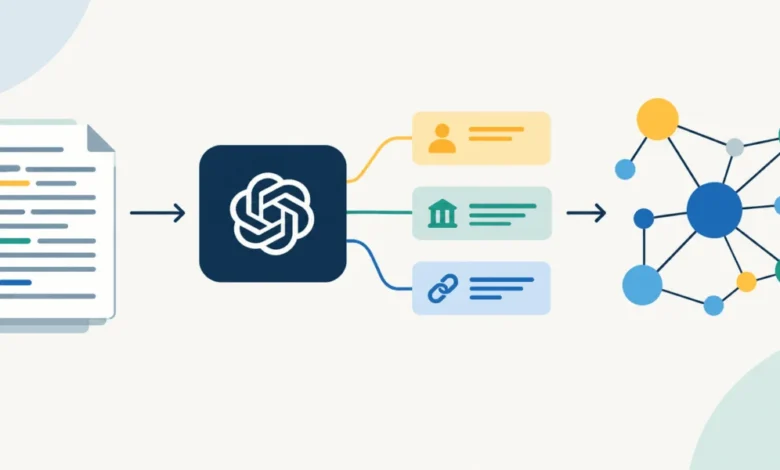
When processing a document, such as a biographical entry on Alan Turing, the system initiates a multi-step workflow:
- Source Retrieval: The raw text is fetched and partitioned into manageable segments, ensuring the context window of the LLM is not exceeded.
- Atomic Fact Identification: The LLM analyzes the text to identify entities (the Subject and Object) and the nature of their relationship (the Predicate).
- JSON Normalization: The output is formatted into a standardized JSON schema. This ensures that the downstream application can parse the data without risk of format corruption.
- Validation and Insertion: The extracted triples are appended with a metadata tag (the Context) and committed to the
QuadStore.
Chronology of Data Transformation
A typical pipeline execution follows a rigid timeline:
- T+0 seconds: Initialization of the Ollama background process.
- T+3 seconds: Model loading and server readiness.
- T+10 seconds: Wikipedia API call and raw text acquisition.
- T+20 seconds: Inference phase, where the LLM performs entity relationship extraction.
- T+30 seconds: Parsing and normalization of the JSON payload.
- T+35 seconds: Final injection of validated quads into the local graph database.
Implications for Enterprise AI
The shift toward automated, local knowledge graph population has significant implications for enterprise-grade AI.
First, Cost Optimization: By utilizing open-source models like Llama 3.2 on local hardware, organizations eliminate the recurring costs associated with per-token billing models from major cloud AI providers.
Second, Data Sovereignty and Security: Sensitive data remains within the organizational firewall. When the extraction process is performed locally, the data is never transmitted to a third-party server, a critical requirement for industries such as finance, healthcare, and defense.
Third, Determinism and Hallucination Mitigation: By grounding the LLM in a deterministic graph, developers can implement a "verification before generation" workflow. Before the model produces an answer, it can query the QuadStore to verify that the key facts are supported by the extracted quads. If the information is missing from the graph, the system can be configured to decline to answer rather than hallucinating, significantly increasing the reliability of the output.
Challenges and Future Considerations
While the automation of knowledge graphs is a major advancement, it is not without challenges. LLMs can still occasionally misinterpret complex sentence structures, leading to erroneous predicate assignment. To address this, current research is moving toward "Human-in-the-loop" validation, where the model suggests quads that are then reviewed by a domain expert before being committed to the permanent graph.
Furthermore, the scalability of local QuadStore implementations remains a topic of study. As graphs grow to include millions of nodes, simple in-memory storage will require transition to more robust graph databases like Neo4j or ArangoDB. However, the logic remains the same: the LLM serves as the bridge between the fluid nature of human language and the rigid structure of relational databases.
Conclusion: Closing the Loop
The integration of automated knowledge extraction into RAG pipelines marks the end of the "black box" era of information retrieval. By creating a system that explicitly maps facts in a 4-dimensional SPOC format, developers provide LLMs with a foundational source of truth. As demonstrated through the practical example of processing biographical data, the ability to rapidly convert unstructured, chaotic text into a clean, queryable knowledge base is now within the reach of any developer with access to local hardware and open-source models. This approach not only enhances the accuracy of AI systems but also provides the necessary transparency and auditability required for the next generation of industrial-strength applications. Through this methodology, the vision of truly deterministic, reliable AI is closer to realization than ever before.