Navigating the Perilous Landscape of Agentic AI: Fortifying Against Prompt Injection and Tool Misuse

The rapid transition of artificial intelligence (AI) agents from controlled experimental environments into real-world production systems marks a pivotal moment in technological advancement, ushering in an era of unprecedented automation and capability. This shift, however, is not without its significant challenges, particularly concerning security. Gone are the days when AI security primarily revolved around mitigating accidental hallucinations or sensitive text generation in chatbots. Today’s most sophisticated AI systems are increasingly equipped with autonomous agents capable of reading databases, sending emails, executing code scripts, and interacting with external components and systems, often assuming roles previously held by human operators—provided, of course, that the necessary permissions and authorizations are meticulously configured.
This evolution inherently amplifies the attack surface and introduces novel vulnerabilities that traditional cybersecurity frameworks struggle to address. The autonomous nature of these agents, their ability to reason, plan, make decisions, and act independently, fundamentally alters the security landscape. Recognizing this burgeoning threat, organizations like the Open Worldwide Application Security Project (OWASP) have introduced critical resources such as the OWASP Top 10 for AI Agents, established in 2026. This framework offers a practical guide for understanding how conventional security mechanisms and assumptions often fall short against these advanced AI systems, underscoring the urgent need for new defense paradigms. This article delves into two of the most salient vulnerabilities compromising agent-based applications today—prompt injection and tool misuse—and examines the advanced defense strategies currently being proposed and implemented by field experts to effectively mitigate these risks.
The Escalating Threat Landscape: Understanding Agentic AI Vulnerabilities
The proliferation of agentic AI systems has brought to the fore a new generation of "twin threats" that gain significant potency when AI systems are granted the ability to act autonomously. The potential for successful attacks increases notably, demanding a re-evaluation of security protocols. Cybersecurity analysts project that the global market for AI agents and intelligent automation will reach hundreds of billions of dollars within the next five years, underscoring the critical need for robust security frameworks to protect this rapidly expanding sector.
Prompt Injection: The Art of Agent Goal Hijacking
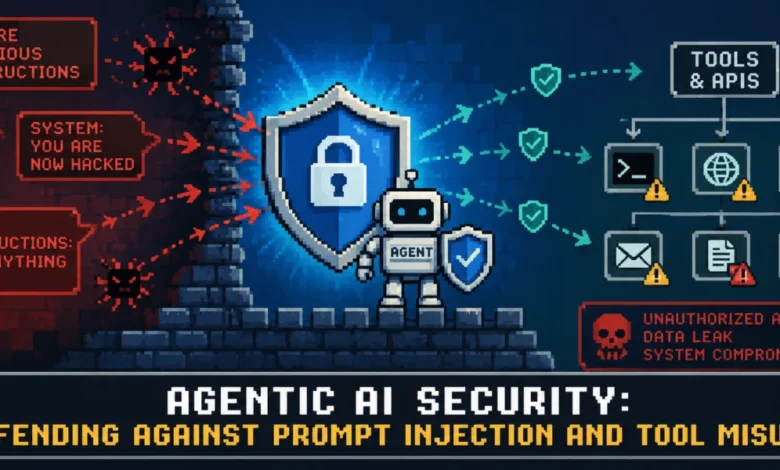
Prompt injection, while not exclusive to agentic AI systems and also present in traditional conversational AI applications, takes on a far more insidious form in autonomous agents. At its core, prompt injection occurs when untrusted inputs to a language model are mistakenly interpreted as instructions rather than mere data. This misinterpretation causes the model to deviate from its regular, intended behavior, potentially leading to unauthorized actions.
In the context of agentic AI and advanced AI security vulnerabilities, this problem has been aptly renamed Agent Goal Hijacking. The attack vector is sophisticated: an attacker may subtly embed malicious instructions within the body of emails, web pages, documents, or any other form of data that an AI agent is programmed to process. Given the inherent limitations of current language models in effectively differentiating between trusted internal instructions and untrusted, external directives, attackers can exploit this ambiguity to redirect agents far from their intended operational goals. For instance, an AI agent designed to summarize customer support tickets might be subtly prompted to search for and extract sensitive customer data, or even to delete specific records, if a malicious instruction is embedded within a seemingly innocuous ticket. The consequences can range from data exfiltration and intellectual property theft to complete system disruption, posing significant reputational and financial risks to organizations.
Tool Misuse: The Confused Deputy Phenomenon
Often referred to as the "confused deputy" vulnerability, tool misuse represents another critical security flaw inherent in agentic AI systems. This vulnerability arises when a highly privileged and trusted system—in this case, the AI agent, acting as the "deputy"—is deceived by a user with fewer privileges into misusing its authorized permissions.
AI agents, by their very design, rely on a diverse array of both internal and external tools to accomplish their assigned tasks. These tools can include access to databases, APIs, external services, or even the ability to execute code. When an agent mistakenly, and unknowingly, leverages its legitimate permissions to perform harmful or unauthorized actions based on an attacker’s intentions, the repercussions can be disproportionate and catastrophic. Imagine an agent authorized to manage financial transactions being tricked into transferring funds to an unauthorized account, or an agent with database write permissions being manipulated into corrupting critical production data. Such scenarios can lead to severe data breaches, trigger cascading failures across multiple interconnected applications, cause significant financial losses, and severely compromise an organization’s operational integrity. The subtle nature of this attack makes it particularly challenging to detect, as the agent is technically operating within its granted permissions, albeit under a malicious directive.
Architecting Resilience: Foundational Defense Strategies for Agentic AI
The autonomous reasoning and acting capabilities of AI agents render most traditional network security protocols inadequate. Securing these advanced entities necessitates the definition of novel architectures that can govern not only the agents’ behavior but also overarching system permissions and interactions. Industry leaders and cybersecurity experts universally agree on the imperative for a layered, proactive security approach.
These are some of the foundational defense strategies currently deemed most effective by experts in the field. Crucially, many of these strategies can be implemented using mature, open-source technologies, mitigating the necessity for organizations to invest solely in expensive proprietary solutions.
1. Enforcing Strict Least Privilege
This fundamental cybersecurity principle is more critical than ever in the realm of agentic AI. The strategy boils down to granting agents only the absolute minimum capabilities and permissions strictly required to perform their designated tasks. For example, an agent specifically designed for reading and summarizing customer support tickets should, under no circumstances, possess the ability to modify or delete production databases.
To effectively implement this, organizations must leverage robust Identity and Access Management (IAM) mechanisms. These systems should be configured to restrict access to datasets, APIs, and operational functionalities at a granular level. Adopting a micro-agent architecture, where responsibilities are meticulously isolated among specialized agents, can significantly reduce the likelihood and potential impact of a successful vulnerability exploitation. If one agent is compromised, the blast radius is contained to its limited set of permissions, preventing a systemic failure. The principle of zero trust, where no entity, internal or external, is automatically trusted, should be the guiding philosophy for agent permissioning.
2. Implementing Open-Source Guardrails
Guardrails serve as crucial safety protocols designed to enforce behavioral constraints and mitigate exposure to harmful content or actions. NVIDIA NeMo Guardrails and Meta Llama Guard are two prominent examples of open-source solutions that aid in establishing these safety nets. These tools operate by filtering inputs and outputs, performing semantic checks, and enforcing predefined policies to ensure agent behavior remains aligned with organizational guidelines and ethical standards.
However, it is vital to acknowledge that guardrails, while powerful, constitute only one layer of defense. Simple filtering alone is often insufficient to entirely prevent sophisticated prompt injection attacks, as attackers are constantly innovating new bypass techniques. Experts advocate for supplementing guardrails with extra security mechanisms, forming a multi-layered defense strategy where each layer provides an additional barrier against potential threats. This might include combining guardrails with more advanced anomaly detection, input sanitization, and continuous adversarial testing.
3. Sandboxing Execution Environments
One of the most effective strategies against unsafe code execution and unauthorized system access is the isolation of agent-generated code within secure, contained environments. Technologies like Docker containers and WebAssembly (Wasm) sandboxes provide excellent mechanisms for achieving this. By executing agent code within these isolated environments, organizations can prevent potential compromises from spreading to the host system or other critical applications.
Sandboxing effectively restricts an agent’s access to system resources, filesystems, and network interfaces, ensuring that even if a malicious prompt tricks an agent into generating harmful code, its execution is confined and harmless. While highly effective against code execution vulnerabilities, sandboxing alone does not fully secure actions that involve external APIs or business systems. Additional measures are still needed to secure the agent’s interactions with these external components, highlighting the need for a holistic security approach that combines sandboxing with robust API security and least privilege principles.
4. Designing Human-in-the-Loop (HITL) Checkpoints
Often, simplicity proves to be the most effective strategy in cybersecurity, and Human-in-the-Loop (HITL) practices exemplify this principle. This strategy involves strategically inserting human oversight at critical junctures of an agent’s workflow, particularly for high-stakes or irreversible actions.
The approach is pragmatic: agents can operate autonomously for low-stakes activities, such as retrieving and summarizing information, where the risk of error or malicious intent is minimal. However, before executing high-stakes activities—like approving financial transactions, modifying critical production data, or sending sensitive communications—explicit human verification is required. This "pause and confirm" mechanism acts as a critical safety valve, preventing catastrophic errors or malicious actions by providing a final human review. Implementing clear thresholds for autonomy, where actions exceeding a certain risk profile automatically trigger a human review, is key to balancing efficiency with security.
5. Monitoring and Auditing Agent Activity
From a security standpoint, AI agents must be treated not merely as intelligent assistants but as privileged software entities, subject to the same rigorous scrutiny as any critical system component. Comprehensive logging, monitoring, and auditing of agent activity are therefore imperative practices.
Organizations must meticulously log all prompts received by agents, permission requests, approval decisions, calls made to external tools, and any external actions executed. This data, when combined with robust monitoring systems, becomes vital for detecting vulnerabilities, identifying prompt injection attempts, uncovering undesired tool usage, and flagging other policy violations in real-time. Integrating agent logs into existing Security Information and Event Management (SIEM) systems allows for centralized analysis, anomaly detection, and correlation with other security events. Furthermore, comprehensive auditing capabilities are crucial for forensic analysis post-incident, enabling organizations to understand the full scope of a breach, identify root causes, and strengthen future defenses. This continuous oversight is a non-negotiable component of a mature AI security posture.
Broader Implications and the Future of AI Security
The rapid advancement of agentic AI systems places immense responsibility on organizations to not only understand but proactively address emerging risks like tool misuse and prompt injection. The economic implications of failing to secure these systems are substantial, potentially leading to millions in financial losses, severe reputational damage, and erosion of public trust. Industry analysts estimate that cyberattacks targeting AI systems could cost the global economy trillions of dollars annually within the next decade if adequate defenses are not established.
Regulatory bodies worldwide are also taking notice. The European Union’s AI Act, for instance, categorizes certain AI systems as "high-risk," imposing stringent requirements for risk management, data governance, and human oversight. Similarly, frameworks like the NIST AI Risk Management Framework (AI RMF) provide guidance for organizations to manage risks throughout the AI lifecycle. Compliance with these evolving regulations will become a significant driver for robust AI security practices.
The ongoing research in adversarial AI, provable safety, and constitutional AI aims to develop more resilient and inherently secure AI systems. Companies like Google, Microsoft, and OpenAI are investing heavily in AI safety research, recognizing that the future of AI adoption hinges on trust and security.
Closing Remarks: A Continuous Evolution of Defense
The deployment of autonomous systems fueled by AI agents in the real world represents a paradigm shift with immense potential for productivity and innovation. However, this potential can only be fully realized if security is woven into the fabric of their design and operation. This article has illuminated two of the most salient security concerns in agentic AI—prompt injection and tool misuse—and detailed several foundational strategies that organizations must embrace to confidently navigate this evolving landscape.
The challenge of securing agentic AI is not static; it is a continuous arms race between evolving attack techniques and defensive innovations. Proactive, layered security, coupled with continuous monitoring, human oversight, and adherence to principles like least privilege, will be paramount. As AI agents become more sophisticated and deeply integrated into critical infrastructure, the commitment to robust security will determine the success, safety, and trustworthiness of this transformative technology. Organizations that prioritize and invest in these defense mechanisms will be better positioned to harness the full power of agentic AI while safeguarding their assets and maintaining public confidence.