Building a Robust JSON Serialization Pipeline in Python for Complex Machine Learning Systems

The rapid evolution of machine learning (ML) operations has shifted the primary burden of engineering from pure model architecture design to the complexities of data orchestration. While practitioners often focus on hyperparameter tuning and neural network layers, the reality of modern AI development involves extensive data plumbing: the continuous, high-volume transfer of structured datasets between disparate files, microservices, and cloud-based APIs. As these systems scale, the native limitations of JSON—a data-interchange format that struggles with Python-specific objects—have become a significant bottleneck for developers, leading to runtime failures, data corruption, and fragile production pipelines.
The Problem with Native Serialization
Standard JSON libraries are limited to a narrow set of primitive data types: strings, numbers, booleans, arrays, and dictionaries. However, machine learning configuration files often rely on rich Python types, including datetime objects for versioning, set collections for feature tracking, pathlib.Path objects for file system abstraction, and Enum classes for strict model definitions.
When a developer attempts to serialize an object containing these types using the default json.dumps() method, the process terminates immediately with a TypeError. This limitation forces engineers to either write manual, error-prone conversion scripts for every object or, worse, rely on less-efficient storage formats that lack the interoperability of JSON. The need for a standardized, robust serialization pipeline has reached a critical threshold, as the stability of downstream ML models depends entirely on the fidelity of their input configurations.
A Three-Step Architecture for Serialization
To address these limitations, engineering teams are increasingly adopting a tiered approach to serialization. This involves the implementation of custom encoders, specialized decoders, and a schema validation layer. This framework ensures that data remains type-safe during transit and provides a mechanism to recover from malformed or outdated information.
1. Architecting a Custom Encoding Pipeline
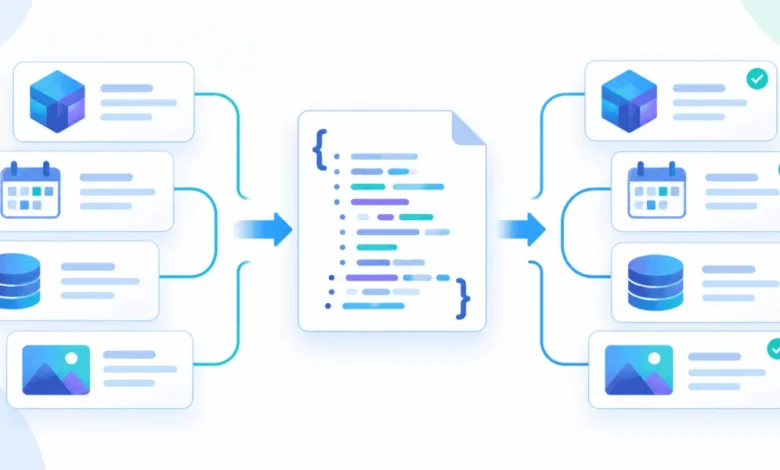
The first phase of a robust pipeline involves extending the base json.JSONEncoder class. By overriding the default() method, developers can explicitly define how the system should handle non-standard objects. A best-practice implementation involves "type-tagging," where complex objects are wrapped in a dictionary containing a __type__ key. This metadata acts as a contract, allowing the receiver to understand exactly how to reconstruct the original data structure.
For example, a datetime object can be converted into an ISO-8601 string, while a set can be transformed into a list, with both objects tagged appropriately. This approach maintains the portability of JSON while preserving the semantic meaning of the original Python types. By using cls=RobustEncoder during the dumping phase, the entire configuration object is safely transformed into a valid, machine-readable string.
2. Implementing a Resilient Decoding Hook
The reverse process—deserializing JSON back into Python objects—requires the use of an object_hook within the json.loads() method. This hook functions as a recursive parser that scans every nested dictionary for the __type__ markers defined during the encoding phase.
This stage is critical for error recovery. When the decoder encounters a marker that it cannot process, or when it detects data that violates expected formats, it must fail gracefully. Rather than crashing the entire pipeline, a well-engineered decoder logs the anomaly and, if possible, returns a fallback value or a sanitized version of the raw data. This "fail-safe" capability is essential in distributed systems, where a single malformed configuration file could otherwise halt the training of an entire model cluster.
3. Managing Schema Evolution and Migration
One of the most persistent challenges in machine learning is "configuration drift." As projects mature, the schema for model metadata inevitably changes—hyperparameters are added, metrics are renamed, and legacy fields are deprecated. Without a validation layer, loading a configuration file created six months ago into a current codebase would cause immediate runtime errors.
The most effective solution is the implementation of a factory function that sits between the raw deserialization and the application logic. This function serves as a migration layer. If a key like learning_rate is missing from an older JSON file, the factory function applies a safe default value. Simultaneously, it can filter out deprecated keys, ensuring that the application logic always receives a clean, predictable dictionary. By formalizing this "migration by default," teams can maintain backward compatibility without maintaining multiple versions of their parsing code.
Industry Implications and Best Practices
The necessity of robust serialization extends beyond mere convenience; it is a fundamental requirement for the reproducibility of machine learning experiments. In regulated industries such as finance and healthcare, auditors require proof of exactly how a model was configured at the time of training. If the configuration pipeline is fragile or prone to data loss during serialization, the entire audit trail is compromised.
Industry experts advocate for the following best practices when building these pipelines:
- Schema Versioning: Every configuration file should ideally include a
versionfield. This allows the decoder to apply specific migration rules depending on the age of the file. - Minimalistic Payloads: While serialization can handle complex types, it is best practice to keep the payload as flat as possible. Excessive nesting increases the complexity of the decoder and makes debugging more difficult.
- Logging and Observability: Every time a decoder encounters a type mismatch or applies a default value during a migration, this event should be logged. This provides observability into the health of the data pipeline and highlights when upstream processes are generating malformed configs.
- Validation Libraries: For highly complex schemas, integrating validation libraries like
Pydanticalongside the custom JSON logic can provide an extra layer of type checking, further reducing the risk of runtime errors.
The Evolution of Data Plumbing
The shift toward standardized, robust serialization is a reflection of the "maturation phase" of MLOps. As machine learning moves out of the research lab and into mission-critical production environments, the focus is shifting from "how do we get this model to run?" to "how do we ensure this model is reliable, reproducible, and maintainable?"
The strategies outlined here—custom encoders, object hooks, and schema migration factories—form the bedrock of reliable data plumbing. By treating configuration files with the same level of architectural rigor as the model code itself, engineers can significantly reduce the "hidden debt" associated with machine learning pipelines. This not only increases the velocity of development but also ensures that as systems grow in complexity, they remain resilient to the inevitable shifts in data structure and schema evolution.
In conclusion, the ability to safely serialize and deserialize custom types is not just a technical necessity for Python developers; it is a critical skill for the modern machine learning engineer. By mastering these techniques, teams can build pipelines that are capable of surviving the transition from a local development environment to a high-scale production deployment, ultimately leading to more stable, transparent, and reliable AI systems. As the industry continues to prioritize reliability, the adoption of these robust serialization patterns is expected to become a standard requirement for all enterprise-grade machine learning workflows.