The emergence of open-source solutions like Hermes Agent by Nous Research and the local model-serving capabilities of Ollama now provide a viable, enterprise-grade alternative for users who require autonomy over their infrastructure. By keeping data processing within the confines of local hardware, users can effectively eliminate privacy risks while mitigating the long-term expenses associated with cloud scaling.
The Architecture of Local Autonomy
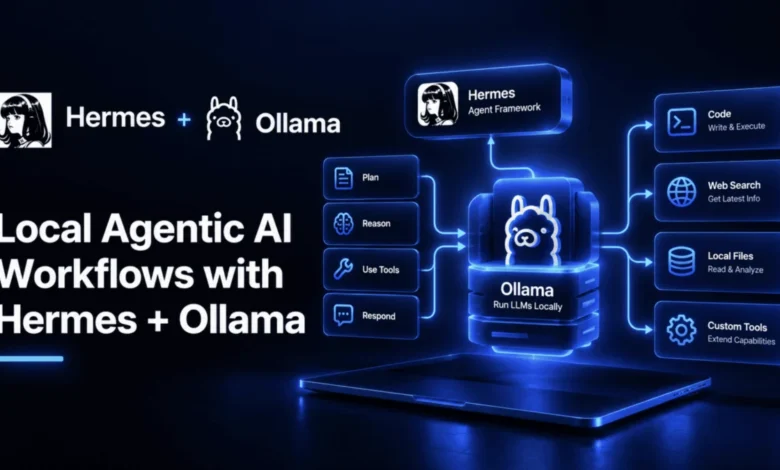
At the heart of this transition is a clear division of labor between model serving and agentic reasoning. Ollama acts as the foundational layer, responsible for managing the lifecycle of large language models (LLMs) on local silicon. By exposing an OpenAI-compatible API at the local host address, it allows sophisticated agentic software to interact with models—such as the Gemma or Llama series—without the need for external network calls.
Hermes Agent, meanwhile, serves as the orchestration layer. Unlike a standard chatbot, an agentic system is designed to interface with the host environment. It possesses the capability to manipulate files, execute terminal commands, browse the web, and engage in "tool calling." This allows the agent to move beyond text generation and into the realm of practical utility, such as refactoring codebases, summarizing documentation, or automating system administrative tasks. The integration of these two technologies creates a robust ecosystem where the agent, the data, and the compute remain under the user’s absolute control.
Chronology and Development of the Local-First Movement
The development of local agentic workflows has accelerated rapidly over the last eighteen months. In late 2023, the open-source community began prioritizing "tool-calling" capabilities in open-weight models, a move that directly challenged the dominance of closed-source models. By mid-2024, tools like Ollama matured to support high-concurrency requests and standardized API formats, effectively lowering the barrier to entry for non-specialists.
The release of Hermes Agent version 0.21.1 marks a pivot point, introducing features like persistent memory and cross-platform messaging gateways. These advancements allow the agent to build a "skill set" based on previous interactions, preventing the repetitive prompting cycles that often frustrate users of simpler AI tools. This evolution mirrors the trajectory of early computing, where centralized mainframes were eventually supplemented, and in many cases superseded, by local workstations capable of handling complex computations in real-time.
Hardware Considerations and Performance Benchmarks
A critical hurdle for local AI remains the hardware requirement. Because these agents require large context windows to process file structures and terminal outputs, memory (RAM) is often the primary bottleneck.
For users seeking to implement a 31B parameter model—often considered the "sweet spot" for reliable tool-calling and reasoning—a system with at least 32GB of RAM and a dedicated NVIDIA GPU with 8GB or more of VRAM is recommended. While CPU-only execution is possible, it significantly increases latency. A 9B model on a modern 8-core CPU may yield 10 tokens per second, which is adequate for background tasks but suboptimal for interactive development. Conversely, larger 31B models on CPU-only hardware may drop to 2 to 5 tokens per second, creating a perceptible delay that can interrupt a user’s creative flow.
The following table summarizes the operational requirements for various model tiers:
| Component | Entry-Level (3B Models) | High-Performance (27B+ Models) |
|---|---|---|
| RAM | 8 GB | 32 GB+ |
| Storage | 5 GB | 30 GB+ |
| Processing | 4 Cores | 8 Cores + GPU Acceleration |
| Latency | Near-Instant | Moderate (Model Dependent) |
Strategic Optimization: The Path to Efficiency
To maintain a high-functioning local agent, users must move beyond default settings. A common pitfall is the default context window, which is frequently limited to 2,048 tokens. For agentic workflows involving multiple files, this is insufficient. Users can bypass this by creating a custom "Modelfile" in Ollama, which allows for the explicit configuration of the context window (e.g., setting num_ctx to 64,000).
Furthermore, the "keep_alive" parameter in Ollama is essential for users deploying Hermes across multiple platforms. By default, models are purged from memory after five minutes of inactivity. For a Telegram-based bot, this would necessitate a lengthy reload time for every interaction. Configuring the model to remain in memory for 24 hours ensures that the agent remains responsive, providing a near-instant experience that rivals cloud-based services.
Privacy and Security Implications
The most profound impact of a local-first agentic workflow is the containment of data. In a professional environment, sending sensitive code snippets to a third-party server can violate corporate compliance policies and intellectual property agreements. By localizing the entire stack, organizations can utilize AI-assisted development tools without the risk of their proprietary data being used to train future iterations of public models.
Moreover, the "sandboxing" features within Hermes Agent allow for even greater security. By utilizing Docker or SSH-based isolation, the agent can execute code in a restricted container. This prevents the AI from accidentally modifying critical system files or performing unauthorized actions on the host machine, providing a layer of safety that is often missing in cloud-based AI tools.
The Hybrid Future: Fallbacks and Integration
While local models are increasingly capable, they may occasionally struggle with highly abstract or novel queries that larger, proprietary models handle with ease. The industry-standard approach to this is the "hybrid fallback." In this configuration, the local Hermes Agent handles the 90% of tasks—such as file organization, script generation, and general research—that require no external dependencies.
For the remaining 10% of queries that fall outside the local model’s reasoning capacity, the system is configured to route requests to a secondary provider, such as an Anthropic or OpenAI model via OpenRouter. This ensures that the user never encounters a "dead end," while still keeping the vast majority of operational costs at zero. This tiered approach is expected to become the blueprint for future AI development, balancing the efficiency of local compute with the immense knowledge base of cloud-scale models.
Conclusion: A New Standard for Digital Workflows
The move toward local, agentic AI is not merely a cost-saving measure; it is a fundamental reclamation of digital sovereignty. As Hermes Agent and Ollama continue to evolve, the distinction between local tools and cloud services will continue to blur. For the developer, the student, and the professional, the ability to build, iterate, and automate without leaving their own hardware is a significant milestone. By investing the time to configure these systems correctly, users are positioning themselves at the forefront of a more secure, efficient, and cost-effective era of artificial intelligence.
Related posts: