DiffusionGemma: Exploring the Paradigm Shift in Non-Autoregressive Language Modeling

The landscape of generative artificial intelligence experienced a significant pivot on June 10, 2026, when Google DeepMind released DiffusionGemma, an experimental model that challenges the long-standing dominance of autoregressive architectures. While models like GPT-4, Claude, and standard versions of Gemma rely on a sequential, left-to-right token generation process, DiffusionGemma utilizes a diffusion-based approach, fundamentally changing how text is constructed. By treating language generation as a simultaneous refinement of a 256-token block rather than a word-by-word sequence, this model addresses some of the most persistent bottlenecks in modern large language model (LLM) performance, specifically memory bandwidth constraints and the inability of models to revise their own outputs.
The Mechanics of Non-Autoregressive Generation
To understand the significance of DiffusionGemma, one must first look at the traditional "autoregressive" constraint. In standard LLMs, the model predicts the next token based on all preceding tokens. This necessitates constant, repetitive access to the model’s entire weight set from VRAM for every single token produced. Because the GPU must wait for these weights to load, the actual compute cores—the parts of the hardware responsible for the heavy lifting—often sit idle, resulting in a system where memory throughput, rather than raw processing power, dictates generation speed.
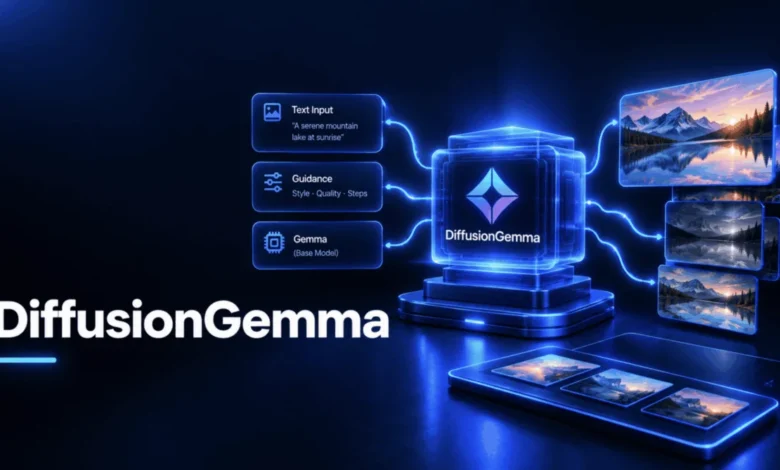
DiffusionGemma, built upon the foundation of the Gemma 4 26B architecture, employs a Mixture-of-Experts (MoE) design that activates 3.8 billion parameters per token out of a 26-billion parameter total. Instead of generating text sequentially, it initiates the process with a "canvas" of 256 placeholder tokens represented as random noise. Through a series of iterative denoising steps, the model resolves this entire block of text in parallel. This method, termed "Uniform State Diffusion," allows the GPU to utilize its massive parallel compute capacity more effectively. As the model gains confidence in certain tokens, these tokens influence the resolution of others, causing the entire sequence to "snap" into coherence.
Chronology and Development Context
The emergence of DiffusionGemma follows a multi-year trend in AI research aimed at moving beyond the limitations of the Transformer architecture’s sequential nature. Since the introduction of the original Transformer in 2017, the industry has sought ways to improve inference efficiency.
- Early 2024: Research into non-autoregressive text generation began gaining momentum in academic circles, with early papers exploring the potential of diffusion models—previously reserved for images and audio—to generate discrete tokens.
- Late 2025: Google DeepMind began internal testing of the "A4B" (Active 4 Billion) architecture, aiming to balance the performance of large models with the efficiency of smaller, sparse architectures.
- June 10, 2026: The public release of DiffusionGemma provides the developer community with a functional, open-source model under the Apache 2.0 license, intended primarily for research and development.
This release is characterized by Google as an "experimental preview," acknowledging that while the technology is promising, it is not yet intended to replace production-grade, autoregressive LLMs in high-concurrency environments.
Technical Implementation and Hardware Requirements
DiffusionGemma represents a departure from standard practices in the Hugging Face Transformers ecosystem. Because it utilizes a block-diffusion architecture, developers cannot rely on the standard AutoModelForCausalLM class. Instead, the model requires the specific DiffusionGemmaForBlockDiffusion class, which manages the complex denoising loop and the logic for handling multiple modalities.
The hardware requirements for this model reflect its sophisticated design. While the full, unquantized model requires high-end enterprise hardware (typically GPUs with 60GB+ of VRAM, such as the NVIDIA A100 or H100), the quantized versions are optimized for the consumer market. An RTX 4090 or 5090, equipped with 24GB of VRAM, can comfortably host the 18GB quantized version. The software stack requires transformers version 5.11.0 or newer to support the unique class structures and denoising logic.
Multimodality and Reasoning Capabilities
One of the most notable features of DiffusionGemma is its multimodal input capability. The model natively processes text, images, and video. When a user provides an image or video, the AutoProcessor handles the translation of these inputs into a sequence of internal tokens that the diffusion process can interpret. It is critical to note, however, that the diffusion process applies only to the text output. The model remains a text-generator; it does not generate images or video, regardless of the input modality.
Furthermore, the model introduces a "thinking mode." By toggling enable_thinking=True, users can trigger a separate reasoning channel. In this mode, the model generates a block of "thoughts"—essentially a scratchpad of logic—before synthesizing the final output. This mimics the reasoning chains seen in recent high-end models, providing a window into the model’s internal decision-making process.
Serving in Production: The Role of vLLM
Recognizing the need for a practical deployment path, Google collaborated with the vLLM team to integrate DiffusionGemma into their high-performance serving engine. This integration is not merely a wrapper; it involves deep changes to how vLLM handles token generation.
By utilizing flags such as --hf-overrides to set entropy-bound parameters and --diffusion-config to define the 256-token canvas length, developers can deploy DiffusionGemma as an OpenAI-compatible API endpoint. The model’s performance is highly sensitive to the sampling configuration, particularly the temperature schedule and the entropy threshold for adaptive early stopping. Google recommends an entropy threshold of 0.005 for halting, which allows the model to stop denoising a block as soon as two consecutive passes reach consensus, significantly improving latency.
Analysis of Implications
The implications of DiffusionGemma are twofold. First, for the individual developer or local researcher, it offers a way to overcome the "memory wall" of autoregressive generation. By shifting the bottleneck from memory bandwidth to compute power, users with high-end GPUs can experience faster, more reliable generation for single-user tasks. The ability to perform self-correction—re-noising tokens that the model is uncertain about—is a major structural advantage that autoregressive models lack, as they are inherently "locked in" once a token is generated.
Second, the model serves as a proof-of-concept for the industry. While standard autoregressive models remain the gold standard for high-concurrency cloud environments, the success of the block-autoregressive denoising technique suggests a future where hybrid models might exist. In such a future, long-form, complex, or reasoning-heavy tasks could be handled by diffusion-based architectures, while routine, low-latency tasks continue to utilize the proven efficiency of autoregressive batching.
Conclusion and Future Outlook
DiffusionGemma is not merely a new model; it is a fundamental shift in how we conceive of text generation. By moving from a linear, sequential process to an iterative, parallel one, Google DeepMind has provided a clear path toward overcoming the hardware limitations that have hindered LLM performance for years. While the model is currently in an experimental phase, its ability to revise its own output, its support for multimodal inputs, and its highly efficient use of GPU compute cores make it a significant milestone in AI research. As the developer community begins to experiment with the model, the data gathered from these deployments will likely dictate whether this diffusion-based approach will become the foundation for the next generation of large language models or remain a specialized tool for specific, compute-intensive applications.