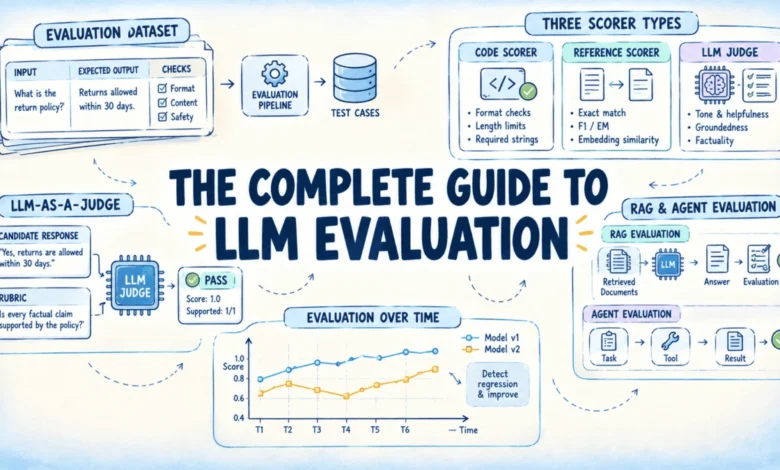
In the rapidly evolving landscape of artificial intelligence, Large Language Model (LLM) applications have moved from experimental prototypes to critical components of enterprise infrastructure. As organizations integrate these models into customer support, data analysis, and decision-making workflows, the primary challenge has shifted from model selection to performance verification. Unlike traditional software development, where deterministic unit tests can verify outcomes, LLM outputs are inherently probabilistic and context-dependent. This paradigm shift necessitates a robust, systematic framework for evaluation to ensure reliability, safety, and performance consistency across the product release cycle.
The Failure of Spot-Checking
Historically, many developers relied on manual spot-checking—reading a handful of outputs and making a qualitative judgment. While intuitive, this approach is fundamentally flawed for production-grade systems. Minor alterations to a prompt, a shift in the underlying model version, or changes to a retrieval pipeline can induce "silent failures" that remain undetected until they reach the end user. Because LLM outputs are non-deterministic, a single prompt might yield different results across successive runs, rendering standard equality-based testing ineffective.
Industry data suggests that without a structured evaluation loop, the probability of regression during iterative updates exceeds 60% for complex RAG (Retrieval-Augmented Generation) architectures. To mitigate this, developers must transition toward a regression-testing model specifically adapted for generative AI, where outputs are graded against defined criteria rather than compared against static strings.
The Three Pillars of Scorers
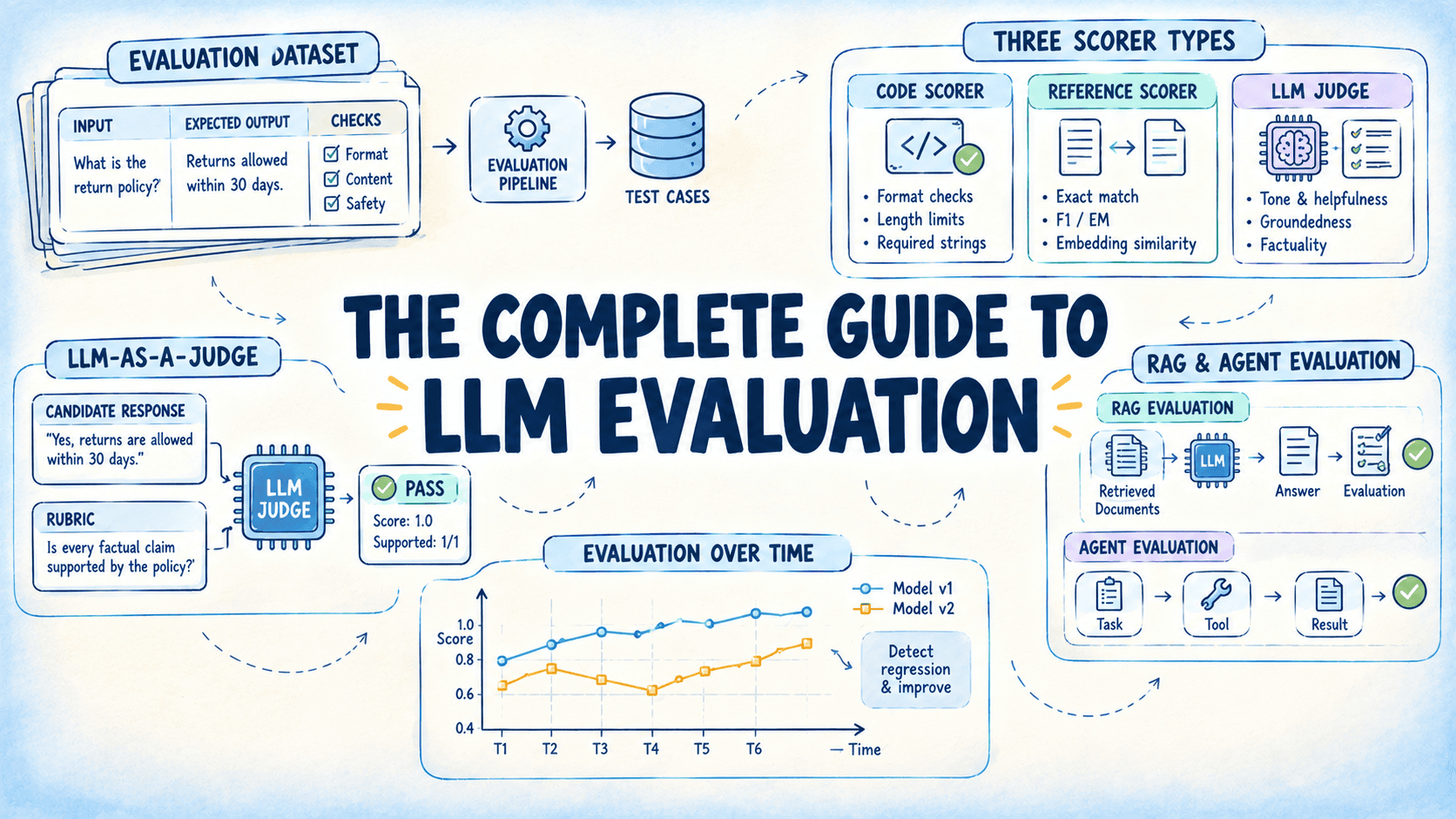
A comprehensive evaluation strategy relies on a multi-tiered approach to scoring. The industry has converged on three distinct categories of scorers, each serving a specific role in the quality assurance pipeline:
- Code-Based Scorers: These are deterministic checks used for structural validation. They are ideal for ensuring that a model adheres to output formats (e.g., JSON schema compliance), length constraints, or the presence of mandatory keywords. Because they are computationally inexpensive and return consistent results, they should form the foundation of any evaluation suite.
- Reference-Based Scorers: When an application has a "ground truth" or a known correct answer, these metrics are essential. Traditional metrics such as BLEU and ROUGE, which rely on n-gram overlap, are increasingly being superseded by embedding-based metrics like BERTScore. These utilize cosine similarity between token embeddings, allowing the system to recognize that paraphrased answers—even if they share no common words—are functionally correct.
- LLM-as-a-Judge: This is the most versatile category, where a separate, often more capable LLM is tasked with evaluating the output of the application based on a provided rubric. This method is the industry standard for assessing subjective qualities like tone, helpfulness, and factual groundedness.
Architecting the LLM-as-a-Judge Framework
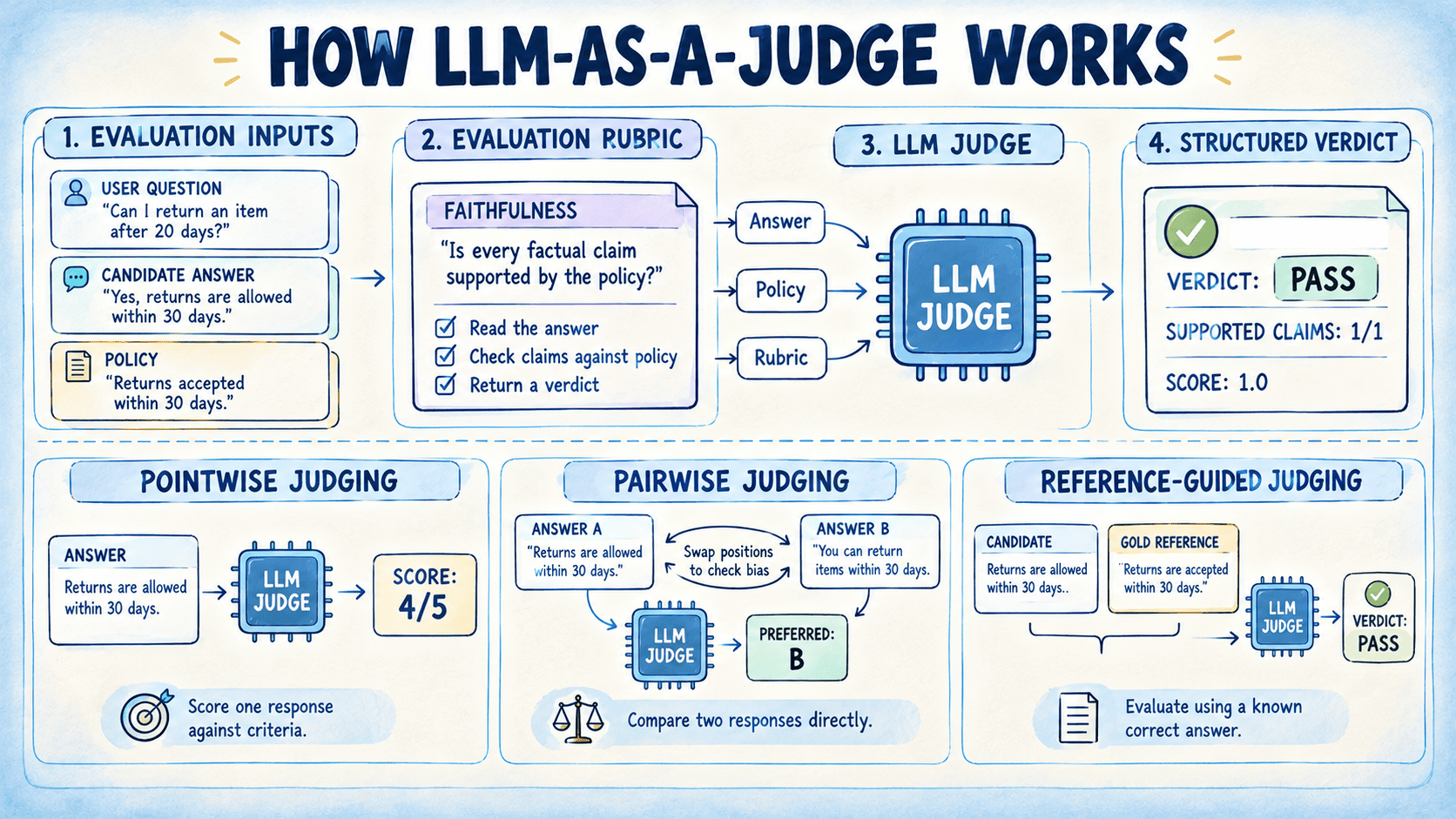
Implementing an LLM judge requires precision in prompt engineering. An effective rubric must include a clear definition of the criterion, relevant context, a step-by-step procedural guide, and a strict, machine-readable output format, such as JSON. By utilizing a "chain-of-thought" approach—where the judge lists evidence or claims before rendering a final verdict—developers can gain transparency into the scoring process.
For instance, in a RAG system, the judge might be instructed to extract every factual claim from an answer, verify each against the source context, and output a boolean for each claim. This allows for quantitative analysis: if three out of four claims are supported by the provided documentation, the answer receives a score of 0.75. This methodology, known as Question-Answer Generation (QAG), has significantly reduced the variance associated with subjective rating scales.
Furthermore, G-Eval provides a more granular approach for evaluating nuanced traits like coherence. By analyzing the probability distributions of output tokens, G-Eval can calculate an expected value score (e.g., 4.4 out of 5), providing a more stable and high-resolution metric than simple integer-based grading.
Addressing Bias and Ensuring Reliability
The primary criticism leveled against LLM-based judges is the presence of inherent biases, such as "positional bias" (a tendency to prefer the first answer provided in a comparison) or "verbosity bias" (a preference for longer, more verbose responses).
To counteract these, rigorous calibration is required. Best practices include:
- Position Swapping: In pairwise evaluations, always test the candidate answers in both orders and discard results that are inconsistent.
- Human-in-the-Loop Calibration: Teams should label a "golden set" of 30 to 50 representative queries. By comparing the judge’s performance against human labels using statistical measures like Cohen’s Kappa, developers can verify the judge’s reliability. A kappa score above 0.6 is generally considered a benchmark for substantial agreement.
- Model Separation: Using a different, more powerful model family for the judge than the one being tested helps prevent the judge from inheriting the same blind spots as the system under evaluation.
Evaluating RAG and Agentic Workflows
RAG systems present a unique challenge because they involve two distinct failure points: the retriever (which fetches the wrong context) and the generator (which fails to interpret the correct context). Evaluation must therefore be decoupled. Context precision and recall metrics determine the effectiveness of the retrieval layer, while faithfulness and answer relevance assess the generator.
When a system exhibits high precision but low faithfulness, it indicates that the model is receiving the correct information but "hallucinating" or ignoring the evidence. Conversely, high faithfulness with low precision indicates that the generator is performing well, but the retriever is providing insufficient data.
For autonomous agents, which involve multi-step planning and tool usage, evaluation shifts toward "task completion." If an agent can maintain a fluent conversation but fails to execute the necessary API calls to resolve a user’s request, the system is fundamentally broken. By tracking the trajectory of agentic actions, developers can identify the exact step—such as tool selection, argument parsing, or loop termination—where the process diverged.
The Release Cycle: From Offline to Online
A mature evaluation strategy spans the entire release cycle.
- Offline Evals: Before any deployment, a versioned "golden set" of queries—including adversarial inputs and edge cases—must be run against the application. This ensures that new features do not regress performance on established requirements.
- Online Evals: Post-deployment, the focus shifts to monitoring live traffic. By sampling production inputs and applying reference-free metrics, teams can detect "drift" in quality or performance caused by updates to underlying provider models or changes in user behavior.
Broader Implications and Strategic Outlook
The transition toward automated, rigorous evaluation marks the maturation of the LLM ecosystem. As AI applications become more deeply embedded in enterprise operations, the ability to quantify quality—rather than relying on anecdotal evidence—will determine the competitive viability of these systems.
The current consensus among industry leaders is that evaluation should not be an afterthought, but a core component of the CI/CD pipeline. By integrating automated scoring into every pull request and maintaining a robust set of diagnostic tools, organizations can move beyond the "experimental" phase of AI and into a period of reliable, scalable production deployment. This discipline not only protects the end-user experience but also provides the data-driven insights necessary for continuous, iterative improvement in an increasingly complex technical environment.