Google Cloud Unveils AI-Powered Security Guardrails and Model Context Protocol Server to Combat Cloud Misconfigurations

Despite the continuous evolution and deployment of sophisticated zero-day exploits by malicious threat actors, the vast majority of enterprise cybersecurity incidents still originate from a much more fundamental vector: human error leading to easily preventable cloud misconfigurations. As organizations accelerate their digital transformations and migrate critical workloads to multi-tenant cloud environments, the attack surface expands exponentially. In response to this persistent industry vulnerability, Google Cloud has announced the general availability of its Organization Policy Model Context Protocol (MCP) server, alongside innovative natural-language constraint authoring capabilities driven by Gemini. These new tools are explicitly designed to help platform engineering and security operations teams author, audit, and scale security guardrails with unprecedented speed, granular control, and operational simplicity.
The persistent threat of cloud misconfiguration remains one of the most pressing challenges in modern enterprise security. According to numerous industry cybersecurity reports, misconfigured storage buckets, overly permissive identity and access management (IAM) roles, and unauthorized resource deployments account for a significant percentage of cloud-related data breaches. Traditional cloud governance models have historically relied on manual auditing, complex hierarchy parsing, and rigid policy languages that often lag behind the velocity of modern software development life cycles. As development teams push code updates multiple times a day, security teams frequently struggle to maintain comprehensive visibility and posture management across sprawling resource hierarchies, creating dangerous security gaps that attackers routinely exploit.
Google Cloud’s Organization Policy Service has long served as a foundational pillar for securing resource configurations and establishing security guardrails across a company’s resource hierarchy. Featuring a robust catalog of more than 100 predefined policies tailored for common cloud governance requirements, the service allows administrators to establish clear boundaries. Furthermore, the introduction of Custom Organization Policy has empowered enterprises to define bespoke architectural standards and enforce them uniformly across supported services. However, the operational overhead of translating organizational security mandates into technical expressions—traditionally written in Common Expression Language (CEL)—has often required specialized technical expertise and deep familiarity with complex Google Cloud resource schemas.
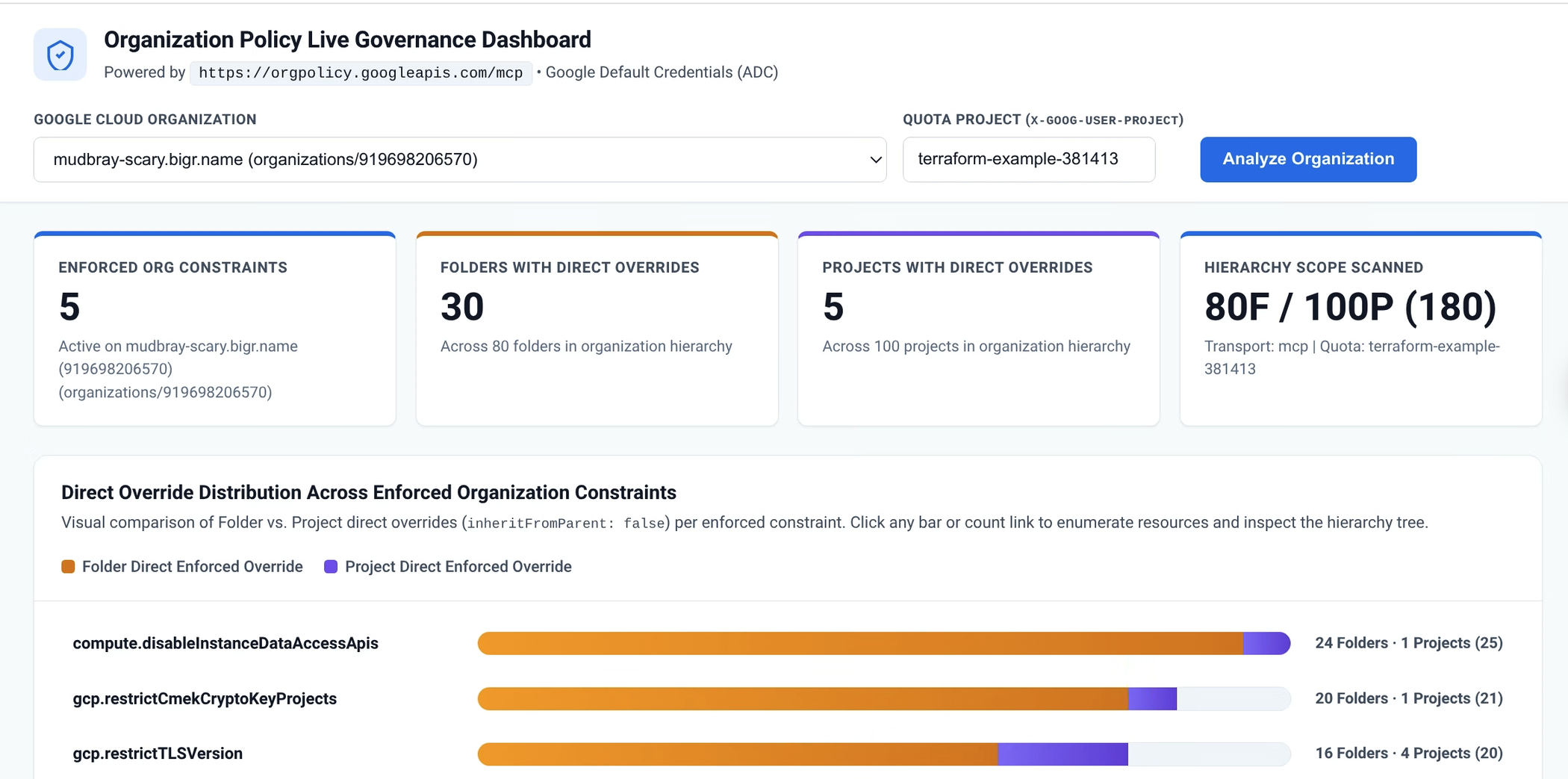
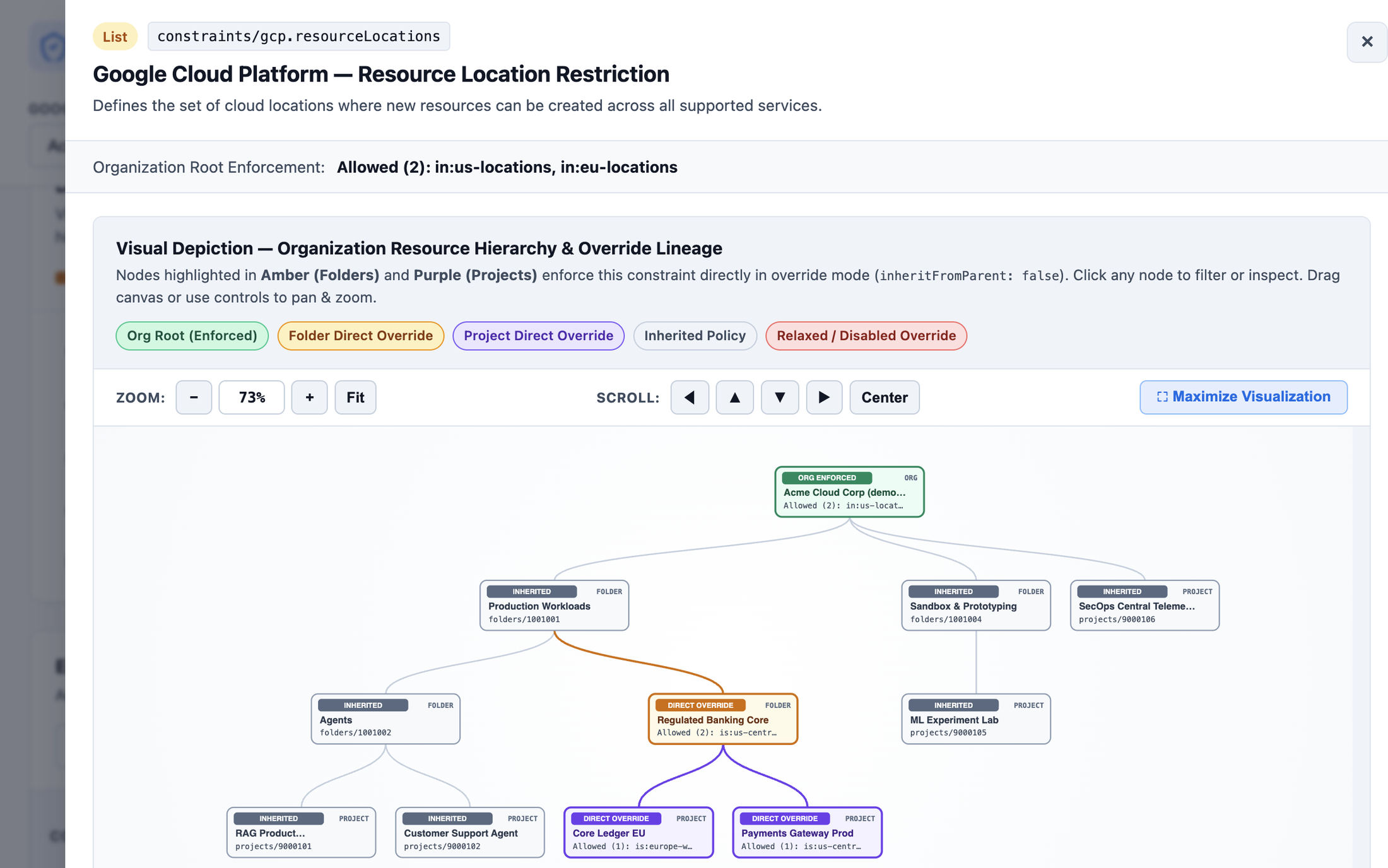
To address this friction point, the newly released Organization Policy MCP server fundamentally transforms how administrative teams interact with security governance. Rather than forcing personnel to manually parse complex multi-tier hierarchy chains, the MCP server provides standardized tools that allow autonomous agents, automated pipelines, and custom dashboards to interact directly with the Organization Policy architecture. Security and platform teams can now combine their preferred coding agents with MCP tools to build specialized visualization interfaces. These custom dashboards can display all enforced constraints across an enterprise, dynamically highlight folders and projects that have received policy exemptions, and facilitate proactive drift detection without manual intervention.
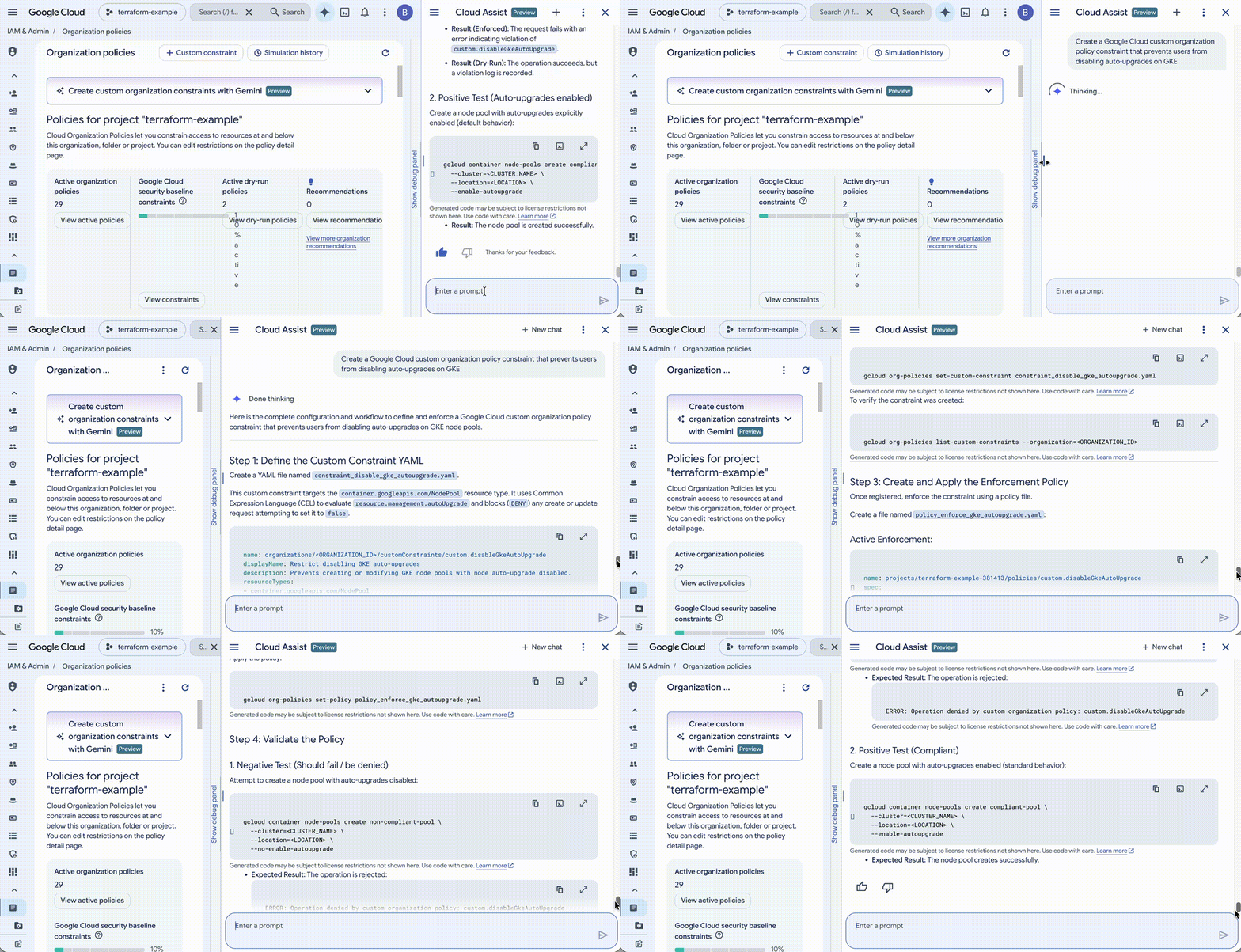
Simultaneously, Google Cloud is lowering the barrier to entry for custom policy creation through the integration of Gemini. Administrators are no longer required to manually author rules in CEL. Instead, they can express complex governance standards using conversational natural language directly through a Gemini prompt. For instance, security personnel can instruct Gemini to mandate agent-identity protocols within the Agent Runtime environment, ensure that all deployed autonomous agents utilize an approved Agent Gateway, or prevent developers from inadvertently disabling auto-upgrades on Google Kubernetes Engine (GKE) clusters. This conversational refinement process significantly reduces the time required to translate regulatory compliance requirements into enforceable technical guardrails.
To ensure that newly authored policies do not inadvertently disrupt production workloads, Gemini’s capabilities extend beyond simple code generation. The AI model can automatically generate both compliant and non-compliant test resource configurations based on the user’s prompt. This functionality allows engineering teams to thoroughly test policies and validate system behavior in a safe dry-run mode before enforcing the constraint organization-wide. By bridging the gap between intent and execution, this feature minimizes the risk of self-inflicted outages caused by overly aggressive or improperly configured security policies.
To accelerate adoption and provide immediate value, Google Cloud Professional Services has released a comprehensive sample custom constraints library. Hosted on GitHub, this repository features pre-authored custom constraint samples meticulously mapped to established industry benchmarks, including the Center for Internet Security (CIS) benchmarks and Payment Card Industry (PCI) data security standards. These templates provide a reliable baseline for organizations looking to rapidly align their cloud infrastructure with regulatory mandates. Moreover, custom constraints enjoy broad service-level support across Google Cloud, spanning foundational AI and compute engines such as Agent Runtime, Agent Search, and Agent Studio on the Gemini platform, alongside established services like Cloud Run and Google Kubernetes Engine.
Industry analysts and enterprise security leaders have noted that the convergence of artificial intelligence and cloud governance infrastructure represents a paradigm shift in how organizations approach risk management. By automating posture audits, streamlining exemption management, and democratizing custom policy authoring through natural language, cloud providers are attempting to solve the chronic talent shortage in cybersecurity. When security guardrails are easy to write, audit, and deploy, engineering teams are far more likely to embrace them rather than bypass them in the pursuit of deployment velocity.
The broader implications of these developments extend well into the future of autonomous enterprise operations. As organizations increasingly deploy autonomous AI agents to manage complex business logic and cloud infrastructure, the need for deterministic safety boundaries becomes paramount. Without strict organizational policies governing agent behavior—such as mandatory identity verification and centralized gateway routing—enterprises expose themselves to novel AI-specific vulnerabilities, including prompt injection, unauthorized data exfiltration, and unintended resource consumption. Google Cloud’s integration of the Model Context Protocol ensures that autonomous agents operate strictly within pre-defined administrative guardrails, effectively turning AI from a potential security liability into an active participant in enterprise defense.
Ultimately, the general availability of the Organization Policy MCP server and Gemini-powered constraint authoring underscores a maturing approach to cloud security. Security is no longer viewed merely as a reactive gatekeeper or a collection of static compliance checklists, but as an integrated, programmable, and artificially intelligent fabric of the cloud architecture. By providing enterprises with proactive governance tools that scale seamlessly alongside rapid software development, Google Cloud is equipping organizations with the necessary controls to innovate rapidly while maintaining a resilient, secure posture in an increasingly hostile threat landscape. Administrators and security professionals seeking to establish foundational guardrails and explore advanced resource governance are encouraged to review the official Organization Policy documentation.