A Comprehensive Roadmap for Mastering the Development of Modern Voice Agents

Voice interfaces have evolved from rudimentary command-line tools into sophisticated conversational systems, marking a pivotal shift in how humans interact with artificial intelligence. As the global voice and speech recognition market continues to expand—projected to reach a valuation exceeding $50 billion by 2030—the demand for engineers capable of building seamless, low-latency voice agents has reached an all-time high. Unlike traditional text-based large language models (LLMs), voice agents require a complex, multi-stage architecture capable of processing auditory input, reasoning in real-time, and synthesizing natural-sounding speech.
The Evolution of Conversational AI
The timeline of voice technology began with simple automated telephone systems in the 1990s, characterized by rigid, menu-driven interactions. The second wave, defined by virtual assistants like Apple’s Siri and Amazon’s Alexa, introduced basic natural language processing (NLP). Today, we are in the third wave: the integration of generative AI and LLMs into voice pipelines. This integration allows for fluid, non-scripted dialogue, moving away from "if-this-then-that" programming toward generative, context-aware interaction.
This transition from static scripting to dynamic generation is not merely a technical upgrade; it is a fundamental shift in user experience design. The current landscape is populated by enterprise-grade applications in healthcare, where AI agents assist in triage, and in the retail sector, where they manage high-volume customer service inquiries with human-like efficiency.
Deconstructing the Voice Agent Pipeline
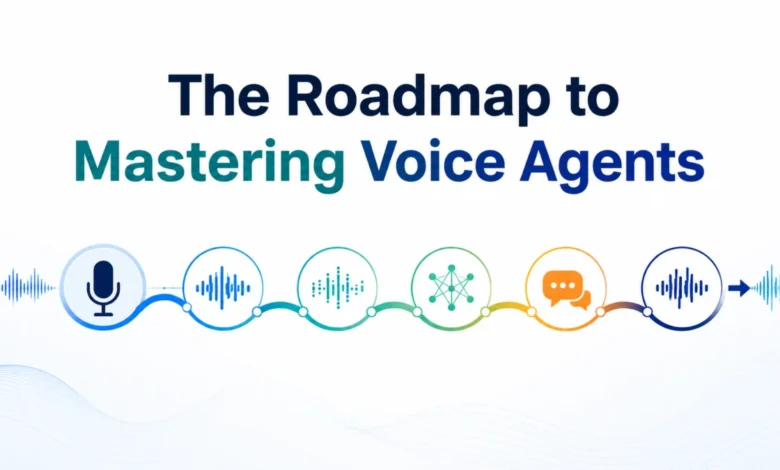
To understand the mechanics of these systems, one must look at the "Three-Pillar" architecture: Speech-to-Text (STT), Language Reasoning, and Text-to-Speech (TTS).
- Automatic Speech Recognition (ASR): This stage is responsible for converting raw audio waveforms into a textual format. Advanced ASR systems must contend with ambient noise, varying accents, and inconsistent microphone quality. The performance of this layer is measured by the Word Error Rate (WER); even a 5% increase in error can significantly degrade the downstream reasoning performance.
- The LLM Core: Once the audio is transcribed, the text is fed into an LLM. This is the "brain" of the agent, responsible for determining intent, retrieving external data, and formulating a coherent response.
- Speech Synthesis (TTS): The final step is the conversion of text back into human-like audio. Modern neural TTS models now incorporate prosody—the rhythm, stress, and intonation of speech—to ensure the agent does not sound robotic.
Technical Challenges: Latency and Interruptibility
A critical differentiator between text-based AI and voice agents is the tolerance for latency. Research in human-computer interaction indicates that a response delay of more than 500 milliseconds is perceived by users as a "lag," while delays exceeding two seconds often lead to user abandonment.
Engineering teams are currently focusing on "streaming" architectures to mitigate this. By sending partial audio tokens to the client as the model generates them, developers can create the perception of instantaneous response. Furthermore, managing "barge-in"—the ability for a user to interrupt the agent mid-sentence—requires complex asynchronous programming. Without this, an agent that continues to speak while a user is trying to ask a follow-up question breaks the illusion of a natural conversation.
A Structured Roadmap for Development
For developers seeking to enter this field, a seven-stage progression is recommended to bridge the gap between text-based LLM experience and voice-first engineering.
Phase I: Architecture Fundamentals
Begin by mastering the pipeline. Understand how audio codecs, such as Opus or PCM, impact transmission speed. Study the relationship between audio sampling rates and transcription accuracy.
Phase II: LLM Optimization for Spoken Word
Text is designed for the eye, but speech is designed for the ear. During this phase, focus on prompt engineering that emphasizes brevity and clarity. Remove bullet points and headers, replacing them with conversational markers that help a listener follow the logic without visual aids.
Phase III: Real-Time Streaming Systems
Transition from batch processing to streaming. Learn to implement WebSockets or gRPC to handle the constant flow of audio data. This phase involves deep dives into buffer management and the tradeoffs between speed and model complexity.
Phase IV: Conversation Design
This stage addresses the "soft" science of AI. It involves crafting personas, managing turn-taking logic, and designing "error recovery" flows. If an agent fails to understand a user, how does it gracefully pivot without repeating the same mistake?
Phase V: Integration and Memory
An agent without memory is a novelty; an agent with memory is a tool. Integrate Retrieval-Augmented Generation (RAG) to allow the agent to query private databases. Implement session memory so the agent can reference a user’s previous preferences or account history.
Phase VI: Deployment and Evaluation
Moving to production requires managing telephony infrastructure, such as Twilio or Amazon Connect. Evaluation metrics must shift from simple accuracy to task completion rates, average handle time (AHT), and user sentiment analysis.
Phase VII: Advanced Specialization
The final stage explores emerging frontiers: multilingual support, emotion detection—which allows an agent to adjust its tone based on the user’s stress level—and voice cloning for branded identities.
Industry Implications and Future Outlook
The shift toward voice-first AI has profound implications for digital accessibility and operational efficiency. For the visually impaired, voice agents provide a more intuitive navigation tool than traditional interfaces. For corporations, the ability to deploy "digital employees" that can handle thousands of concurrent, complex interactions represents a significant reduction in operational overhead.
However, the field faces regulatory and ethical hurdles. Concerns regarding data privacy—specifically how audio data is stored and used for model training—are at the forefront of policy discussions. Companies are increasingly adopting "privacy-by-design" frameworks, ensuring that voice data is encrypted and, where possible, processed locally (on-device) rather than in the cloud.
As development tools mature, the barrier to entry will continue to drop. We are approaching a point where the "human-like" quality of AI assistants will be indistinguishable from human customer support in most standardized scenarios. The challenge for the next generation of developers will not be the technical capability to make an agent speak, but the refined, thoughtful design required to make that agent a genuinely helpful partner in daily life.
For those looking to enter the space, the trajectory is clear: prioritize latency management, master the nuances of audio-visual interaction, and maintain a rigorous focus on the end-to-end conversation experience. The foundation of successful voice AI is not just in the intelligence of the model, but in the seamless, silent choreography of the pipeline that connects it to the user.