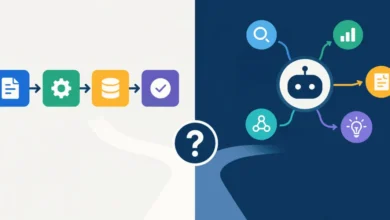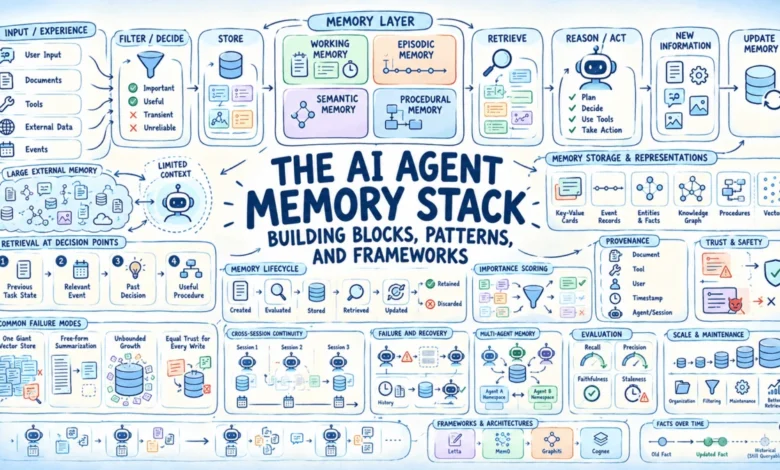
The rapid evolution of artificial intelligence has moved beyond the simple, stateless chatbot toward the era of autonomous AI agents. Unlike traditional large language models (LLMs) that treat every interaction as an isolated event, modern agents must possess the ability to retain context, learn from past failures, and maintain long-term user preferences. This architectural shift from stateless processing to stateful reasoning is known as "Agent Memory," a critical layer that determines whether an AI can function as a reliable assistant or merely a conversational novelty.
The Problem of Statelessness in LLMs
At their core, LLMs are transformer-based models that operate within a fixed context window. Once a conversation or a computational task concludes, the model effectively "forgets" everything. For simple queries, this is an advantage, ensuring privacy and preventing bias carry-over. However, for agents designed to automate complex workflows—such as coding assistants, autonomous research tools, or personal digital secretaries—statelessness is a fundamental bottleneck.
Without memory, an agent cannot perform multi-step reasoning, track the progress of a long-term project, or avoid repeating mistakes. To overcome this, engineers are increasingly implementing specialized memory architectures that act as an external database, feeding relevant, curated information into the model’s context window on demand.
A Chronology of Memory Evolution
The progression of AI memory has followed a distinct technical trajectory over the last several years:
- 2022–2023: The Context Injection Era: Developers relied on basic RAG (Retrieval-Augmented Generation) patterns, where documents were blindly embedded into vector databases. This allowed agents to "look up" information but lacked temporal awareness.
- 2024: The Rise of Structured Memory: The industry began shifting toward hierarchical storage. Developers realized that storing everything in a flat vector store led to "noise" that degraded model performance.
- 2025–Present: The Era of Agentic Frameworks: Current focus has turned to specialized memory frameworks like Letta, Mem0, and Graphiti, which prioritize entity-relationship modeling, temporal updates, and autonomous memory maintenance.
The Four Pillars of Agent Memory
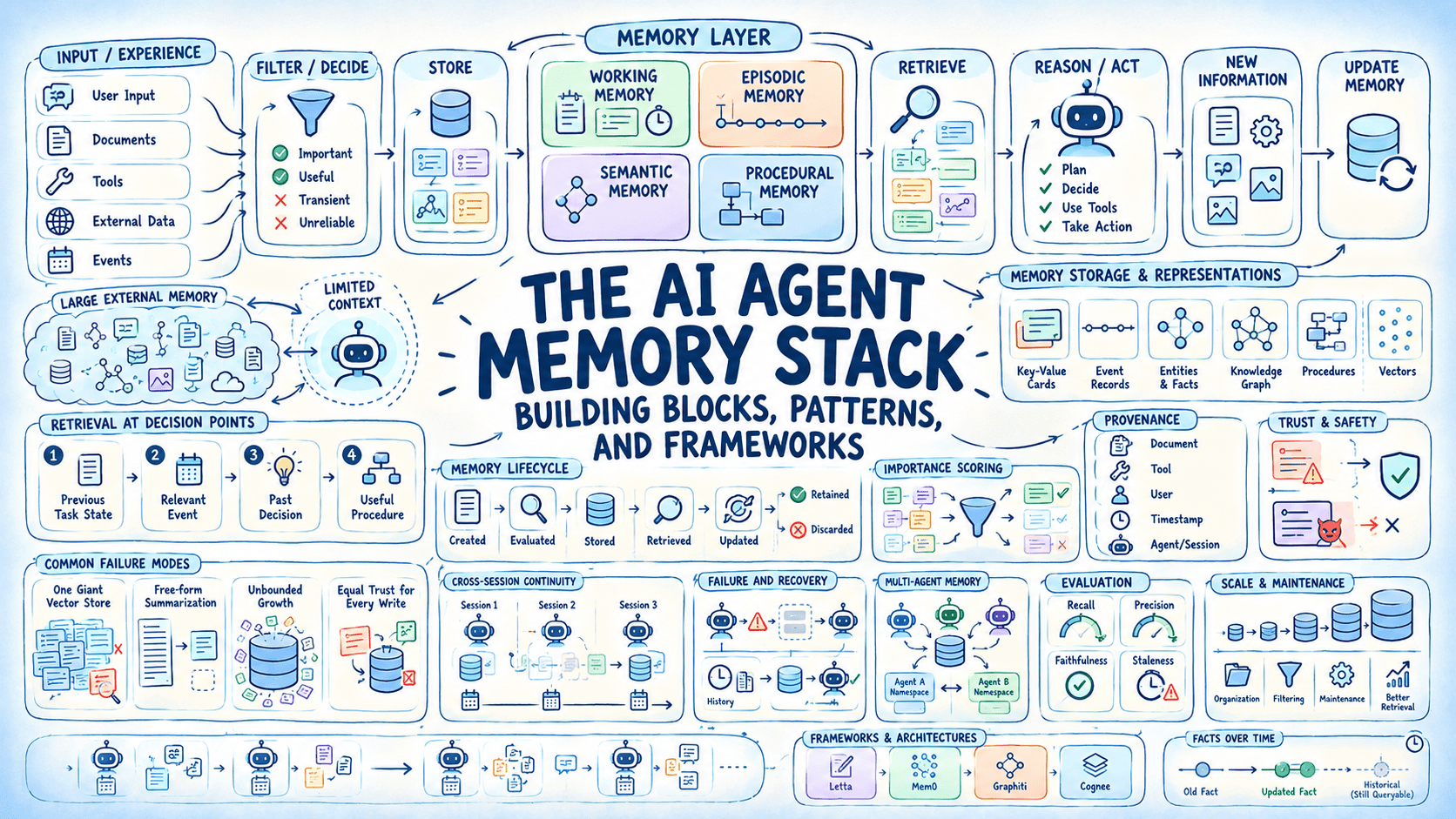
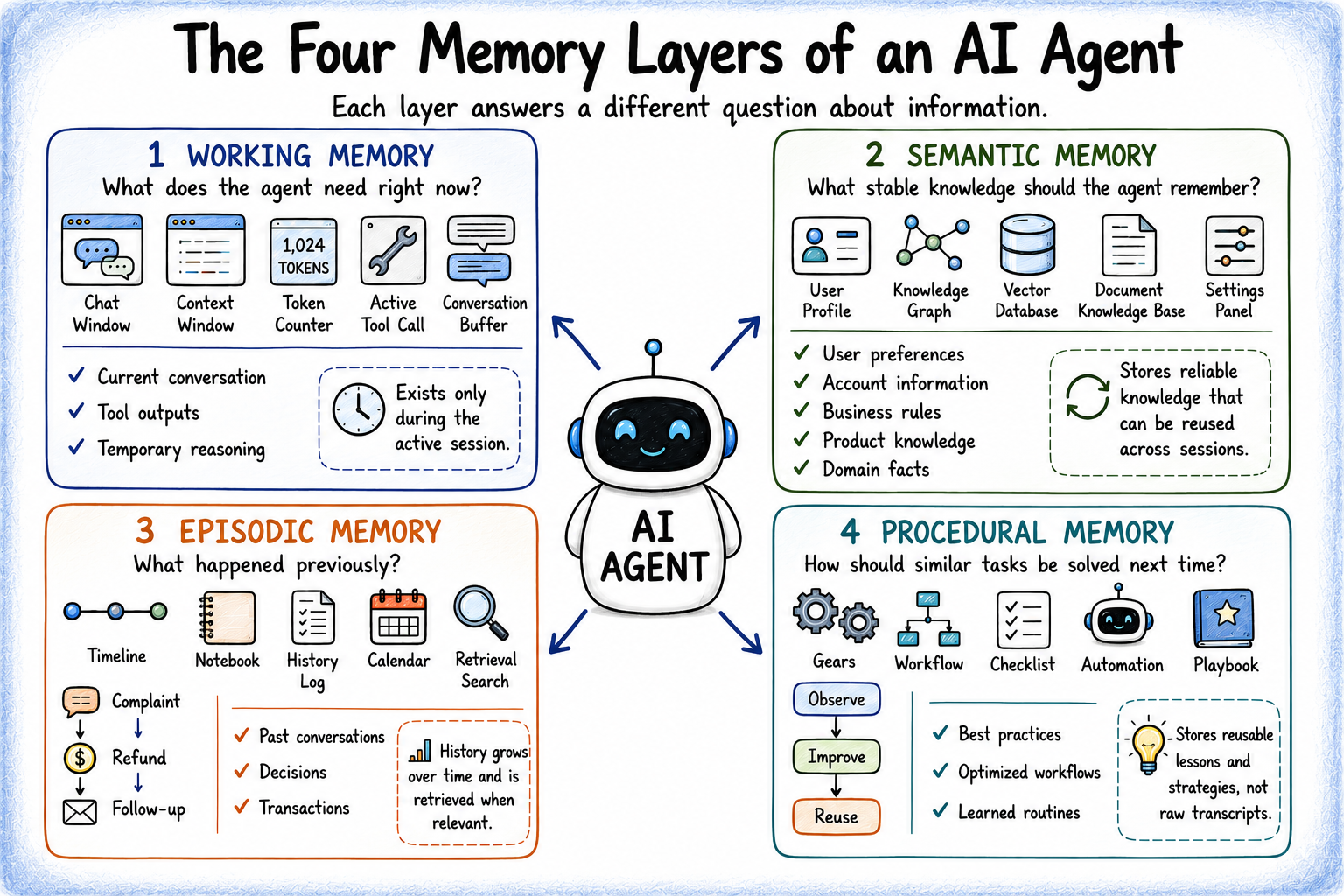
To effectively manage information, researchers categorize agent memory into four distinct functional types, each requiring a unique retrieval strategy:
- Working Memory: This is the "RAM" of the agent. It stores intermediate task states, scratchpad calculations, and immediate variables. It is characterized by high-speed, short-lived, and volatile storage, usually cleared once a specific sub-task is completed.
- Episodic Memory: This functions as a historical log. It records chronological events, past interactions, and specific decisions made during a process. It is essential for auditing and for allowing the agent to "remember" why it took a specific path in a previous session.
- Semantic Memory: This represents the agent’s "knowledge base." It stores facts, user preferences, and environment-specific constraints. Unlike episodic memory, semantic memory is frequently updated; as the agent learns more about the user, its semantic knowledge evolves.
- Procedural Memory: This is the most complex layer, encompassing the "how-to" knowledge of the agent. It involves stored strategies, successful action patterns, and verified failure modes. It is often implemented through dynamic prompt templates or fine-tuned behavioral sets.
Data-Driven Design: The Cost of Improper Management
Recent industry audits of AI deployment reveal that improper memory management is a primary cause of system degradation. Data indicates that when agents rely solely on "unbounded" memory—where every interaction is stored without curation—retrieval latency increases by approximately 40% within three months of deployment. Furthermore, "memory poisoning," where an agent is fed contradictory or malicious information, can cause performance drops of up to 60% in reasoning tasks.
To combat these issues, architects are adopting "Memory Engineering" principles. These include the implementation of "importance scoring," where only high-value insights are promoted to long-term storage, and "memory compaction," which involves summarizing past interactions to reduce the total storage footprint without losing critical constraints.
Leading Frameworks and Industry Approaches
The market for memory management has become increasingly competitive, with several frameworks emerging as industry standards:
- Letta: Designed around the concept of self-editing memory, it allows the agent to treat its memory as a writable text file. If the agent discovers a contradiction, it can proactively update its memory state, effectively performing its own data cleanup.
- Mem0: Focuses on personalization by utilizing entity-aware retrieval. It excels at recognizing that a user’s preference for a specific coding style is a long-term fact, whereas a specific bug report is a transient event.
- Graphiti: Adopts a bi-temporal knowledge graph approach. This allows the system to query not just what the agent knows, but when it knew it, which is vital for compliance and debugging in regulated industries like finance or healthcare.
- Cognee: A sophisticated pipeline that automatically transforms unstructured data into graph, vector, and relational layers. This multi-layered approach ensures that the agent can answer both simple questions ("What is the file name?") and complex relational questions ("How does this file relate to the project objective?").
Implications for Future AI Systems
The transition toward memory-aware agents signals a major shift in how organizations will interact with AI. As these systems become more capable of retaining institutional knowledge, the distinction between a software tool and an autonomous employee begins to blur.
However, this brings significant challenges in evaluation. Measuring whether an agent "remembers" correctly is far more difficult than testing standard software. Current industry standards for evaluating agent memory focus on:
- Retrieval Precision: Did the agent retrieve the correct fact among thousands of stored items?
- Consistency Metrics: Does the agent maintain the same "opinion" or "knowledge" across multiple sessions?
- Update Reliability: When a new fact contradicts an old one, how effectively does the agent invalidate the outdated information?
Broader Impact and Ethical Considerations
As AI agents gain deeper, more persistent memories, the privacy and security implications become paramount. A system that remembers a user’s professional preferences over years could become a liability if that memory store is compromised. Consequently, developers are increasingly integrating "forgetting" protocols—automated processes that purge sensitive or PII-laden data—to ensure compliance with global data protection regulations like the GDPR.
The architectural choices made today regarding agent memory will define the capabilities of AI for the next decade. As agents move from reactive tools to proactive agents capable of independent, long-term work, the ability to curate, retrieve, and manage memory will be the primary differentiator between successful AI deployments and those that fail to scale. The path forward lies in moving away from monolithic, "one-size-fits-all" databases toward modular, purpose-built memory systems that mimic the layered structure of human cognition.
For engineers and product managers, the mandate is clear: the future of AI is not in larger models, but in more reliable, more contextual, and more "memorable" agents. Organizations that master these architectural patterns will be the ones to successfully integrate AI into the core of their operational infrastructure.