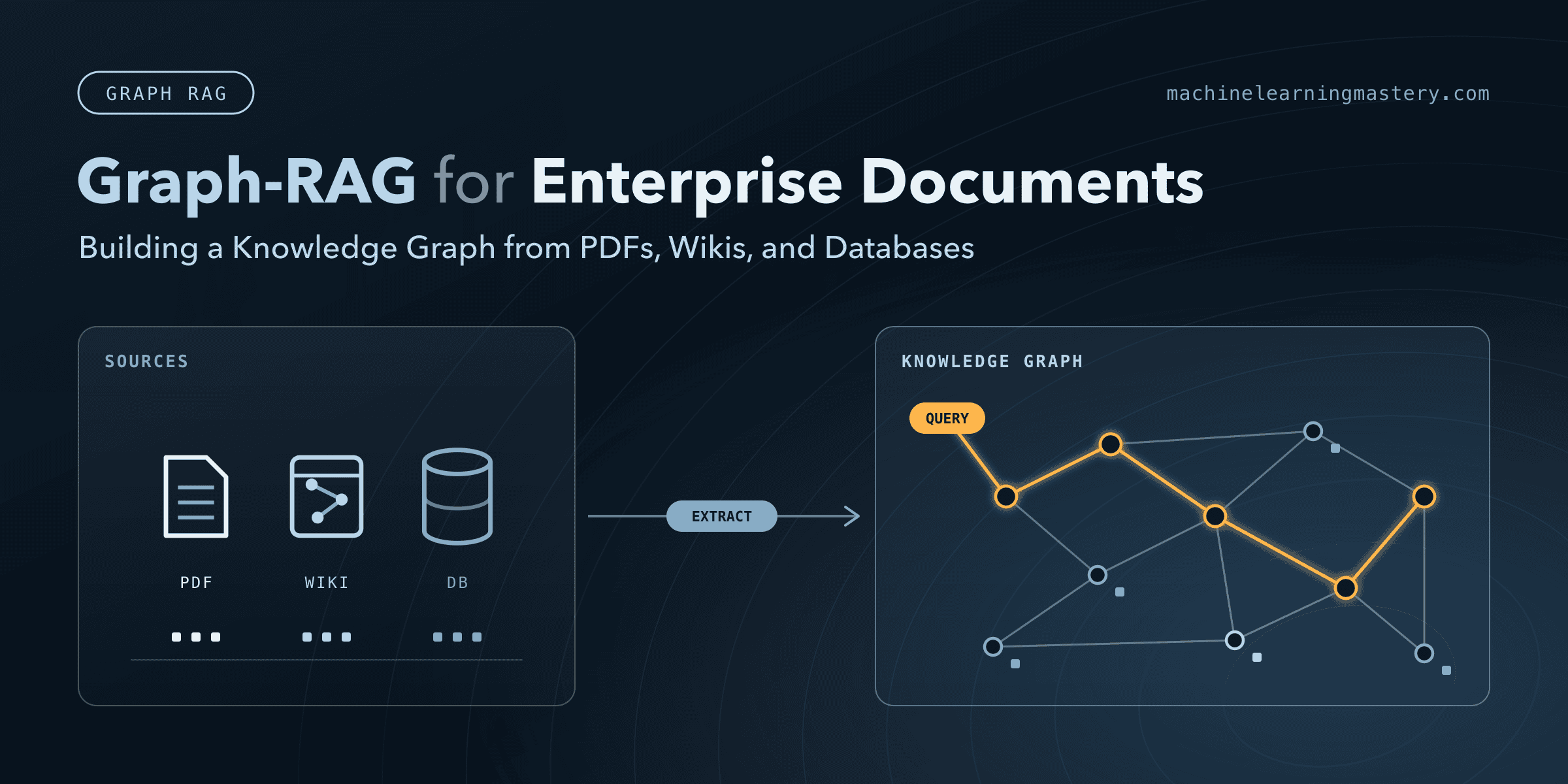
Graph-RAG for Enterprise Documents: Building a Knowledge Graph from PDFs, Wikis, and Databases

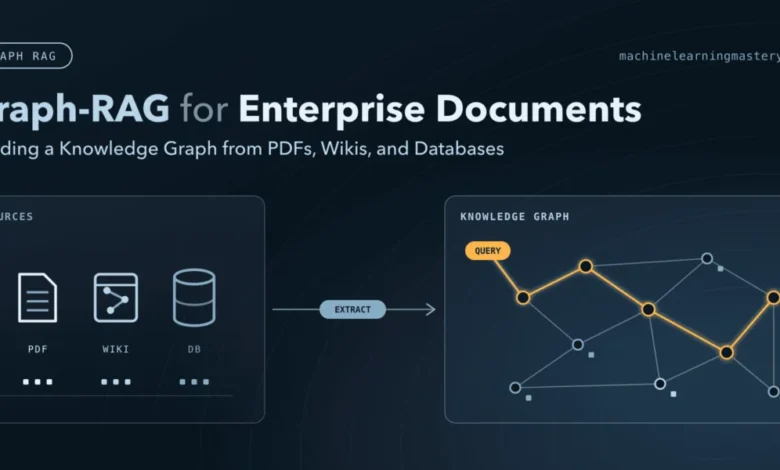
In the modern enterprise, artificial intelligence assistants are increasingly tasked with providing mission-critical information, yet they frequently struggle with the fundamental problem of data fragmentation. When an engineer queries an internal AI at 11 p.m. to identify the on-call responder for a payments service, the assistant may have access to three distinct data sources: a live service registry database, an aging internal wiki, and a repository of technical PDFs. In standard Retrieval-Augmented Generation (RAG) systems, these sources are often treated with equal weight. This lack of hierarchy leads to systemic failures, such as the assistant presenting outdated contact information found in a wiki over the live, accurate data residing in a database. To resolve this, architects are moving toward a deterministic, three-tiered Graph-RAG system that prioritizes data based on its reliability and volatility.
The Problem of Contextual Conflict in AI Retrieval
The primary limitation of current vector-based RAG architectures is their tendency to conflate semantic similarity with factual accuracy. When multiple versions of a "fact"—such as the name of an on-call engineer or the current owner of a software service—exist across different documents, a vector database will often retrieve all of them because they are semantically similar. Without a clear hierarchy, the Large Language Model (LLM) may struggle to discern which piece of information is the "ground truth."
This issue is not merely an inconvenience; it represents a significant operational risk. According to a study conducted by IDC and sponsored by Neo4j, organizations that ground generative AI in graph-based context can reduce hallucination rates by an average of 44 percent. In specific sectors, such as the life sciences, some enterprises have successfully slashed hallucination rates from 40 percent down to as low as 2 percent by implementing structured, graph-backed retrieval mechanisms.
Architecting the Three-Tiered Hierarchy
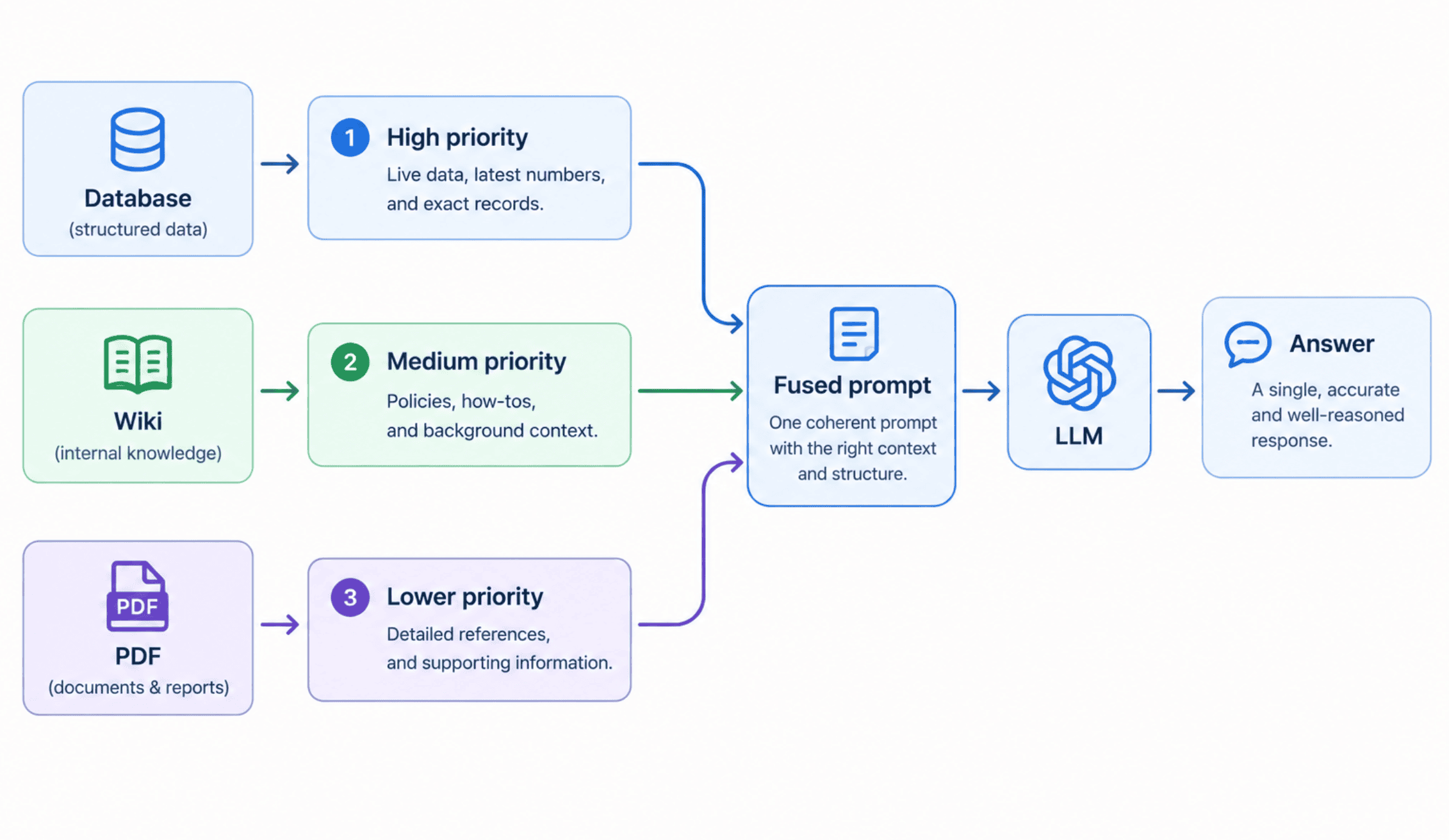
To eliminate these conflicts, developers are implementing a prioritized retrieval framework. This architecture classifies data into three distinct tiers based on its source and inherent reliability:
- Priority 1: The Absolute Facts (CMDB/Live Database): This tier consists of structured, real-time data from a Configuration Management Database (CMDB) or a live service registry. Because this data is queried in real-time, it is treated as the ultimate source of truth. Any information extracted here overrides data from all other sources.
- Priority 2: The Contextual Knowledge (Wikis/Runbooks): Wiki pages and runbooks provide valuable, descriptive, and procedural information. However, they are prone to "drift"—a state where the document no longer reflects the current reality of the system. This tier is secondary; it is consulted only when the CMDB lacks specific information, and its contents are strictly ignored if they contradict Priority 1.
- Priority 3: The Narrative Fallback (Unstructured PDFs/Docs): The final tier includes PDFs such as SLA agreements, incident post-mortems, and whitepapers. These documents provide rich, narrative context that structured databases cannot hold. They serve as a final resort for the AI to provide human-readable explanations or history, but they are never permitted to override the hard facts established in the higher tiers.
Implementing the Technical Framework
Building this system requires a transition from simple vector search to a more granular, entity-based retrieval approach. By utilizing a Subject-Predicate-Object-Context (SPOC) quad-store, developers can explicitly tag every piece of data with its source and priority.
The implementation process begins with the establishment of the Priority 1 store, typically a SQL-based database like SQLite or PostgreSQL. By mapping database columns to specific predicates (e.g., "on_call_engineer"), the system ensures that every query is anchored in the most current operational state.
The second tier, the wiki, requires a parser—often using regex or targeted LLM-based extraction—to convert natural language text into structured facts. The final tier, the PDF repository, utilizes a vector database (such as ChromaDB) for semantic searching. Unlike the first two tiers, the PDF content is chunked into small segments to maintain precision, ensuring that the model retrieves only the most relevant snippets rather than entire documents.
Resolving Conflicts Through Prompt Engineering
The core of the "deterministic" aspect of this architecture lies in the system prompt. Rather than relying on the LLM’s internal logic to decide which source is more credible, developers must explicitly define the conflict-resolution rules.
A typical system instruction for this architecture dictates: "Priority 1 is always current. If it answers the question, use only that answer. If Priority 2 conflicts with Priority 1, ignore the version in Priority 2 entirely. Priority 3 is for narrative detail only and must never override a Priority 1 fact." By instructing the model to refrain from mentioning the conflict (e.g., "the database says X, but the wiki says Y"), the AI provides a single, clean, and actionable answer, effectively shielding the user from the confusion of conflicting data.
Operational Implications and Future Scaling
The transition to a multi-tiered Graph-RAG system represents a shift from "probabilistic AI" to "deterministic AI" in enterprise environments. By treating data as a structured graph, firms gain significantly higher transparency. Every output can be traced back to the specific document or database row that generated it, providing a clear audit trail for compliance and debugging.
However, this architecture is not without its operational burdens. Maintaining the system requires a robust data pipeline. While Priority 1 data remains live, the ingestion pipelines for wikis and PDFs must be scheduled on a recurring cadence. A failure to update the Priority 2 or 3 stores can lead to "stale information" scenarios, which can be more dangerous than having no information at all.
Furthermore, as the complexity of the enterprise increases, so too does the need for sophisticated graph databases. For a single team, a lightweight, in-memory quad-store may suffice. However, for an organization with thousands of services and millions of interconnections, transitioning to dedicated graph engines like Neo4j or ArangoDB becomes necessary to maintain performance and data integrity.
Balancing Token Usage and Accuracy
One of the primary trade-offs in this approach is the increase in token consumption. By injecting structured facts from multiple tiers into the system prompt, the total context window size increases, which can lead to higher latency and costs in large-scale deployments. Yet, for enterprise-grade applications, this is generally viewed as an acceptable cost. The risk of providing incorrect, hallucinated, or obsolete information to a staff member during an incident—which could result in delayed system recovery or security breaches—far outweighs the marginal cost of additional compute tokens.
Conclusion: A New Standard for Enterprise AI
The move toward deterministic, three-tiered Graph-RAG systems signals the maturation of enterprise AI. It represents a pivot away from the initial excitement of "chatting with documents" toward the more pragmatic goal of building reliable, safe, and accurate information systems. By layering data based on its source-of-truth status, enterprises can harness the linguistic capabilities of large language models while maintaining the rigorous accuracy required for technical operations. As this architecture becomes more standardized, the expectation for AI to "know" not just the answer, but the authority behind that answer, will likely become the industry standard for all corporate AI implementations.