365 Data Science Announces Its Annual Free Access Initiative to Bridge the Global AI Skills Gap

Between November 5 and November 20, 2026, 365 Data Science will unlock its entire educational ecosystem, providing unrestricted, complimentary access to its comprehensive library of courses. This initiative, which begins at 8:00 a.m. UTC, marks the sixth consecutive year that the organization has opened its platform to the public. As the global labor market undergoes a seismic shift driven by the rapid integration of artificial intelligence and machine learning, this event serves as a strategic intervention designed to lower the barrier to entry for aspiring data professionals and seasoned engineers alike.
The initiative, first launched as a social responsibility project during the global pandemic in 2020, has evolved into one of the most significant open-access events in the digital education sector. By offering free access to more than 134 expert-led courses, the company aims to address the widening disparity between the skills required by modern industry and the current proficiency levels of the global workforce.
A Legacy of Accessible Education: A Six-Year Chronology
The 365 Data Science Free Access Initiative originated during the 2020 lockdowns, a period defined by massive professional displacement and a sudden transition to remote work. Recognizing that many professionals were seeking to upskill in a digital-first economy, the company opted to provide its full curriculum without a subscription fee.
In 2021 and 2022, the program transitioned from an emergency resource to an annual fixture of the company’s operational calendar. Each iteration has focused on refining the curriculum to match the shifting technological landscape, moving from foundational data analysis and SQL toward advanced machine learning, neural networks, and, most recently, AI engineering.
The 2025 iteration of the event serves as a historical benchmark for the project’s scale. Data provided by the organization indicates that the previous year attracted over 220,000 unique participants hailing from 216 countries. These learners engaged with the platform for a cumulative 7.2 million minutes, culminating in the issuance of over 36,000 verifiable certificates. These metrics underscore a growing global appetite for structured, high-quality technical education, particularly in regions where formal data science university programs may be prohibitively expensive or inaccessible.
The Curriculum: From Data Literacy to AI Engineering
The platform’s curriculum is structured to accommodate a wide spectrum of expertise, ranging from absolute beginners to experienced developers looking to pivot into specialized AI roles. During the 15-day open-access period, participants gain entry to the entirety of the 365 Data Science catalog.

The courses are segmented into three primary tiers:
- Foundational Literacy: These modules cover the essential prerequisites for any data-driven career, including probability, statistics, Excel, and introductory Python programming.
- Applied Analytics: This phase focuses on the tools of the trade, such as SQL for database management, Tableau and Power BI for data visualization, and R for statistical modeling.
- Advanced AI Engineering: The most contemporary additions to the platform center on AI-driven workflows, including large language models (LLMs), agentic AI, and the deployment of intelligent systems that can plan and act autonomously.
Beyond video-based instruction, the platform integrates interactive exercises and real-world project simulations. These simulations are designed to mirror the challenges faced by data scientists in corporate environments, requiring users to clean datasets, build predictive models, and communicate findings to non-technical stakeholders.
Industry Implications and the AI Talent Deficit
The urgency behind this initiative is rooted in a well-documented global talent shortage. According to recent reports from the World Economic Forum and various industry analysts, the demand for AI-literate professionals consistently outstrips supply. As organizations across finance, healthcare, manufacturing, and retail integrate generative AI into their operational stacks, the need for individuals who understand how to deploy and maintain these systems has become a critical business priority.
Ned Krastev, CEO of 365 Data Science, has framed the initiative as a direct response to this systemic change. "The AI and data landscape is evolving faster than ever," Krastev noted in a recent briefing. "We are seeing a pivot where traditional data analytics is no longer the ceiling; it is now the floor. The new frontier is AI engineering—the ability to design systems that don’t just process information but act upon it."
By providing these resources for free, the company is effectively lowering the opportunity cost for career changers. For many, the ability to earn industry-recognized certifications—which serve as a portfolio credential—can be the deciding factor in securing an entry-level position in a competitive job market.
Economic and Professional Impact
The value of this initiative extends beyond theoretical knowledge. In the current economic climate, where employers are placing a higher premium on "demonstrable skill" over purely academic credentials, the ability to showcase a verified history of completed coursework and project work is significant.
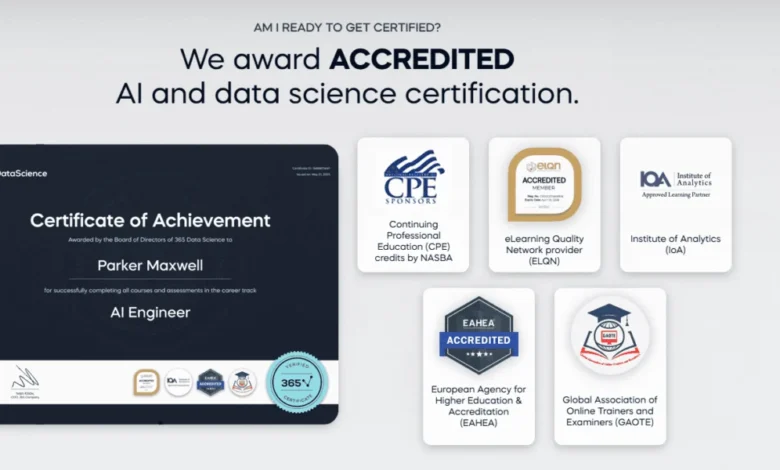
The certifications offered through the platform are designed to be shareable on professional networking sites like LinkedIn, providing a measurable signal to recruiters and hiring managers. Because the courses are built by practitioners who mirror actual industry requirements, the resulting credentials act as a proxy for practical competence.

Furthermore, the "learning path" structure of the platform addresses a common pain point for self-taught developers: the lack of a coherent roadmap. By guiding users through a logical progression of skills—from basic data cleaning to complex neural network architecture—365 Data Science reduces the fragmentation often associated with disparate online tutorials.
Strategic Outlook for the 2026 Initiative
As the 2026 event approaches, the organization has signaled a focus on "Intelligent Agents"—systems capable of autonomous reasoning and planning. This reflects the broader industry trend where the focus is shifting from "AI as a tool for search" to "AI as a tool for action."
For the prospective learner, the 15-day window is not merely a chance to watch videos, but an opportunity to build a tangible project portfolio. The company encourages participants to dedicate consistent time throughout the three-week period to ensure they can complete at least one specialized track.
The implications for the broader tech ecosystem are notable. By democratizing access to these specialized skills, 365 Data Science is contributing to a more diversified talent pool. This is particularly important for underrepresented groups in tech, for whom cost and geographic limitations have historically been significant barriers to entry.
Conclusion and Call to Action
The 2026 Free Access Initiative represents a strategic opportunity for individuals at any stage of their career to align their skill sets with the future of the digital economy. Whether one is a student exploring data science for the first time, a professional seeking to transition into an AI-adjacent role, or an established expert looking to keep pace with rapid technological updates, the platform offers a comprehensive environment to achieve these goals.
The initiative officially commences on November 5, 2026, at 8:00 a.m. UTC and concludes on November 20, 2026. Interested participants are encouraged to visit the official 365 Data Science website to create an account and plan their learning path ahead of the start date. In an era defined by the rapid acceleration of artificial intelligence, the ability to learn and adapt has become the most valuable currency in the professional market. Through this open-access window, 365 Data Science provides the necessary capital for those ready to invest in their future.