HighScalability Hot Links: Evolution of Engineering from Mainframes to Quantum Systems

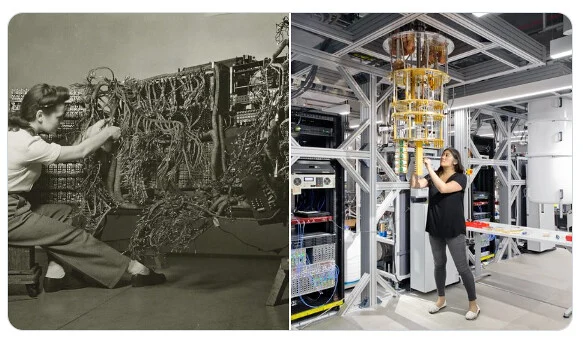
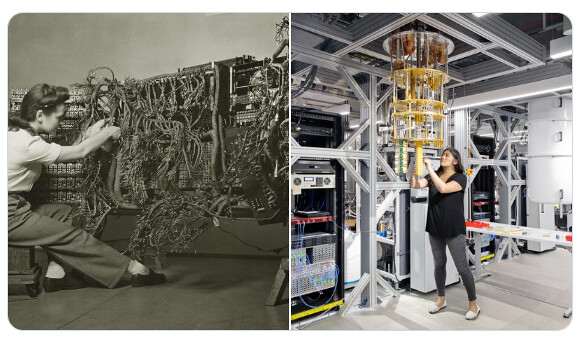
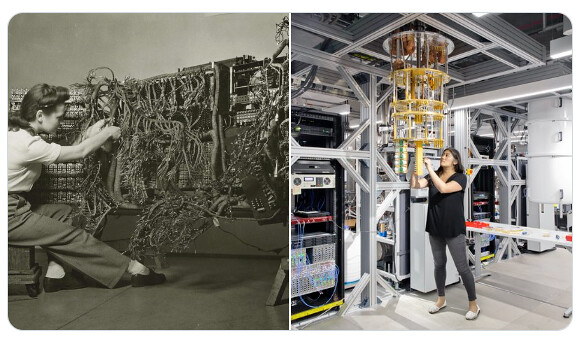
The history of computing is often viewed through the lens of exponential growth, but a closer examination of the physical hardware reveals a fascinating continuity in the human element of engineering. A viral comparison featuring an engineer wiring an IBM mainframe in 1958 alongside an engineer configuring an IBM quantum computer in 2021 highlights that despite the leap in processing power and architectural complexity, the fundamental requirement for skilled manual labor in the assembly and maintenance of cutting-edge hardware remains a constant. This juxtaposition serves as a point of reflection for the modern technology industry as it navigates the transition from classical silicon-based architectures to the volatile, sub-zero environment of quantum processing.
The Chronology of Computing Complexity
To understand the current state of quantum engineering, one must look back at the trajectory of classical computing. In 1958, the industry was dominated by vacuum tubes and early transistors. The IBM 700/7000 series, which represented the pinnacle of high-performance computing at the time, required extensive manual wiring. Engineers were tasked with the precise placement of cables to minimize electromagnetic interference and ensure signal integrity. This work was tedious, highly specialized, and defined the limits of what a machine could achieve; the hardware was essentially a physical manifestation of logical gates, constructed by hand.
Fast forward over six decades to the present day, and the visual similarity between the two eras is striking. While the 1958 engineer was dealing with binary logic on a macroscopic scale, the 2021 engineer working on a quantum processor—specifically the IBM Quantum System One—is dealing with the manipulation of superconducting qubits. These systems require cryogenics to function, often operating at temperatures near absolute zero. The "wiring" seen in modern quantum setups is essentially a complex web of coaxial cables and signal lines designed to carry microwave pulses to the qubits while isolating them from thermal noise. The engineering discipline has shifted from standard electrical distribution to precision microwave engineering and cryogenic thermal management, yet the physical act of manually calibrating and connecting these components remains a bottleneck in the development of scalable quantum systems.
Supporting Data and Technical Evolution
The evolution of these systems is best measured by the shift in computational density and environmental requirements. In 1958, an IBM mainframe occupied an entire climate-controlled room, requiring significant floor space for both the processing unit and the cooling systems for its vacuum tubes. The power consumption was massive, and the reliability of the system was limited by the mean time between failure (MTBF) of its individual components.
Modern quantum computers, while smaller in their core processor, require massive support infrastructure. A quantum processor, or QPU, is no larger than a coin, but it sits at the bottom of a dilution refrigerator that can be several meters tall. The total system power required to run the cooling infrastructure often dwarfs the power consumed by the processor itself. Furthermore, while a classical computer in 1958 had a handful of vacuum tubes, today’s most advanced quantum processors, such as IBM’s Osprey or Condor chips, feature hundreds of superconducting qubits. The complexity of controlling these qubits scales linearly with the number of qubits, leading to a "wiring nightmare" that has prompted significant research into integrated cryo-CMOS controllers, which aim to move the control electronics closer to the QPU to reduce the volume of cabling.
Industry Perspectives on Hardware Scaling
The engineering community has long recognized that the "manual" phase of hardware development is a precursor to automation. In the early days of classical computing, the transition from hand-wired boards to printed circuit boards (PCBs) and eventually to integrated circuits (ICs) was driven by the need for consistency and mass production.
Industry analysts observe that quantum computing is currently in its "vacuum tube era." Just as early computing required bespoke assembly, current quantum systems are largely experimental and hand-built. Leaders at major firms like IBM, Google, and Rigetti have noted that the primary challenge for the next decade is not merely increasing the number of qubits, but standardizing the "interconnects."
"We are currently in a phase where the architecture of the quantum machine is constrained by our ability to physically connect, cool, and isolate the processing elements," says Dr. Elena Rossi, a lead researcher in quantum hardware infrastructure. "The visual similarity between 1958 and 2021 is not a sign of stagnation, but a sign that we are solving the same problem at a higher level of precision. We are moving from the era of ‘making it work’ to the era of ‘making it reproducible’."
Implications for the Future of High Scalability
The implications for the broader tech industry are profound. As high-performance computing (HPC) environments begin to integrate quantum processors as co-processors, the data centers of the future will need to adapt to hybrid workflows. This shift necessitates a new breed of infrastructure engineers—those who are as comfortable with cryogenic systems as they are with traditional server rack management.
Furthermore, the comparison underscores the "Human-in-the-Loop" reality. Despite the rapid advancement of artificial intelligence and automated design tools, the physical reality of hardware—whether it is the routing of copper wires in 1958 or the installation of microwave shielding in 2021—requires human intuition and dexterity. As we move toward larger-scale quantum machines, the industry will likely see a push toward modular, "plug-and-play" quantum hardware. The current reliance on manual assembly is an unsustainable model for a technology that aims to reach the scale of millions of qubits.
Analyzing the Engineering Bottleneck
From a structural analysis perspective, the bottleneck is twofold: thermal management and signal fidelity. In 1958, heat dissipation was the enemy of reliability; today, heat is the enemy of the quantum state. The engineering constraints have shifted from preventing circuit failure to preventing decoherence.
Data from the International Roadmap for Devices and Systems (IRDS) suggests that the transition from current laboratory-scale quantum systems to commercial-scale quantum computers will require an order-of-magnitude increase in the density of signal lines. Current techniques, such as the use of flexible superconducting cables and high-density connectors, are already pushing the limits of physical space within the dilution refrigerators.
Broader Impact and Conclusion
The historical parallel between the 1958 IBM engineer and the modern quantum engineer serves as a necessary reminder that technology is not magic; it is the cumulative result of thousands of hours of manual labor, precise engineering, and incremental improvements. While the digital age often focuses on the abstract—code, algorithms, and cloud services—the physical foundations of our computing power remain tied to the laws of physics and the limitations of material science.
As we look toward the future, the integration of quantum systems into the global IT infrastructure will rely on solving these physical challenges. The lessons learned from the transition from mainframes to the microchip era provide a blueprint for what is to come: standardization, miniaturization, and eventually, the automation of assembly. While we may never see a time when an engineer is not required to oversee the delicate installation of these complex systems, the evolution of the field suggests that the "wiring" of the future will be a far more automated and streamlined process.
For now, the image of the engineer at their desk, surrounded by a tangle of cables, remains the most accurate representation of the cutting edge of progress. It is a testament to the persistence of human ingenuity, standing as the bridge between the theoretical possibilities of quantum mechanics and the functional reality of modern computing. As organizations continue to invest in quantum research, the focus will undoubtedly shift from the experimental to the industrial, turning today’s hand-wired marvels into tomorrow’s standard-issue enterprise components. The journey from the vacuum tube to the qubit is far from over, but the history of the industry proves that when engineers face a barrier, they do not simply fear it—they wire around it.
Related posts: