The rapid acceleration of artificial intelligence across corporate infrastructure has given rise to one of the most multidisciplinary and sought-after technical professions of the decade: the Forward Deployed Engineer. Bridging the gap between high-level software development, applied machine learning, systems architecture, and client-facing consulting, this role has evolved from a niche position pioneered by defense tech and specialized SaaS firms into a mainstream enterprise necessity.
Major industry shifts underscore this demand. Recently, Anthropic announced a multi-year global alliance with professional services giant DXC Technology, detailing plans to train tens of thousands of Claude-certified forward-deployed engineers specifically for enterprise deployments. This massive workforce scaling reflects a broader market reality: organizations no longer want generic AI demos; they require specialized technical professionals who can embed within an enterprise, untangle legacy architectures, and deploy secure, mission-critical AI solutions.
Market data from ZipRecruiter indicates that the average annual salary for a Forward Deployed Engineer in the United States hovers around $116,463, with median earnings reaching approximately $124,300. However, compensation packages at top-tier artificial intelligence research laboratories and high-growth venture-backed startups often far exceed these figures. This high compensation ceiling corresponds directly to a uniquely demanding matrix of required competencies. To succeed, an engineer must possess the ability to write robust production software, deploy and monitor cloud systems, navigate disorganized enterprise data silos, harness modern AI frameworks, and articulate complex technical concepts directly to non-technical stakeholders.
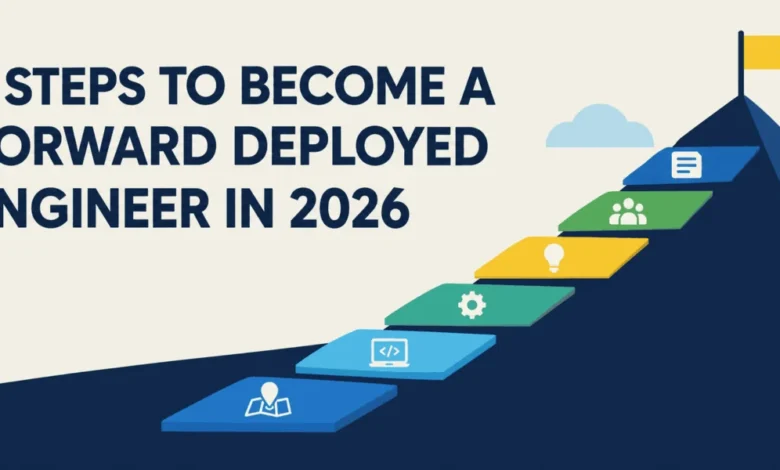
To address this talent shortage, industry experts have mapped out a comprehensive, seven-step roadmap for software professionals aiming to transition into Forward Deployed Engineering roles.
Defining the Forward Deployed Engineer Role
To understand the trajectory required for the profession, one must first examine the fundamental distinction between a conventional software engineer and a forward-deployed counterpart.
A traditional software engineer typically operates within a well-defined product development lifecycle. They are handed specific requirements—such as building a microservice or optimizing a database query—within the controlled environment of their own engineering organization.
Conversely, a Forward Deployed Engineer operates in high-ambiguity environments. A typical assignment might involve embedding with a legacy financial institution where eighteen years of claims data are fractured across six disparate database systems, resulting in internal analysts spending hours investigating routine claims. The FDE must independently determine whether artificial intelligence can reduce processing times without compromising data privacy or generating hallucinated, unreliable decisions.
Consequently, major AI labs like OpenAI describe their FDE organizations as owning customer deployments from end to end. This lifecycle spans initial discovery and technical scoping through system design, implementation, evaluation, and eventual production rollout. In essence, the role demands a hybrid skill set: software engineer, data engineer, solutions architect, and technical consultant combined.
Step 1: Establishing Robust Software Engineering Fundamentals
The foundation of any successful FDE career begins with core software engineering capabilities. While the role requires consulting acumen, it remains fundamentally an engineering position.
An analysis of global hiring data reveals that Python remains the dominant programming language within the sector, appearing in a vast majority of FDE and FDE-adjacent job descriptions. Python’s versatility makes it indispensable, as it spans backend web development, data engineering pipelines, automation scripts, and machine learning integration.
Candidates must master basic data structures, object-oriented programming paradigms, asynchronous execution, and systematic debugging. While algorithmic puzzle-solving at the level of competitive programming is rarely required for day-to-day tasks, standard technical interviews for these roles routinely feature conventional coding evaluations. Aspiring FDEs should focus on writing clean, modular, and well-tested code that can be easily maintained by external teams.
Step 2: Mastering APIs, Databases, and Data Integration
Real-world enterprise environments rarely present engineers with pristine, pre-cleaned datasets. Instead, FDEs encounter a labyrinth of PostgreSQL databases, Salesforce instances, Snowflake data warehouses, internal REST APIs, Amazon S3 buckets, OAuth authentication protocols, legacy XML webhooks, and fragmented documentation.
Data integration is arguably the most common hurdle in any enterprise software deployment. Professionals must become proficient in reading unfamiliar API documentation on short notice, writing robust ingestion pipelines, and handling schema migrations. Understanding how to securely connect modern applications to legacy systems without disrupting ongoing business operations is a defining trait of an effective FDE.
Step 3: Acquiring Deployment and Operational Competencies
A prototype that functions exclusively on a developer’s local laptop holds zero value in an enterprise deployment. Forward Deployed Engineers are routinely expected to own the entire delivery pipeline, taking an application from an experimental concept to a stable, monitored production environment.
This necessitates practical proficiency in modern cloud infrastructure and DevOps methodologies. Engineers must be comfortable containerizing applications using Docker, orchestrating services with Kubernetes, configuring continuous integration and continuous deployment (CI/CD) pipelines, and setting up comprehensive logging and monitoring tools. Furthermore, understanding cloud providers such as Amazon Web Services, Google Cloud Platform, or Microsoft Azure is essential for integrating modern workloads into existing corporate infrastructure.
Step 4: Developing Applied AI Engineering Expertise
Given the current technological landscape, modern FDE roles are overwhelmingly AI-centric. Organizations such as OpenAI maintain distributed forward-deployed engineering teams across North America, Europe, Asia, Australia, and the Middle East specifically to help enterprise clients integrate advanced language models into their core workflows.
Job descriptions across the sector frequently demand hands-on experience with large language models, autonomous AI agents, retrieval-augmented generation (RAG) frameworks, and vector databases. Crucially, candidates do not need to spend months mastering the heavy mathematics behind transformer architectures unless they are targeting core research positions. Rather, an FDE’s mandate is applied engineering: leveraging existing models to solve tangible business problems efficiently and cost-effectively.
Step 5: Prioritizing Enterprise Security, Compliance, and Reliability
The boundary separating a clever portfolio demonstration from a production-ready enterprise system lies in security architecture and reliability engineering. Corporate clients operate under strict regulatory frameworks, making data privacy and system resilience non-negotiable requirements.
Enterprise job specifications frequently emphasize competencies such as tenant isolation, least-privilege access control, encrypted data handling, and robust error-handling mechanisms. FDEs must design systems that withstand unexpected network failures, protect sensitive personally identifiable information (PII), and maintain deterministic behavior even when interacting with non-deterministic probabilistic models.
Step 6: Cultivating Customer Discovery and Problem-Solving Skills
Perhaps the most pronounced divergence between a traditional backend developer and a Forward Deployed Engineer lies in interpersonal communication and client engagement. FDEs must be comfortable interacting directly with a wide spectrum of stakeholders, ranging from frontline end-users and software developers to corporate security officers and C-suite executives.
When a client requests a generic solution—such as asking for an enterprise AI chatbot—the FDE’s responsibility is not to begin coding immediately. Instead, they must conduct thorough discovery sessions: identifying the root business problem, evaluating existing workflows, analyzing data readiness, and defining precise success metrics. Often, rigorous problem-solving reveals that the client requires an entirely different technical intervention. Converting high-level ambiguity into a structured, executable engineering specification is among the most valuable skills an FDE can possess.
Step 7: Constructing an FDE-Centric Portfolio
Candidates seeking to enter the field should avoid compiling a series of disconnected tutorial projects. Instead, portfolios should feature two or three comprehensive, end-to-end systems that showcase integration capabilities, deployment proficiency, and decision-making under messy constraints.
An ideal project might involve building an enterprise support agent that combines retrieval-augmented generation with ticketing systems, database lookups, and external tool execution. To mimic real-world constraints, developers should incorporate user authentication, source citations, evaluation datasets, human-in-the-loop approval workflows for high-risk actions, failure logging, and token cost tracking.
Another effective project involves an automated document-processing pipeline that ingests messy PDFs, extracts structured fields, validates data integrity, stores results in a relational database, routes ambiguous cases to human reviewers, and exposes the workflow via a secure API. Every repository should feature comprehensive documentation detailing the system architecture, the underlying customer problem, explicit security considerations, evaluation methodologies, and measured latency and cost metrics.
Broader Implications and Outlook
As enterprises across finance, healthcare, manufacturing, and logistics race to integrate artificial intelligence into their core operations, the demand for adaptable technical talent will only intensify. The rise of partnerships between foundation model developers and global IT service providers points to a future where bespoke AI integration is a standard corporate expenditure.
For software professionals willing to step outside the traditional confines of isolated backend coding, the Forward Deployed Engineer track offers an intellectually rigorous and lucrative career path. Success in this domain relies less on memorizing specific frameworks and more on cultivating a resilient problem-solving mindset: the ability to enter an unfamiliar environment, diagnose complex operational friction, acquire necessary technical knowledge rapidly, and deliver scalable, secure software solutions that drive measurable business value.
Related posts: