Google Cloud Enhances Dataflow with Pause/Resume Functionality and NVIDIA Blackwell GPUs to Scale Enterprise AI Workloads

As global enterprises increasingly scale complex artificial intelligence and agentic workflows, the underlying infrastructure demands for data preparation, model training, evaluation, and inference have never been more rigorous. To address these evolving architectural bottlenecks, Google Cloud has announced major enhancements to Dataflow, a foundational serverless stream and batch data processing service. The newly introduced capabilities—specifically, general availability (GA) for Pause/Resume functionality in batch jobs and expanded support for high-performance G4 virtual machines powered by NVIDIA RTX PRO 6000 Blackwell Server Edition GPUs—aim to directly resolve two of the most persistent enterprise pain points: compute inefficiency in long-running operations and infrastructure constraints in demanding machine learning deployments.
These additions arrive at a pivotal moment in the cloud computing landscape, where organizations are aggressively seeking ways to balance soaring computational costs with the need for accelerated development lifecycles. By integrating granular job control alongside cutting-edge GPU hardware, Google Cloud aims to streamline how development teams orchestrate massive datasets and execute resource-intensive AI models without getting bogged down in infrastructure management.
Main Facts of the Dataflow Overhaul
The core of the recent Google Cloud update centers on two distinct yet complementary features designed to optimize both developer productivity and operational expenditure.
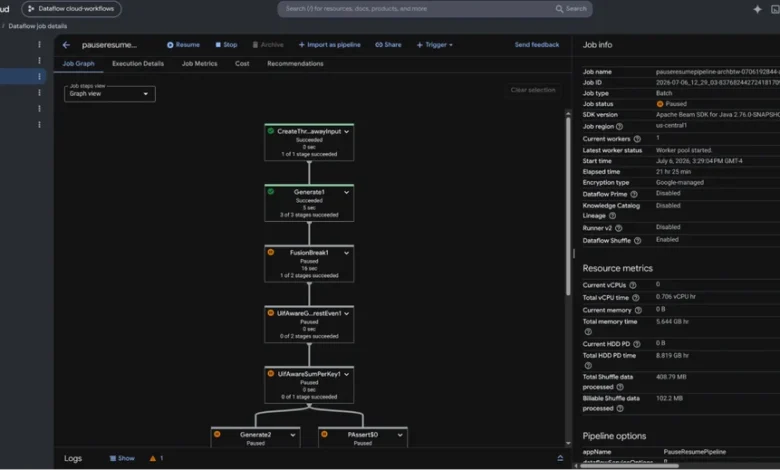
First, the general availability of the Pause/Resume feature for Dataflow batch jobs transforms how organizations handle interruptions and resource reallocation. Historically, large-scale data processing pipelines—frequently running over the course of several days—faced severe vulnerabilities if a job failed or was interrupted. In previous iterations, a system failure meant that all data processed prior to the interruption was lost, forcing engineers to restart the entire execution from scratch. This limitation resulted in substantial waste of billable compute hours and diminished engineering output.
Furthermore, the new Pause/Resume capability introduces dynamic resource flexibility. Enterprises operating heterogeneous AI workloads often require the ability to shift expensive, accelerated hardware—such as Graphical Processing Units (GPUs) and Tensor Processing Units (TPUs)—away from lower-priority data processing tasks and toward mission-critical operations like real-time feature engineering or high-volume AI inference. With the GA release, administrators can intentionally pause running batch jobs, free up accelerated infrastructure for urgent tasks, and subsequently resume the data pipelines precisely where they left off.
Second, Google Cloud has significantly bolstered its machine learning execution layer by introducing support for G4 virtual machines driven by NVIDIA RTX PRO 6000 Blackwell Server Edition GPUs. Designed to surpass the capabilities of previous-generation hardware like the NVIDIA L4 GPU, the Blackwell-powered RTX PRO 6000 boasts an impressive 96 gigabytes of virtual GPU memory alongside a memory bandwidth of 1.6 terabytes per second. This immense performance ceiling allows enterprise data teams to execute complex AI inference pipelines directly inside their Dataflow jobs, supporting sophisticated models containing 70 billion parameters or more.
Chronology and Development of Serverless Data Processing
To understand the significance of these updates, it is instructive to examine the trajectory of serverless data processing architectures over the past decade. When Google initially introduced Dataflow, it was engineered to unify batch and streaming data processing through a single programming model, heavily inspired by internal Google technologies like MapReduce, Flume, and MillWheel.
Over subsequent years, the rapid maturation of generative AI shifted the primary workload requirements of cloud customers. Enterprises transitioned from simple extract, transform, load (ETL) pipelines to intricate, multi-stage agentic workflows requiring seamless integration between data lakes, vector databases, and machine learning model endpoints.
Recognizing these shifts, Google incrementally introduced specialized ML-focused features into Dataflow, such as the RunInference API, which simplifies the integration of machine learning models into data pipelines. However, as model sizes scaled into tens of billions of parameters, customers frequently encountered infrastructure bottlenecks. Long-running batch jobs remained vulnerable to transient cloud infrastructure events or node preemptions, leading to prolonged downtimes. The internal development of the Pause/Resume mechanism began as an engineering solution to these reliability gaps, culminating in internal validation cycles throughout the previous year before reaching the commercial general availability milestone announced today. Simultaneously, the rapid commercialization of NVIDIA’s Blackwell architecture paved the way for the integration of the RTX PRO 6000 GPUs, completing a multi-year effort to bridge the gap between heavy data orchestration and high-performance neural network inference.
Supporting Data, Hardware Specifications, and Architecture
The technical metrics underpinning these updates highlight a substantial leap in processing capability and cost-efficiency for enterprise data architectures.
Dataflow’s serverless architecture fundamentally eliminates the need for manual cluster provisioning, auto-scaling configuration, and node maintenance. However, the introduction of the NVIDIA RTX PRO 6000 Blackwell Server Edition GPUs introduces a new tier of hardware acceleration previously difficult to manage within standard ETL pipelines. With 96GB of vGPU memory, a single G4 virtual machine instance can now accommodate large language models (LLMs) and computer vision architectures that previously required dedicated, standalone inference clusters.
The accompanying memory bandwidth of 1.6 TB/s ensures that data throughput matching the ingestion rate of Dataflow streams does not bottleneck at the model execution phase. This performance parity between data ingestion and model inference is critical for real-time and near-real-time agentic workflows.
Moreover, the integration operates alongside native Dataflow optimization tools:
- RunInference API: Allows developers to write machine learning model inference code directly within Apache Beam pipelines without managing low-level batching, threading, or model loading boilerplate.
- Right-Fitting: Automatically analyzes pipeline resource utilization to recommend or dynamically adjust machine types, preventing over-provisioning.
- GPU-Enabled Autoscaling: Dynamically scales the number of worker nodes equipped with accelerators based on real-time queue lengths, ensuring that organizations only pay for the exact compute power required at any given moment of a workload’s lifecycle.
Industry Implications and Strategic Analysis
From an economic and operational standpoint, these enhancements address critical friction points that have historically hindered large-scale AI adoption.
In enterprise environments, cloud expenditure is heavily scrutinized. Long-running batch jobs that fail near completion represent a direct financial loss in wasted compute cycles, compounded by the opportunity cost of delayed data delivery to downstream analytical teams. By enabling state preservation through Pause/Resume, Google Cloud is effectively mitigating the financial risks associated with massive data processing tasks. Enterprises can now design multi-day batch jobs with structural resilience against transient failures, significantly lowering the total cost of ownership for petabyte-scale data operations.
Furthermore, the capability to dynamically shift high-performance hardware between jobs introduces a new paradigm of resource elasticity. Rather than maintaining static, dedicated pools of expensive GPUs for intermittent high-priority inference tasks, organizations can pool their accelerated compute and reallocate units on demand using Dataflow’s orchestration layer.
The inclusion of NVIDIA RTX PRO 6000 Blackwell GPUs also democratizes access to large-scale model execution. Historically, running models with upwards of 70 billion parameters necessitated complex Kubernetes deployments or specialized MLOps platforms. By embedding this capability directly within Dataflow, Google Cloud allows data engineering teams—who may not be infrastructure specialists—to execute complex AI inference pipelines natively within their standard data transformation workflows. This convergence of data engineering and machine learning operations (often termed DataOps and MLOps integration) reduces architectural complexity, minimizes data movement across different cloud storage tiers, and accelerates the time-to-market for enterprise AI initiatives.
Future Outlook for Google Cloud’s AI Stack
As artificial intelligence models continue to scale in parameter size and operational complexity, the boundary between data ingestion, preparation, and model inference will continue to blur. Google Cloud’s latest enhancements to Dataflow signal an ongoing strategic commitment to building a unified, highly efficient serverless ecosystem capable of sustaining autonomous agentic workflows.
Industry analysts note that as enterprises move past the initial experimental phases of generative AI deployment, operational efficiency, cost control, and architectural resilience will dictate long-term cloud platform selection. By directly targeting the operational friction of long-running batch jobs and lowering the barrier to entry for advanced GPU-accelerated inference, Google Cloud has positioned Dataflow as a central nexus for modern enterprise data and AI infrastructure. As developers begin to deploy these new features into production environments, the broader technology sector will closely monitor the resulting gains in developer productivity, computational efficiency, and overall cost optimization.
Related posts: