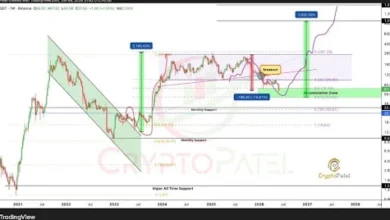
Bitcoin achieved a major technical milestone on September 21, breaching the $85,000 threshold for the first time since January 2026. The asset reached a session peak of $85,174.35, signaling a potential shift in market sentiment after a protracted period of consolidation and downward pressure. This move is particularly significant for institutional and retail market participants, as it marks the successful reclamation of a price range that had acted as a formidable ceiling for the better part of the year. While the price action provides a clear data point for technical analysts, the broader market remains focused on whether this level can serve as a floor for future growth or if it represents a transient deviation within a wider range-bound environment.
Chronology of the 2026 Market Trajectory
To understand the weight of this breakout, one must contextualize the price action within the broader timeline of the 2026 fiscal year. Following a robust start in January, where Bitcoin sought to establish new momentum, the asset encountered significant macroeconomic headwinds. Throughout the spring and summer months, the market experienced several failed breakout attempts. On multiple occasions, Bitcoin tested the $80,000 to $83,000 range, only to be met with concentrated sell-side liquidity that forced a retracement toward the mid-$60,000s and $70,000s.
The period between February and August was characterized by high volatility and a notable lack of sustained conviction from buyers. Market participants watched as the asset oscillated within a band, hampered by uncertainty surrounding interest rate adjustments, global liquidity conditions, and regulatory discourse. The September 21 move is the first time the market has effectively cleared the "January wall," effectively erasing the losses and stagnation that defined the previous eight months. This shift suggests that the demand side has finally overcome the supply overhang that dominated the second and third quarters of the year.
Supporting Data and Technical Market Structure
The technical implications of crossing the $85,000 mark are multi-faceted. In quantitative terms, the breach represents a psychological victory for bulls, as $85,000 has served as a key resistance point in multiple Fibonacci retracement models utilized by institutional trading desks. The move was accompanied by a surge in trading volume, indicating that the breakout was driven by active participation rather than low-liquidity "wicking."
From a derivatives perspective, the open interest (OI) in Bitcoin futures saw a marked increase in the hours leading up to the breach. Traders were positioning themselves for a breakout, and the subsequent liquidation of short positions—often referred to as a "short squeeze"—likely accelerated the price movement once the $85,000 level was breached. The current market structure suggests that for the trend to remain sustainable, Bitcoin must maintain support above this level for several consecutive daily closes. Historical data indicates that breakouts lacking a consolidation period are prone to "mean reversion," where the price quickly falls back into its previous trading range. Therefore, the market is currently in a "wait and see" phase, with traders monitoring daily volume profiles to determine if the $85,000 level is being treated as a new base of support by long-term holders.
Institutional and Market Reactions
While no singular entity speaks for the entire cryptocurrency market, the consensus among analysts at major financial institutions is one of cautious optimism. Institutional desks have noted that the reclamation of the $85,000 level aligns with a broader resurgence in risk-on assets globally. Market strategists suggest that the move reflects a cooling of inflationary fears, which has historically correlated with increased demand for non-sovereign digital assets.
In private communications with investors, several digital asset management firms have noted that the September 21 move was likely bolstered by a combination of retail interest and a shift in spot demand. The "validated spot-price snapshot" used to track this milestone indicates that the buying pressure was consistent across major exchanges, reducing the likelihood that the move was an isolated anomaly on a single platform. Furthermore, the absence of negative regulatory headlines or black-swan events during this specific price action has allowed the market to digest the gains more effectively than during previous rallies, which were often interrupted by sudden external shocks.
Implications for the Broader Cryptocurrency Ecosystem
The ripple effects of Bitcoin’s performance extend well beyond the asset itself. As the primary bellwether for the digital asset class, Bitcoin’s ability to establish a new, higher baseline at $85,000 has historically acted as a catalyst for broader market participation. Altcoins and decentralized finance (DeFi) protocols often track Bitcoin’s momentum; a sustained period of stability above $85,000 could lead to a rotation of capital into smaller-cap tokens, potentially driving a wider market rally.
However, the implications are not purely bullish. The volatility that historically accompanies such breakouts remains a concern for risk management departments. If the move proves to be a "bull trap"—a technical pattern where a price breaks resistance only to fall back down—it could lead to a wave of forced liquidations. Traders are currently looking for a "retest," where the price drops slightly to touch the $85,000 level from above and bounces off it, confirming the zone as support. If such a retest occurs successfully, it would provide the technical validation needed to shift the outlook for the remainder of the year from "neutral" to "bullish."
Macroeconomic Context and Future Outlook
The macroeconomic environment remains a critical variable. Bitcoin’s performance on September 21 must be viewed alongside current trends in equity markets and foreign exchange. As central banks continue to navigate the complexities of economic growth and monetary policy, Bitcoin is increasingly being evaluated by institutional investors as a hedge against currency debasement and systemic instability.
Looking forward, the fourth quarter of 2026 will be defined by whether the $85,000 level can hold through expected end-of-quarter portfolio rebalancing. Institutional investors typically adjust their holdings during the final weeks of September, which can introduce additional noise into the market. Should Bitcoin hold these gains through the close of the month, it would provide a strong foundation for the final quarter, historically a period of heightened activity in the digital asset sector.
The focus for the coming weeks will remain on the volume of inflows into spot exchange-traded products (ETPs) and the behavior of long-term holders. If these cohorts continue to accumulate at these levels, it will signal that the $85,000 milestone is not merely a technical blip but a reflection of a fundamental shift in the asset’s valuation. Conversely, if high-frequency traders and short-term speculators dominate the order books, we may see a period of renewed volatility as the market seeks a more permanent equilibrium.
Ultimately, the reclamation of the $85,000 level on September 21 is a testament to the resilience of the Bitcoin market after a difficult eight-month stretch. Whether this serves as the launchpad for a new cycle or a momentary peak in a persistent range, the event has effectively reset the reference points for every market participant. As the market enters this new territory, the primary objective for the coming days is clear: the validation of the new range and the consolidation of gains above the $85,000 psychological barrier. Investors and observers alike will be watching closely to see if the market can transform this session high into a durable, multi-month foundation.
Related posts: