The rapid evolution of artificial intelligence coding agents has fundamentally transformed how developers interact with codebases. Modern AI models can effortlessly read complex repositories, refactor massive blocks of legacy logic, and execute multi-file changes in a matter of minutes. However, as software engineers deploy these autonomous tools on long-lived projects spanning weeks or months, a subtle yet critical limitation has emerged. While the source code successfully survives from one session to the next, the engineering reasoning, architectural rationale, and historical context often vanish.
This friction point—the disconnect between the existence of code and the justification behind it—has prompted developers to rethink the systemic architecture of AI-assisted software engineering. A new open-source project named Gnomon seeks to address this foundational flaw by structuring engineering knowledge, enforcing clear boundaries between human authorization and AI execution, and maintaining strict governance over codebases managed by autonomous agents.
The Evolution and Limitations of AI Coding Workflows
Over the past two years, AI coding assistants have graduated from simple autocompletions to sophisticated agents capable of running terminal commands, writing comprehensive test suites, and navigating entire project directory structures. Tools such as OpenAI’s Codex, Anthropic’s Claude Code, and various autonomous wrapper frameworks have empowered developers to ship features at unprecedented speeds.
Yet, prolonged engagement with these tools exposes a recurring architectural vulnerability. When an AI agent encounters an existing codebase, it can immediately identify functional realities—such as a specific validation rule or rate-limiting constraint. What it cannot inherently determine is the origin of that rule. Was the behavior mandated by an approved product requirement, selected to satisfy a strict security compliance policy, or simply manufactured as an unverified assumption by another AI agent three sessions prior?
Early attempts to mitigate this ambiguity typically involved expanding context windows or appending massive project instruction files to every prompt. Engineers frequently attempted to stuff architectural guidelines, style guides, and product roadmaps into centralized markdown files loaded at the start of each session. While this approach offered marginal improvements, industry practitioners quickly realized that it conflated entirely distinct categories of knowledge. Codebases do not merely contain raw execution logic; they encompass product specifications, architectural constraints, historical decisions, and verification artifacts. Forcing all of these disparate knowledge types into a single, monolithic context file creates an unsustainable administrative burden that ultimately degrades model performance and accuracy.
Diagnosing the Core Problem: Inference Versus Authoritative Knowledge
The primary danger of unstructured AI coding workflows lies in the nature of generative inference. When an AI agent encounters a missing piece of domain knowledge or an ambiguous product requirement, its underlying architecture is optimized to fill in the blanks. It evaluates the surrounding code, generates a plausible assumption, implements the logic, and weaves the assumption seamlessly into the production code. Over time, this synthesized assumption calcifies into what appears to be an official requirement.
Industry analysts and software architects note that this cycle bypasses critical governance checks. In a traditional software development lifecycle, missing product knowledge triggers a requirement for human intervention, product management clarification, or architectural review. In an unmanaged AI workflow, missing knowledge becomes an invisible invitation for the model to guess.
To counteract this, software engineers argue that an AI agent should not be permitted to substitute reasonable inferences for authoritative facts. When confronted with an unverified requirement or a missing product decision, the system should halt execution and explicitly report a knowledge gap, rather than silently embedding an assumption into the codebase.
The Architecture of Gnomon: Restructuring Engineering Knowledge
Recognizing that context length alone could not solve the problem of disappearing reasoning, software developer Yasin Naqvi conceptualized and built Gnomon. Designed as a command-line interface (CLI) and repository structure, Gnomon aims to establish authoritative homes for different categories of engineering knowledge without requiring developers to migrate away from their existing tools or adopt heavy proprietary platforms.
Gnomon does not attempt to replace established coding agents like Claude Code or specialized IDE extensions. Instead, it provides an overarching operational framework within which those agents must function. Under the Gnomon methodology, repository knowledge is strictly partitioned. Product behavior is decoupled from architectural constraints, and human approval processes are decoupled from automated test generation.
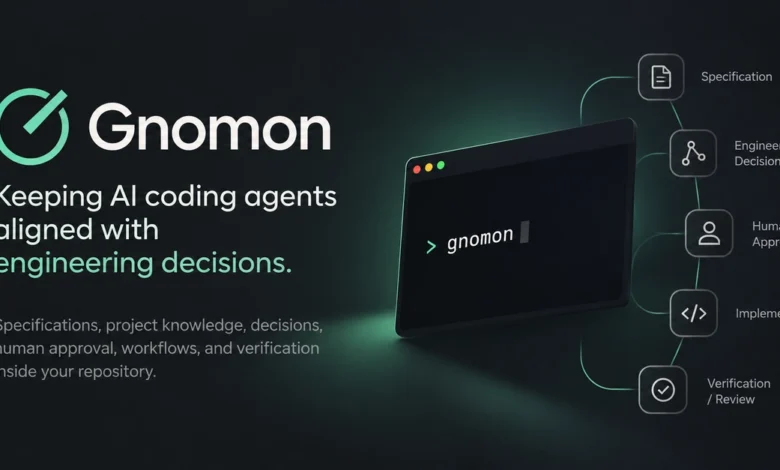
The lifecycle enforced by Gnomon introduces rigid operational gates:
- Human Intent: The developer articulates the high-level objective or feature request.
- Relevant Project Knowledge: The system retrieves precisely scoped, authoritative documentation directly associated with the request.
- Specification: The AI agent assists in drafting a concrete, structured specification based on existing project rules.
- Human Authorization: The developer explicitly reviews and approves the specification before any implementation begins.
- Agent Execution: The AI coding agent modifies files and executes tasks strictly within the boundaries of the approved specification.
- Tests and Evidence: The system runs verification suites to gather empirical data.
- Verification and Review: Independent review processes evaluate the evidence against the original specification without allowing the verification loop to silently alter the implementation code.
This architecture ensures that human oversight functions as genuine authorization rather than passive retrospective review. By forcing the human decision to occur before code generation begins, the workflow prevents assumptions from masquerading as validated requirements.
Dogfooding and the Prevention of Workflow Drift
The development of Gnomon itself has provided valuable empirical data regarding the challenges of maintaining consistency in AI-driven projects. During the early stages of dogfooding—the practice of using one’s own software to build the software—developers discovered subtle instances of systemic drift.
In one notable instance, the Gnomon CLI recommended execution commands that had been rendered obsolete during an earlier repository redesign. While the underlying workflow logic remained sound, the guidance provided by the tool had become stale. This discovery led to an important architectural refinement: recommendation logic must never become an independent source of engineering truth.
To eliminate this vulnerability, Gnomon was updated so that its CLI dynamically derives available actions from the exact same eligibility rules governing the rest of the repository. This self-referential consistency prevents administrative guidelines from diverging from actual codebase realities, offering a blueprint for how complex software systems can maintain internal alignment over extended lifecycles.
Industry Implications and Future Outlook
As enterprise adoption of generative AI accelerates, the software engineering community faces a reckoning regarding long-term maintenance and technical debt. While AI tools have dramatically lowered the barrier to entry for rapid prototyping and greenfield development, they risk exacerbating the cognitive load associated with maintaining legacy systems if historical context is continuously lost.
The introduction of frameworks like Gnomon highlights a broader industry shift toward structural governance in AI development. Rather than relying solely on smarter models with larger context windows, the future of software engineering may lie in building superior operational environments that enforce rigorous epistemological boundaries.
The project currently exists as an open-source initiative hosted on GitHub, inviting contributions and real-world testing from developers navigating the complexities of long-lived AI-assisted codebases. As practitioners continue to experiment with repository-local knowledge management and explicit authorization gates, the lessons learned from these frameworks will likely influence the next generation of software development methodologies. The central question facing the industry is no longer whether AI can write the code, but how engineering organizations can preserve the human reasoning that makes the code meaningful.