Beyond the Prompt: Practical Engineering Strategies for Securing AI Applications in Production

The rapid integration of generative artificial intelligence into commercial software has fundamentally altered the paradigm of application security. For decades, traditional software engineering maintained a rigid boundary between code and data. Code dictated the execution path and structural logic of an application, while data served merely as the passive input processed by those predefined routines. Large language models (LLMs), however, have rendered that foundational barrier obsolete. Because modern AI architectures ingest system prompts, user instructions, retrieved enterprise documents, and raw external content into a single, continuous stream of text, they inherently lack a deterministic mechanism to distinguish trusted system directives from untrusted external inputs.
This architectural reality underpins the systemic vulnerability known as prompt injection. While much of the early discourse surrounding AI security focused heavily on conversational exploits—such as malicious end-users attempting to bypass safety guardrails by typing commands like "ignore previous instructions"—security researchers and practicing developers increasingly recognize that indirect prompt injection poses the gravest operational threat. Indirect injection occurs when an AI model consumes text generated or hosted by an external party on behalf of a user. Examples include inbound customer support tickets, scraped web pages, third-party knowledge base documents, and inbound job descriptions ingested from public marketplaces.
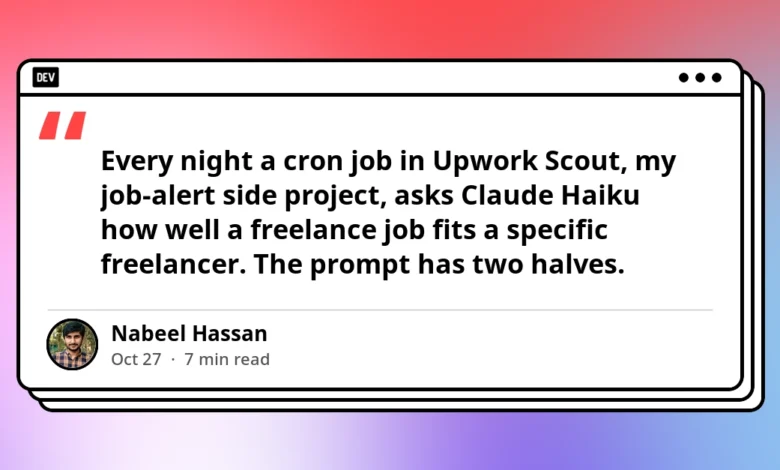
To evaluate how these vulnerabilities manifest and can be mitigated in production environments, software developers are increasingly auditing real-world deployments. A prominent case study is Upwork Scout, an automated side project designed to parse freelance job listings and evaluate their alignment with specific user profiles. Every night, an automated cron job submits a structured prompt to a high-efficiency language model, combining a freelancer’s professional history with the metadata and text description of an available contract. Because the job description is authored by an anonymous third party, it lands directly within the model’s context window alongside the system’s strict scoring guidelines. The model, lacking the cognitive capacity to separate developer instructions from external text, treats the entire payload as a unified instruction set.
This operational vulnerability highlights a broader truth about AI security: prompt wording alone cannot reliably prevent adversarial manipulation. No matter how meticulously engineered a system prompt may be, an industrious actor can construct input text designed to subtly or overtly skew the model’s output. Consequently, securing LLM-driven features requires abandoning the pursuit of the "bulletproof prompt" and instead embracing defensive engineering practices borrowed from traditional web security.
Bounding the Worst-Case Scenario
The foundation of resilient AI architecture begins with risk containment rather than prevention. Because absolute eradication of prompt injection remains practically infeasible given the nature of natural language processing, developers must design features by explicitly answering a fundamental question: What is the absolute worst outcome an injected instruction can achieve?
In the context of the Upwork Scout job matcher, the worst-case scenario is structurally bounded. If a malicious job poster embeds text designed to manipulate the model into returning a maximum compatibility score paired with a deceptive justification, the resulting output will artificially elevate that listing in a user’s notification queue. While this represents a functional failure—potentially causing a freelancer to spend platform currency, known as Connects, on an unsuitable contract—the blast radius of the security incident is strictly contained. No internal corporate data is exfiltrated, no unauthorized write operations are executed, and the physical damage is limited to a single row within an automated email alert.
This bounded risk profile stands in stark contrast to enterprise-grade AI agents equipped with broad read-and-write permissions. When an AI feature possesses the technical capability to query entire databases, modify user accounts, or execute external API requests, an indirect prompt injection can escalate from a minor nuisance into a catastrophic data breach.
To mitigate this, security architects enforce strict principle-of-least-privilege boundaries. The first line of defense must reside outside the LLM entirely: application logic, rather than model inference, must authorize sensitive actions based on cryptographically verified user sessions and explicit permissions. The model should act solely as a semantic parser or reasoning engine, never as the ultimate arbiter of system authority.
Treating Model Output as Untrusted User Input
A persistent architectural misstep across modern software development teams is the assumption that data generated by an AI model is inherently safe. Because an LLM’s output is synthetically derived through token probability distributions rather than retrieved directly from a known database, developers frequently bypass standard sanitization protocols when rendering model responses in user interfaces or downstream systems.
In practice, however, a model’s output must be handled with the same caution applied to untrusted user input originating from the public internet. If a malicious input successfully coerces a language model into generating specific text structures—such as Markdown image tags or HTML hyperlinks embedded with dynamic query parameters—subsequent rendering of that output can trigger unintended side effects. For instance, an automated client application loading an external image URL embedded within a model’s response can inadvertently leak session data or user telemetry to an attacker’s server without requiring any explicit click interaction from the user.
Robust engineering mandates strict validation and sanitization at every architectural boundary. In modern web applications, model-generated text destined for browser rendering must pass through standard escaping functions and content security policies. Similarly, if model outputs are ingested by downstream analytical pipelines, spreadsheets, or automated code execution environments, those inputs must undergo rigorous schema validation, type checking, and boundary constraints before execution.
Data Leaks and the Challenge of Contextual Awareness
Beyond direct manipulation of outputs, one of the most commercially damaging security failures in enterprise AI features is the inadvertent disclosure of confidential data through correct answers derived from unauthorized sources.
Unlike traditional software, where access control lists (ACLs) can be rigidly enforced at the database query layer via SQL permissions, language models often operate on unindexed vector databases, RAG (Retrieval-Augmented Generation) pipelines, or expansive context windows containing mixed data classifications. If a retrieval mechanism pulls restricted corporate records, internal HR documents, or privileged client communications into the context window alongside a public query, the model may synthesize a factually correct answer that violates internal data governance policies or regulatory compliance standards.
Mitigating this risk requires synchronizing retrieval architectures with enterprise access controls. Vector databases and document search engines must filter retrieved chunks based on the querying user’s specific authorization credentials before the data is injected into the model’s context window. Relying on the LLM itself to enforce data privacy ("Do not share this internal document unless the user is a manager") is fundamentally insecure, as prompt injection techniques can easily override such behavioral guidelines.
Managing API Endpoints and Infrastructure Costs
Public-facing AI features present unique operational and financial vulnerabilities. Because third-party foundation model APIs charge per token, deploying an unmonitored or unrate-limited AI endpoint exposes an organization to immediate financial denial-of-service (DoS) attacks. Malicious actors frequently attempt to exploit public support bots, profile parsers, or document summarizers as free general-purpose computing resources, submitting massive payloads or automated scripting routines that inflate provider bills.
Comprehensive defensive measures require a layered infrastructure approach:
- Per-user and per-account rate limiting to restrict request velocity.
- Strict input size limitations and character truncation to prevent context-window exhaustion.
- Mandatory authentication and verified sessions for computationally expensive actions.
- Automated spending alerts and hard budget caps configured within the provider account dashboard.
- Deterministic preprocessing filters to reject obviously malformed or irrelevant requests before incurring LLM inference costs.
The Hidden Vulnerability of Logging Systems
While development teams meticulously encrypt databases and secure API endpoints, application logging pipelines frequently represent an overlooked security blind spot. System logs designed for debugging and observability routinely capture raw user prompts, conversational histories, and retrieved data payloads.
Because these logs often persist across secondary storage systems with broader internal access permissions, they can inadvertently become repositories for sensitive personally identifiable information (PII), proprietary source code, and confidential corporate communications. Securing an AI application requires treating log storage with the same rigorous access control, retention limits, and automated redaction policies applied to primary production databases. Furthermore, error-handling routines should be engineered to record only abstracted metadata—such as error codes, timestamps, and non-sensitive identifiers—rather than dumping raw context windows upon failure.
Industry Implications and the Path Forward
The maturation of generative AI from an experimental sandbox into core production infrastructure demands a return to foundational software engineering principles. Clever prompt engineering and heuristic guardrails are insufficient to guarantee the security of systems operating in adversarial environments.
True resilience is achieved through deterministic application boundaries: decoupling authorization logic from model inference, strictly validating and sanitizing all inbound and outbound data streams, enforcing granular rate limits, and maintaining absolute visibility into data flow and log retention. By approaching large language models as inherently unpredictable components rather than infallible authorities, engineering organizations can transition AI security from an ongoing series of reactive incidents into a predictable, manageable engineering discipline.