Google Cloud Announces Managed Reinforcement Learning Fine-Tuning Service to Unlock Advanced Gemini Model Customization

The landscape of enterprise artificial intelligence is undergoing a significant transformation as cloud providers seek to bridge the gap between powerful foundation models and the specific, highly nuanced needs of business applications. Google Cloud has officially unveiled a fully managed Reinforcement Learning Fine-Tuning (RLFT) service designed specifically for its flagship Gemini family of models. This strategic offering addresses a long-standing technical barrier in the machine learning industry: while reinforcement learning (RL) has long served as a cornerstone for post-training advanced large language models (LLMs), it has historically required massive, specialized training clusters and intimate access to proprietary model internals—resources typically restricted to elite AI research laboratories and unavailable to external enterprise customers.
By packaging this complex machinery into a managed cloud service, Google Cloud aims to democratize access to advanced model alignment techniques. Under the new paradigm, enterprise developers and organizations need only supply a set of prompts and a defined reward function. The Google Cloud infrastructure abstracts away the underlying hardware orchestration, hyperparameter tuning, and model weight management, allowing developers to adapt proprietary Gemini models using reward signals rather than relying exclusively on traditional, labor-intensive datasets of labeled answers.
Background Context and the Evolution of Model Fine-Tuning
To understand the significance of Google Cloud’s RLFT service, one must examine the evolution of model post-tuning methodologies over recent years. Historically, organizations looking to tailor general-purpose foundation models to their proprietary workflows relied primarily on Supervised Fine-Tuning (SFT). SFT requires developers to curate extensive datasets comprising input prompts paired with "gold standard" human-authored responses. The model is then trained via gradient descent to mimic these desired outputs.
While SFT remains an effective baseline for adapting models to specific writing styles, standard formats, or basic classification tasks, it suffers from severe limitations when applied to complex, multi-step, or generative problem domains. SFT struggles immensely with tasks that are easy to evaluate or verify programmatically, but extraordinarily difficult or expensive to pre-demonstrate by hand. For instance, writing the ideal SQL query for a complex, evolving database schema across millions of variations is virtually impossible for human annotators to author exhaustively. However, executing the resulting query against a test database and checking whether it returns the correct data is trivial, fast, and entirely automatable.
Similarly, in domains like advanced mathematical reasoning, automated code generation, structured data extraction, and strategic game theory, there are frequently numerous equally valid paths to a correct solution. Forcing a model to conform to a single, predetermined human-authored trajectory during SFT can penalize creativity, introduce artificial bottlenecks, and ultimately cause performance metrics to plateau. Reinforcement learning bypasses these constraints by rewarding the model based on the quality of the outcome rather than the exact path taken to get there.
How the Managed RLFT Service Operates
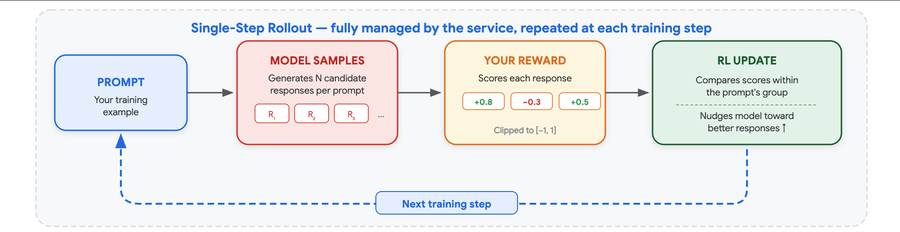
Google Cloud’s new service operationalizes the reinforcement learning feedback loop entirely within a managed cloud environment. At each step of the training cycle, the service prompts the Gemini model to generate multiple candidate responses. These candidate outputs are then evaluated programmatically using the customer-defined reward function—a piece of code or an external evaluation pipeline that assigns a numerical score based on the quality, safety, accuracy, or formatting of the response.
Once the candidates are scored, the service updates the model weights using reinforcement learning algorithms. The objective is twofold: systematically increase the probability of generating high-scoring responses while ensuring the model does not drift catastrophically from its foundational capabilities or destabilize. Throughout this entire iterative loop, the underlying RL infrastructure is fully managed by Google Cloud. Enterprise users are spared the daunting task of configuring distributed actor-learner architectures, managing memory bottlenecks, or stabilizing policy gradients.
Industry analysts note that while the cloud provider assumes responsibility for the infrastructure, the ultimate burden of success rests upon the quality of the customer’s reward function. The reward signal acts as the definitive compass for the model’s evolution, making reward engineering a critical new discipline for enterprise machine learning engineers.
Strategic Criteria: When Enterprises Should Leverage RLFT
Google Cloud’s technical documentation emphasizes that prompting and SFT should remain the first line of defense for standard adaptations, as they are simpler and more cost-effective for straightforward tasks. However, the RLFT service earns its keep under specific operational conditions where traditional methodologies fall short.
According to technical advisory guidelines released alongside the service, organizations should consider deploying RLFT when they encounter three primary scenarios:
- The evaluation bottleneck: When an organization can easily grade the quality of an output but cannot cheaply or exhaustively author the ideal response ahead of time.
- Performance plateaus: When traditional SFT has hit a ceiling on critical business metrics such as factual faithfulness, strict schema validity, or brand tone consistency.
- Multi-path problem spaces: When a task allows for multiple valid solutions, and enforcing a single rigid reference target during training would penalize alternative, equally effective model behaviors.
Real-World Use Cases Across Industries
Early adopters and beta testers across various industry verticals have begun deploying the RLFT service to solve intractable business problems, particularly those involving automated scoring mechanisms.
In the realm of digital entertainment and interactive media, developers are utilizing RLFT to train AI-powered Non-Player Characters (NPCs) in video games. Traditional NPCs often rely on rigid decision trees or unguided LLMs that break character or violate game logic. By rewarding models for maintaining consistent narrative personas, adhering to complex game rules, and generating dynamic player interactions, developers can produce deeply immersive virtual worlds.
For enterprise data operations, structured entity extraction represents another major beneficiary. Extracting disparate, messy invoices, legal contracts, or medical records into strict JSON schemas frequently results in parsing errors under standard SFT. By applying an automated programmatic parser as the reward function—where the reward is 1.0 if the JSON parses and validates against a schema and 0.0 otherwise—the model rapidly learns to eliminate syntax errors.
Content moderation platforms are also leveraging the service to refine safety filters and policy enforcement mechanisms. Because safety guidelines are often expressed as rule sets rather than single-answer examples, reward functions can evaluate nuanced context, local regulatory compliance, and brand-specific risk tolerance much more dynamically than static classification sets.
Furthermore, software engineering teams are turning to RLFT for code generation tasks measured by execution. By integrating automated unit testing suites into the reward loop, generated code can be compiled and executed in a sandbox environment. The model is rewarded directly for passing unit tests, driving unprecedented improvements in generated code reliability and functional correctness.
Finally, automated presentation slide generation via HTML and CSS has emerged as a creative use case. Ensuring that an LLM outputs visually appealing, non-overlapping, and responsive design layouts is notoriously difficult via prompting alone. By using rendering engines and visual validation metrics as a reward signal, enterprises can automate the creation of polished corporate slide decks at scale.
Implementation Best Practices and Workflow
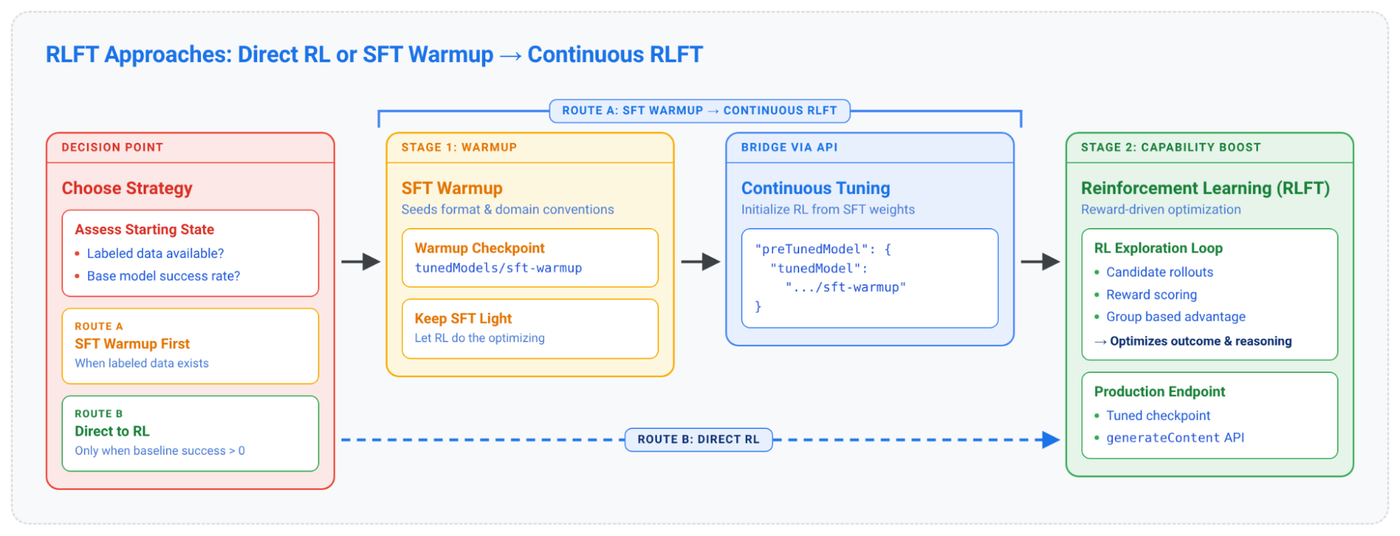
Getting started with the RLFT service involves a structured, iterative workflow designed to minimize compute waste and maximize model alignment. Practitioners are advised to begin with default hyperparameter configurations provided by Google Cloud, establishing a stable baseline before attempting custom optimizations.
During the training process, engineers monitor reward curves and evaluation metrics directly within the Google Cloud console. A key best practice highlighted by Google engineers is to checkpoint and evaluate models based on where validation rewards plateau or saturate, rather than blindly selecting the final training step, which can occasionally lead to overfitting or policy degradation.
Market Implications and Competitive Landscape
The launch of a managed reinforcement learning fine-tuning service for proprietary models represents a notable escalation in the cloud AI wars. Major cloud hyperscalers are currently locked in a fierce race to provide enterprise customers with deeper customization capabilities without compromising data privacy or exposing proprietary model architecture.
By offering a managed service that handles both the complex infrastructure of reinforcement learning and the secure handling of Gemini model internals, Google Cloud lowers the technical threshold for advanced AI engineering. Organizations that previously lacked the specialized machine learning operations (MLOps) talent required to build custom RLHF (Reinforcement Learning from Human Feedback) pipelines can now leverage automated reward-driven optimization out of the box.
As enterprises increasingly demand bespoke AI models that align precisely with internal business logic, compliance standards, and programmatic validation checks, services like Google Cloud’s RLFT mark a definitive shift away from static dataset training toward dynamic, outcome-based machine learning development.
Related posts: