The modern job market for data professionals is currently defined by a pervasive and vaguely defined buzzword: "AI experience." As corporations race to integrate artificial intelligence into their core operations, recruitment listings for data analysts, statisticians, and researchers increasingly mandate this capability. However, a closer examination of hiring practices across diverse sectors reveals that the phrase lacks any standardized technical definition. A requirement for "AI experience" listed by a multinational financial services firm, a localized biotechnology startup, and a traditional retail enterprise can refer to entirely different skill sets, technological stacks, and operational expectations.
This semantic ambiguity stems from the rapid, decentralized evolution of the artificial intelligence sector over the past decade. Unlike legacy technical requirements such as "five years of regression analysis" or "proficient in R"—which carry explicit, universally understood academic and professional meanings—"AI experience" functions primarily as a contemporary market signal. Organizations frequently utilize the term to indicate corporate modernization and to filter for applicants who have actively monitored recent technological disruptions, rather than to designate a precise, measurable competency. For job seekers, successfully navigating this landscape requires a strategic shift from treating job postings as rigid checklists to analyzing them as complex datasets that demand interpretation, contextualization, and translational positioning.
The Evolution of the AI Requirement in Corporate Recruitment
To understand how recruitment language shifted so dramatically, one must examine the timeline of enterprise technology adoption. Prior to the widespread commercialization of advanced machine learning frameworks in the mid-2010s, enterprise recruitment focused heavily on database management, SQL proficiency, and traditional descriptive or diagnostic analytics. By 2018, as predictive modeling gained mainstream traction, job descriptions began incorporating terms like "machine learning" and "data science" alongside specific libraries and programming languages such as TensorFlow, PyTorch, and Python.
The inflection point occurred between 2022 and 2024, catalyzed by the public deployment of generative AI models, large language models (LLMs), and automated enterprise solutions. Corporate human resources departments, eager to align their hiring strategies with executive mandates for digital transformation, rapidly updated recruitment templates. Lacking internal consensus from engineering and data science leads on what competencies were actually necessary to leverage these new technologies, hiring teams frequently defaulted to the umbrella term "AI experience."
According to labor market analyses from technology recruitment agencies, postings containing artificial intelligence or machine learning keywords surged by over 300 percent during this two-year window. Yet, human resources analysts note that a significant percentage of these openings do not actually require the candidate to build foundational algorithms from scratch. Instead, enterprises are frequently searching for professionals who can safely interact with existing pre-trained models, interpret automated outputs, and integrate AI-driven insights into established business workflows.
Categorizing the Demands Hidden Behind the Buzzword
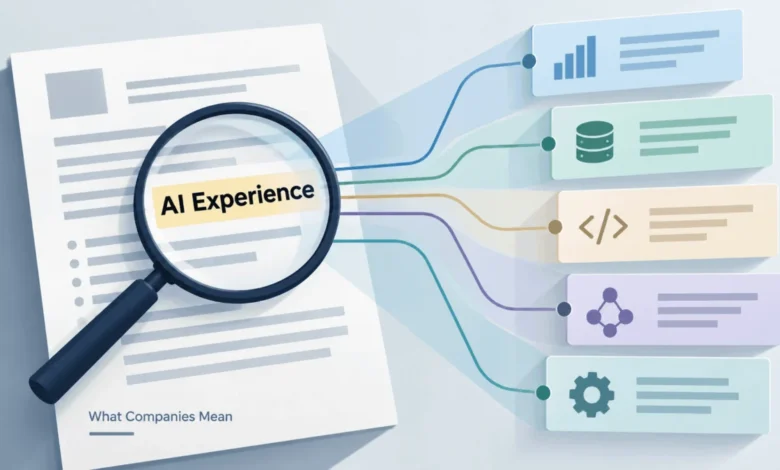
Because the term is applied so broadly, career strategists and hiring consultants generally divide corporate demands for "AI experience" into four distinct operational categories. Identifying which category applies to a specific role is essential for tailoring a candidate’s professional narrative.
The first category centers on tool proficiency and administrative familiarity. In these roles, organizations expect professionals—particularly in marketing, operations, and general data analysis—to leverage off-the-shelf generative AI assistants, automated dashboard builders, and workflow automation platforms. The core competency here is not technical development, but rather efficiency, prompt engineering, and the ability to enhance daily productivity through software tools.
The second category involves conceptual awareness and cross-functional collaboration. Mid-level analysts frequently encounter this expectation. Employers do not necessarily need these workers to write production-level code for neural networks, but they do require them to understand the fundamental mechanics of machine learning, recognize common failure modes such as overfitting or data drift, and effectively communicate these concepts to non-technical stakeholders or executive leadership.
The third category represents hands-on predictive modeling and machine learning engineering. This is the traditional technical interpretation of the phrase. Job descriptions in this tier explicitly demand the ability to clean complex datasets, select appropriate model architectures, train algorithms, and deploy models into production environments using specific programming environments and cloud infrastructure.
The fourth category emphasizes domain-specific AI integration. This is frequently observed in specialized sectors such as healthcare, bioinformatics, quantitative finance, and legal tech. Here, "AI experience" means understanding how to apply machine learning paradigms to proprietary, highly regulated, or structurally unique data types—such as genomic sequences, high-frequency financial tick data, or unstructured legal briefs—while maintaining strict compliance with industry regulations and data privacy standards.
Mapping Traditional Statistical Knowledge to Modern AI Frameworks
For career professionals with robust backgrounds in statistics, mathematics, economics, or quantitative research, the anxiety surrounding missing "AI experience" is largely unfounded. The underlying theoretical foundation of nearly all modern machine learning and artificial intelligence applications is rooted directly in classical statistical inference, linear algebra, probability theory, and optimization methods.
The primary barrier separating a traditional statistician from an AI practitioner is not a lack of analytical capability, but rather a divergence in vocabulary and tooling. For instance, where a traditional statistical resume might state that a candidate "built predictive regression models to forecast quarterly consumer demand," an enterprise hiring manager scanning for AI competency is looking for evidence of supervised learning expertise, feature engineering acumen, and rigorous model evaluation methodologies.
To bridge this gap, job seekers are advised to reframe their historical accomplishments around measurable business outcomes and the underlying reasoning processes rather than merely listing legacy software applications. By demonstrating how historical statistical modeling techniques directly inform modern predictive analytics, candidates can rebrand their traditional analytical experience as advanced AI readiness. A background in hypothesis testing, residual analysis, and confidence interval estimation translates directly into the model validation and risk management skills that modern AI governance teams desperately require.
Decoding Job Postings Through an Analytical Lens
When evaluating a corporate recruitment posting, data professionals should apply the same rigorous, skeptical mindset they would bring to an unvetted dataset. Headline requirements listed at the top of a job advertisement are frequently aspirational wish lists formulated by human resources departments rather than strict operational mandates. It is statistically rare for any single applicant to satisfy every explicit requirement on a modern job description.
A reliable heuristic for decoding a posting involves separating the baseline qualifications from the operational core described in the day-to-day responsibilities section. If "AI experience" is merely mentioned as a bullet point among a dozen general preferences, its real-world weight to the hiring manager is likely low. Conversely, if the core responsibilities explicitly detail the fine-tuning of language models, the deployment of recommendation engines, or the management of automated decision systems, the requirement is mandatory and technical.
Furthermore, applicants must pay close attention to linguistic modifiers within the text. Phrases such as "AI experience preferred" indicate an openness to training strong analytical candidates on internal systems. On the other hand, requirements specifying "hands-on machine learning experience required" coupled with specific framework dependencies signal a strict, technical evaluation hurdle that requires demonstrable portfolio projects or professional history in model deployment.
The Seniority Signal and Corporate Expectations
The interpretation of AI competency scales dramatically depending on the seniority level of the position in question. Understanding these gradations prevents candidates from either over-qualifying themselves or projecting insufficient expertise during the interview process.
At the junior level, employers are primarily searching for adaptability and cognitive agility. Because tools and frameworks evolve at a breakneck pace, junior professionals are not expected to possess mastery over every proprietary model architecture. Instead, hiring managers look for comfort with emerging software, a willingness to learn internal pipelines, and a healthy skepticism toward unvalidated algorithmic outputs.
At the mid-level, the requirement shifts toward informed collaboration. Mid-level analysts and data scientists must demonstrate the ability to work alongside dedicated software engineering teams, participate meaningfully in model evaluation discussions, and effectively translate complex data science outcomes into actionable business intelligence for commercial departments.
At the senior leadership level, the expectation transitions decisively into strategic judgment. Senior professionals are evaluated on their capacity to determine when artificial intelligence is—and importantly, is not—the appropriate solution to a given business problem. They must be capable of communicating technical limitations and systemic risks to the executive suite, helping the broader organization avoid the substantial financial, legal, and reputational costs associated with the careless deployment of unvetted automated systems.
Addressing Common Misconceptions in AI Recruitment
Misunderstandings regarding how to package one’s professional history frequently derail qualified candidates during the application phase. One of the most prevalent misconceptions is the belief that applicants should exhaustively list every artificial intelligence tool, software library, or automated platform they have ever interacted with. Recruitment experts emphasize that this tactic frequently backfires. Hiring managers consistently report that they remember candidates who demonstrated deep critical reasoning and problem-solving judgment, rather than those who merely displayed an extensive catalog of software tools. The optimal approach involves leading with the specific business problems solved and the analytical reasoning applied, utilizing specific technologies merely as supporting context.
A second major misconception is that candidates are categorically disqualified if they have never built a complex machine learning model entirely from scratch. In reality, the vast majority of enterprise roles utilizing the phrase "AI experience" do not require original algorithm design. What routinely disqualifies applicants is an inability to demonstrate critical thinking regarding data hygiene, sample bias, model assumptions, and the accurate interpretation of results. These core competencies are fundamentally statistical in nature, representing precisely what modern organizations require to govern their analytical pipelines safely.
Finally, many professionals operate under the assumption that they must acquire expensive commercial certifications or complete specialized bootcamps before submitting applications. While formal credentials can provide structured learning pathways, hiring managers evaluating analytical and technical roles place significantly higher value on practical interview demonstrations. The ability to articulate precisely when and why an automated system might fail, coupled with a transparent explanation of how to audit data quality, carries far more weight in a technical interview than any collection of online certificates.
Broader Implications for the Future of Data Labor Markets
As artificial intelligence continues its rapid integration into the global economy, the terminology surrounding technical recruitment will inevitably mature. Industry analysts predict that generic catchphrases like "AI experience" will eventually be replaced by more granular, standardized competency frameworks as human resources departments become more sophisticated in evaluating technical talent.
For the immediate future, however, the burden rests upon the job seeker to decode the ambiguous language of modern corporate recruitment. By recognizing that statistical foundations and analytical reasoning form the bedrock of all applied artificial intelligence, data professionals can confidently translate their historical achievements into the vocabulary of contemporary technological demand. Approaching job postings with analytical rigor, identifying the true operational category of a role, and emphasizing critical judgment over mere tool familiarity will remain the most effective strategies for navigating the evolving landscape of data science and artificial intelligence careers.