AWS Announces General Availability of AWS Continuum for Code Vulnerabilities to Transform Enterprise Application Security

Amazon Web Services has officially announced the general availability of AWS Continuum for code vulnerabilities, a groundbreaking security service designed to autonomously discover, validate, and remediate application security flaws. The newly launched platform addresses one of the most persistent and resource-intensive challenges in modern software engineering: managing the overwhelming deluge of security alerts generated by conventional code scanners. By leveraging advanced contextual mapping and automated code patching, AWS Continuum aims to bridge the historical gap between vulnerability identification and effective remediation.
The introduction of AWS Continuum arrives at a critical juncture for enterprise cybersecurity. In recent years, the widespread adoption of frontier artificial intelligence models has fundamentally altered the threat landscape. Malicious actors are now capable of transforming raw vulnerability disclosures into working, weaponized exploit code within minutes of public release. Conversely, while development teams utilize similar AI-driven tooling to accelerate software delivery, these tools simultaneously inflate the volume of security findings that organizations must process daily. Enterprises operating large application estates frequently report receiving thousands of automated security alerts every 24 hours, creating an unsustainable operational burden for security personnel.
Background Context and the Evolution of Vulnerability Management
Traditionally, vulnerability management has relied on generic severity scoring systems, such as the Common Vulnerability Scoring System (CVSS), which often fail to capture the operational reality of a specific cloud environment. Under legacy paradigms, a critical severity score assigned to a developer-only utility tool looks indistinguishable from a medium severity score assigned to a core microservice situated immediately upstream from a production payments database. Consequently, security teams have been forced to spend countless hours manually investigating whether a given finding is actually reachable over the network, whether it is exploitable in practice, or whether existing runtime controls have already mitigated the risk.
Furthermore, once a genuine vulnerability is confirmed, coordinating a patch across disparate security, infrastructure, and application teams has historically taken days or weeks. Without a comprehensive understanding of business context and the precise blast radius of a code modification, engineering teams are often hesitant to ship rapid fixes for fear of introducing regressions or breaking mission-critical dependencies. AWS Continuum was engineered specifically to dismantle these operational bottlenecks by automating the verification process and bounding the risk associated with every proposed remediation.

Architecture and Technical Functionality
At its core, AWS Continuum operates by constructing a dynamic, multi-layered context graph synthesized from two primary data sources: the organization’s code repositories, such as GitHub or Amazon S3 buckets, and its live AWS infrastructure. To capture infrastructure context, organizations deploy a specialized AWS Continuum collector within the target account and region. This collector ingests granular resource metadata, including AWS Config resources and complex network routing configurations.
By analyzing this data, the service evaluates whether a reported vulnerability is truly reachable over the network and maps the potential lateral movement paths available to an attacker. The resulting context graph provides deep visibility into enterprise architecture, automatically identifying business-critical assets—such as customer data repositories, authentication microservices, and transaction pipelines—and determining service ownership and interdependencies. Rather than relying solely on static severity metrics, Continuum ranks identified issues based on their proximity to these high-value systems within the live attack path.
Validation, Sandboxing, and Automated Remediation
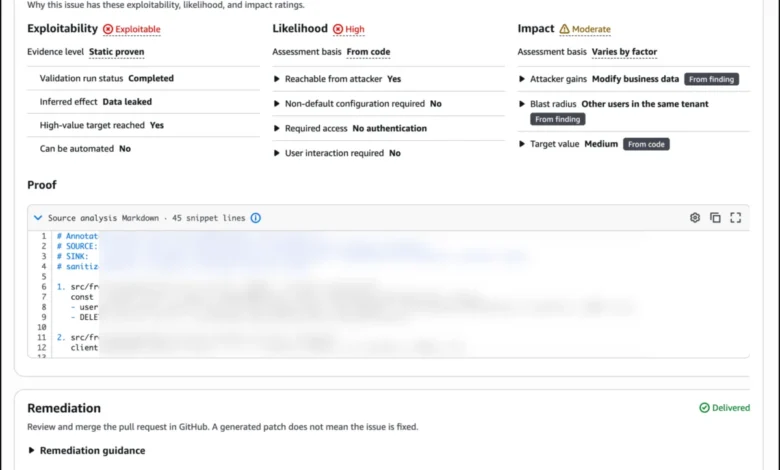
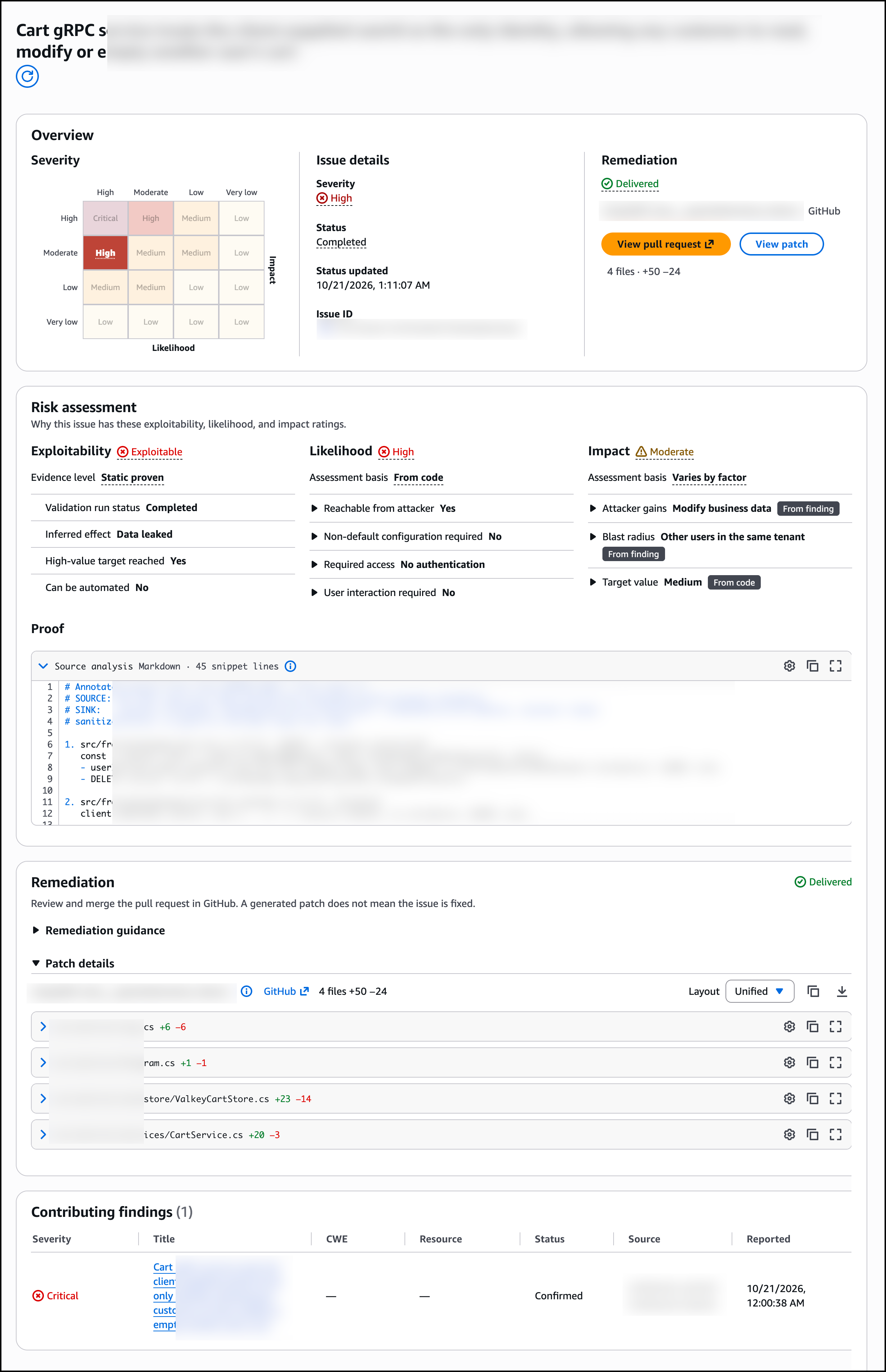
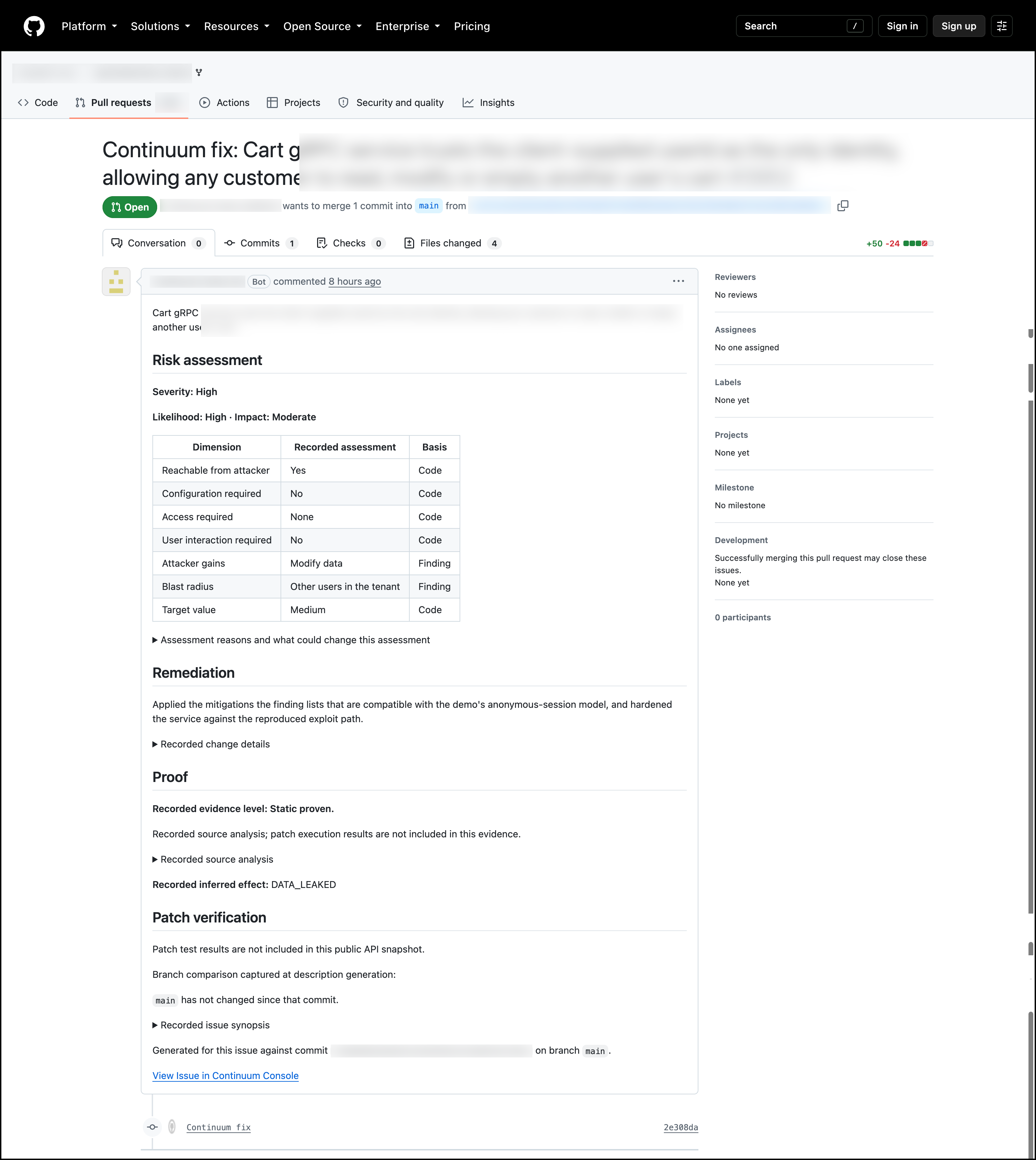
One of the most differentiating capabilities of AWS Continuum is its rigorous validation engine. When the service encounters a finding, it analyzes the code against its environmental context and assigns a definitive evidence level, such as verdicts proven through static code path analysis. For vulnerabilities that can be safely reproduced, Continuum executes the exploit within an isolated, secure sandbox environment. It then attaches concrete proof-of-concept code, step-by-step reproduction instructions, precise attack paths, and comprehensive blast radius assessments to the finding.
Building upon this verified intelligence, Continuum automatically generates precise remediation packages—ranging from source code patches and dependency upgrades to infrastructure configuration adjustments. These fixes are delivered directly to the connected code repository as standardized pull requests complete with detailed descriptions of the risk assessment and source analysis. Crucially, the platform operates under a strict human-in-the-loop governance model during its initial rollout. Every generated patch requires explicit human review and approval before it can be merged into production codebases. Looking ahead, AWS has indicated that users will soon be able to establish confidence-based automation guardrails, allowing the system to autonomously apply specific classes of low-risk fixes once rigorous testing and historical success criteria are met.
Implementation Workflow and Console Experience
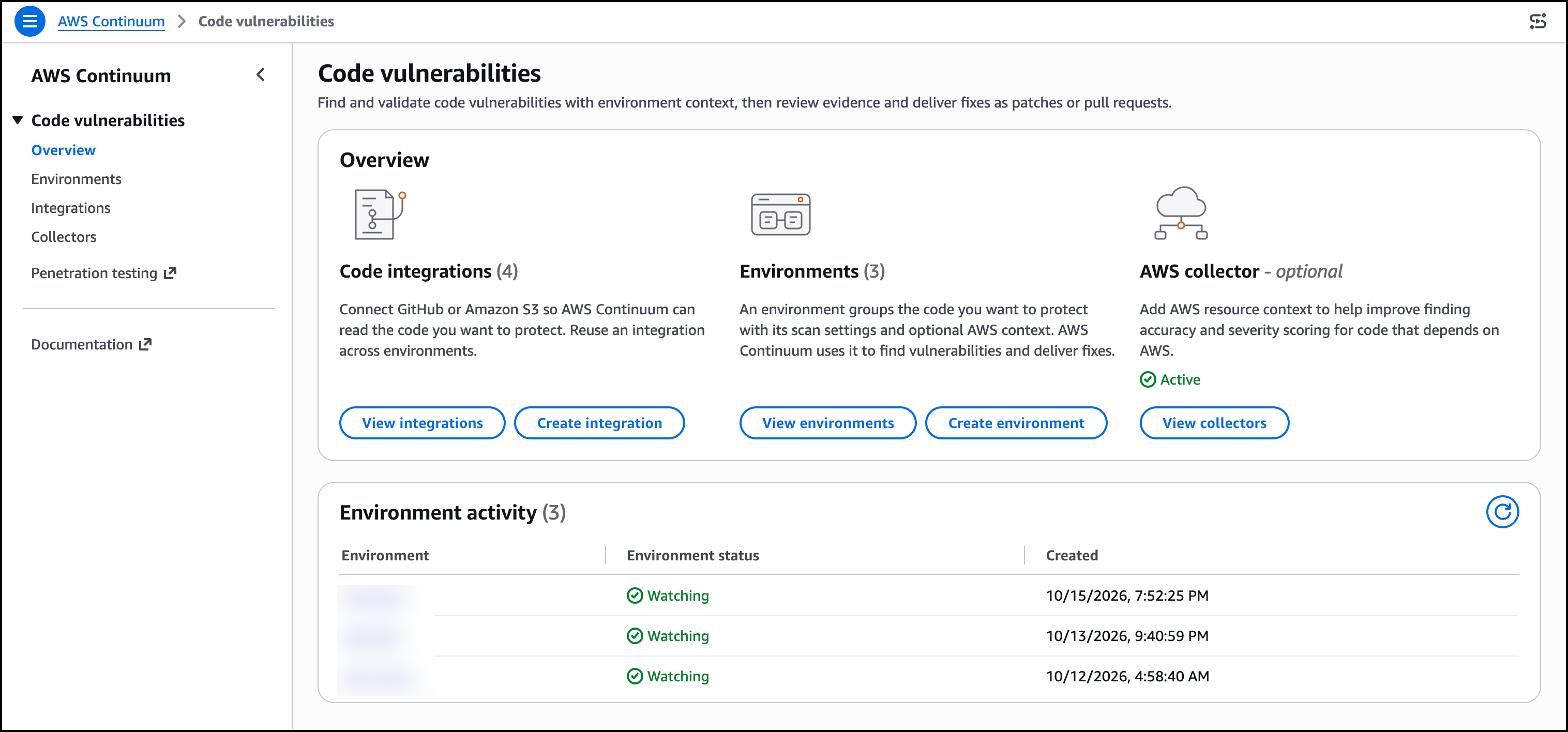
Administrators interact with AWS Continuum via a centralized console dashboard that unifies code integrations, active environments, and infrastructure collector statuses. Setting up an environment requires connecting a code repository via GitHub or designating an Amazon S3 bucket within the same AWS account and region where the service is enabled. After establishing appropriate AWS Identity and Access Management (IAM) roles, users configure scanning schedules and optional infrastructure collectors.
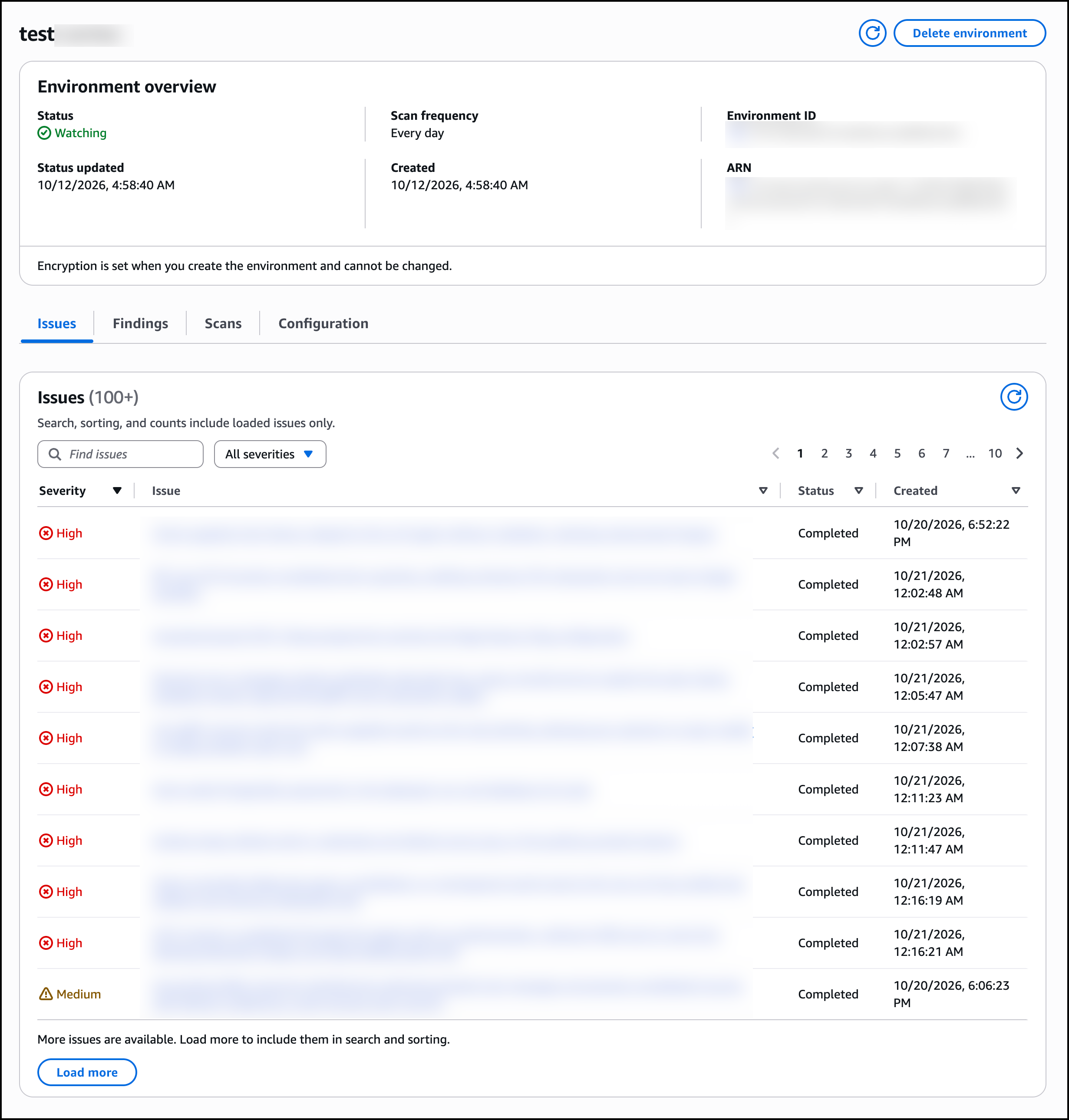
Within the console’s dedicated issue management interface, security engineers are presented with prioritized, validated findings rather than raw, unfiltered scanner output. Selecting an individual issue reveals a comprehensive risk assessment breakdown detailing exploitability, likelihood of attack, business impact, and proof-of-concept data. The remediation panel displays the exact files modified by the generated pull request, allowing reviewers to transition seamlessly to their native Git workflow to inspect and merge the code changes. Additionally, auxiliary tabs provide historical scan logs, on-demand scanning triggers, and fine-grained environment configuration controls.
Industry Implications and Future Outlook
The launch of AWS Continuum reflects a broader industry movement toward autonomous, context-aware cybersecurity tooling. As cloud-native architectures grow increasingly complex, static analysis tools and manual penetration testing are no longer sufficient to maintain an adequate defensive posture. By combining deep infrastructure topology mapping with automated exploit validation and patch generation, AWS is shifting the paradigm from reactive vulnerability reporting to proactive, context-driven risk elimination.
Industry analysts note that services like AWS Continuum could significantly reduce the mean time to remediate (MTTR) critical vulnerabilities, thereby shrinking the window of opportunity for threat actors. However, experts also emphasize that successful enterprise adoption will depend heavily on organizational trust in automated remediation and the careful calibration of human-approval guardrails.
Availability and Pricing
AWS Continuum for code vulnerabilities is generally available starting today in select cloud regions, specifically the US East (N. Virginia) and US West (Oregon) AWS regions. Organizations interested in deploying the service can review detailed pricing models on the official AWS Continuum pricing page and consult the comprehensive AWS User Guide for step-by-step integration instructions. As enterprises continue to grapple with escalating software complexity and rapid threat evolution, AWS Continuum offers a sophisticated, scalable pathway toward resilient and streamlined application security management.